


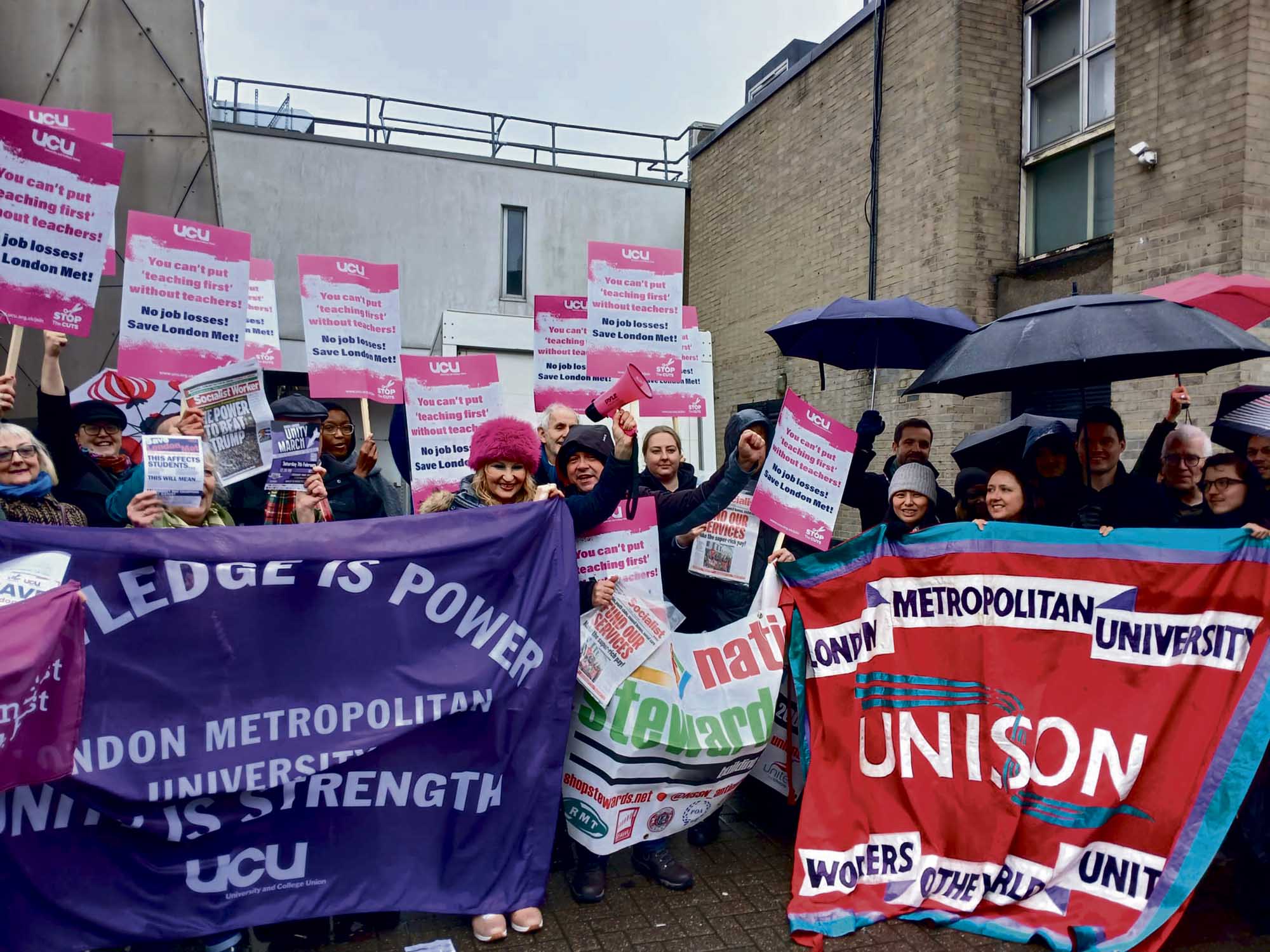
Delegates to UCU Congress report
University and College Union (UCU) Congress met at a time of escalating crisis for post-16 education.
24 universities are now at risk of insolvency: an unprecedented situation and a direct consequence of the failed marketised fees model in higher education. Labour’s only response has been to increase fees.
Further Education Colleges face deep crisis too. The government has announced a funding increase of just 0.5% per student, at a time when costs are increasing at a much faster rate. In real terms, this amounts to a savage cut in funding. Adult and Community education is even worse off.
General Secretary Jo Grady spent her commencement address listing all these issues and more, spelling out the dire situation for our sector. She described the funding crisis engulfing higher and further education as catastrophic and called the university funding model “totally broken”.
She did not mention that her leadership has sown illusions in Starmer’s Labour, forestalling a national fight on the promise of more funding from Westminster that has now failed to materialise. Even now, she described Labour’s leadership election as the “last chance saloon”.
Neither did Grady set out any serious strategy to fight now. Her proposals are for a ‘raising awareness’ campaign. We’re already aware! So are Starmer and all the other bosses’ politicians, who are making a choice to cut funding for education and other vital services to preserve the profits of the super-rich.
Scott Hunter, Swindon College UCU, personal capacity
Sector conferences vote for nationwide strike action
The urgent need for post-16 education to fight back exploded into view on the second day when, in both sector conferences, delegates resolved to prepare for nationally coordinated strike action in 2026-27, without the delays and hesitations attempted by Grady’s supporters.
In the Higher Education sector conference, HE11 passed as amended by London Metropolitan University, one of many university branches currently on strike in local disputes against job cuts, in the case of London Met amounting to roughly a fifth of the entire workforce. The motion called for the union to unite the disparate local disputes already taking place, and move urgently towards national industrial action, to ensure that the fight against redundancies and job losses is taken up across the sector.
The conference rejected motion HE2 calling for disaggregated ballots by default. This motion was an attempt to ensure some coordinated action can take place since the failure of the national union to meet the ballot threshold in the aggregate ballot of HE branches last year. But that failure was due to a lack of clear strategy from the national union leadership to fight the jobs massacre in universities, not because of the unwillingness of members to fight.
In the Further Education Sector Conference, delegates backed motions resolving for the UCU to move to an aggregate ballot of FE colleges in England, in pursuit of the core demands of the New Deal for FE; binding national agreements on pay and workload, and steps towards pay parity with school teachers.
I moved motion FE5 from South Devon College, it and FE7 from the Yorkshire and Humberside Regional Committee were the only motions calling for an aggregate strike ballot. This demand was the centre of the campaign to re-elect me to the NEC. The increase in my vote, as the only candidate arguing for a change of tactics in our industrial strategy to aggregated action, clearly reflected the views of members.
Various speakers, including two past presidents, spoke against, arguing it was too soon and we would not meet the 50% turnout threshold. Even SWP speakers vacillated on the question of an aggregate ballot. In my reply, I pointed to the opportunity of joint action with the NEU, and the record of the RespectFE campaign two years ago, which achieved an aggregate turnout of over 50% in an indicative ballot. With a serious campaign, we can repeat that level of turnout. We won the debate and conference carried the motion (50- 37).
Delegates rejected FE2 from Bolton College (52/41), which, if passed, would’ve delayed any decision about whether to move to an aggregate ballot until a Special Sector Conference, to be held in 2027, meaning the earliest that aggregate action would take place would realistically be the following year. I spoke against, arguing that the cost-of-living crisis is not waiting, and that other education unions in schools are balloting now; we have to do the same.
The UCU is now committed to ballot for strike action across both sectors. Socialist Party members will argue for maximum coordination with our sister union Unison, which organises support staff in universities and colleges, currently running an indicative ballot of members in HE with a recommendation to reject employer association UCEA’s pay offer of 2%, and with the National Education Union, which is launching a formal ballot of school teachers and support staff this autumn. The potential exists for an education-wide strike to force the Labour government to address the crisis in schools, colleges and universities.
This will not be an automatic process, however. Significantly, the motions and arguments calling for delay or retreat from national action in both sectors came from the incoming vice presidents of both further and higher education in the union. Both sector committees on the NEC are majority controlled by supporters of the current general secretary Jo Grady, who have consistently voted against escalating industrial action. Members will need to prepare to defend the important resolutions passed at the union’s supreme policy-making body, by organising to put maximum pressure on the leadership to implement Congress decisions.
Duncan Moore, NEC member
For a class-based fight against racism and division
There were a number of motions debated on the rise of Reform and the threat to further education. For example, Motion 2, moved by New City College in Hackney and South and City College in Birmingham, raised the threat that Reform-led councils pose to education and called on the UCU to campaign for ESOL to have protected funding and to produce campaign materials to combat the far-right in workplaces and elections.
I moved an amendment from my college which explained the role of the Labour government and the need for a programme calling for homes, jobs and services for all.
The ground for dangerous far-right thugs like Tommy Robinson, and for racist right-wing populists like Nigel Farage, has been prepared by years of austerity and a soaring cost of living. The pro-big business, anti-working class, austerity policies of Keir Starmer’s Labour government have compounded that.
The trade union movement must be at the front and centre of the fight against racism. The Together Alliance has recognised that Reform and the far right “seize on the very real economic problems people face, in order to scapegoat migrants, Muslims and refugees.” But proposing ‘love’ and ‘unity’ falls far short of what is needed. To stop the growth of the far right, the trade union movement needs to take a lead, linking the fight against racism to the fight for jobs, homes and services. In 2018, the TUC agreed to launch a campaign for ‘jobs and homes not racism’. They did not follow through on their proposal – it’s up to us to do that now.
The amendment also included for the union to “Compile a list of UCU member volunteers in each region to steward antiracist demonstrations and counter demonstrations where the local trade union movement thinks it is necessary, and to encourage other unions to do the same”.
Congress voted overwhelmingly in favour of the amendment and motion.
David Kaplan, Working Men’s College UCU, personal capacity
Fighting for working-class political representation
The elephant in the Congress hall was the need for new political representation for UCU and the wider trade union movement, given that, as general secretary Jo Grady said, Labour “is unable or unwilling to deliver real, material change”. The logical conclusion to be drawn from that insight is surely that our policies need some sort of serious alternative representation to Labour in parliament.
If Grady had any thoughts on that, they were glaringly absent from her address. Though she did refer to her new cross-party parliamentary group, co-chaired by Labour MP Rachael Maskell and Labour peer Baroness Blower.
At a fringe meeting with Grady and Maskell herself, after a lot of Starmer disparagement by both, I asked: “Besides raising the profile of our crisis in parliament, how is your group planning to win the full funding we need from this government? That surely requires not just begging Starmer to redirect a few crumbs from another equally needy public sector to our own but fighting for him to increase public spending generally and massively?” My question was not answered.
My own college’s motion 39, resolving that UCU support a cross-union conference to discuss political representation for the working class and trade unionists, disappointingly did not get heard for lack of time. Like West London College’s motion 63 last year, calling for UCU to start looking for an alternative political voice to Labour – which did get heard and carried overwhelmingly – this motion lay ready to explode that elephant into view, and resonate with delegates.
I’m convinced the motion would have carried. The membership is bolder than Grady at the moment, and its rage is groping for real solutions.
Undiscouraged, Socialist Party members in UCU will continue to promote motion 39’s call with UCU members. Two immediate opportunities are at the Trade Unionists for a New Party meeting on 8 June and the NSSN conference on 27 June. Onwards!
Marco Tesei, NEC member
