


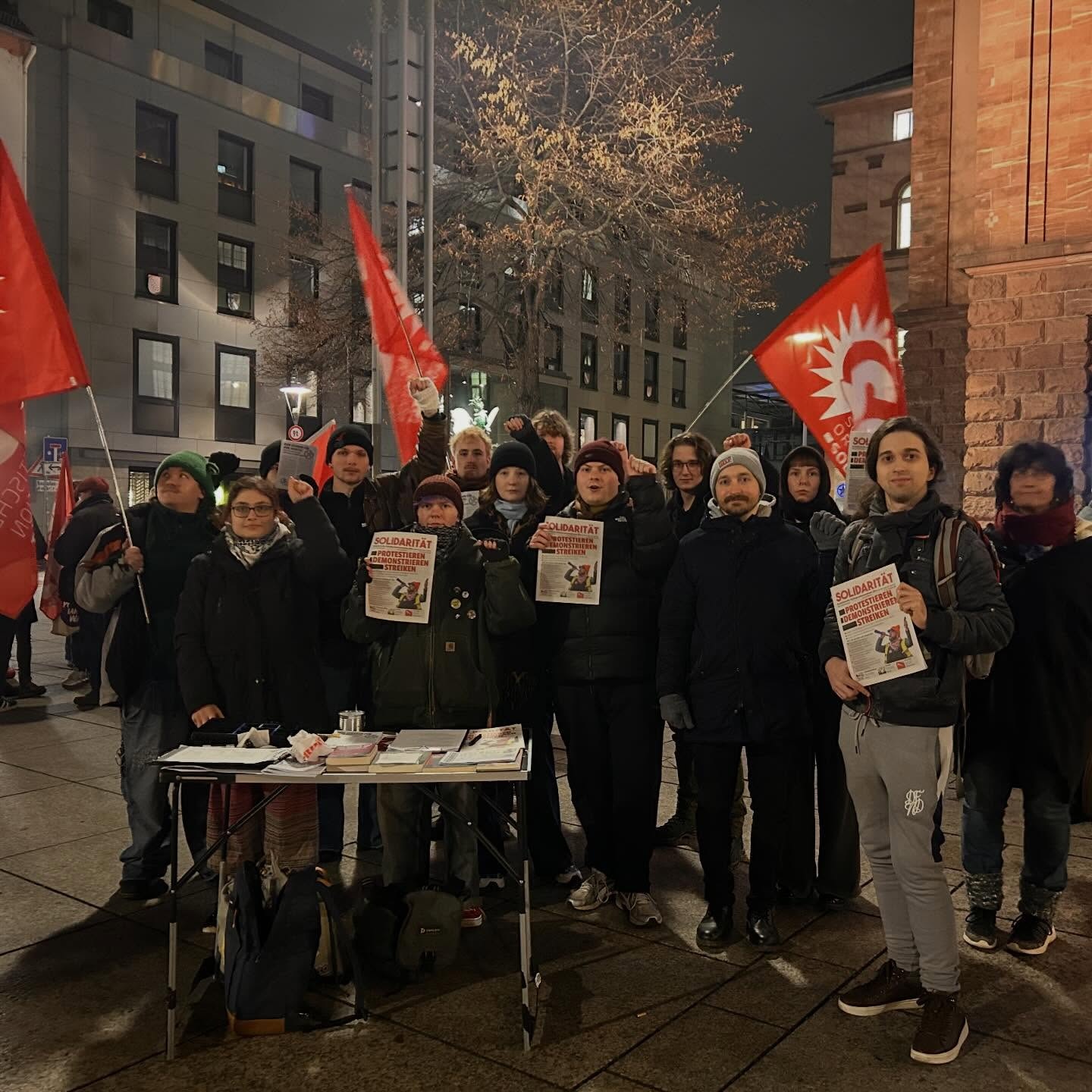
School strikes against conscription, and developing protests against cuts
Chiara Stenger, Sol Executive Committee (CWI in Germany)
Over 110 years after the start of World War One, Germany wants to have the strongest army in Europe once again, according to the government’s new military strategy. The so-called ‘Zeitenwende’ was proclaimed in Germany whilst Chancellor Olaf Scholz was still in office. It was heralded in 2022, following the start of the war in Ukraine, with a special fund of 100 billion euros for the Bundeswehr (military). Military spending had already been rising in recent decades, but since then there has been a significant shift towards open rearmament and the militarisation of society.
It did not stop at 100 billion euros. Since the last general election saw the traditional bourgeois parties losing their two-thirds majority required for constitutional changes and so they used a parliamentary maneuver to lift the constitutional ‘debt brake’, a limit on spending, to finance a huge rise in military spending. This was done, weeks after the general election, by a vote of the old Bundestag (parliament) members before the newly elected members took office. Theoretically, unlimited rearmament thus became possible, and on top a special infrastructure fund of 500 billion euros was established, which is also intended to finance infrastructure relevant to warfare in particular. Germany’s military expenditure is set to exceed that of the UK and France combined by 2030.
Multipolar global situation
This reflects how Germany intends to expand its imperialist influence in the coming years. It is happening in light of the multipolar, crisis-ridden global situation and deteriorating relations between Europe’s major powers and the US, including inside NATO. Russia’s war on Ukraine is being exploited for propaganda purposes to legitimise the need for the largest-scale rearmament in the history of the Federal Republic, and fears of imminent attacks by Russia on NATO states are being whipped up. But the new military strategy also includes preparations for operations in the Indo-Pacific against Russia. In the debate, the concept of ‘defence’ is at the forefront. Yet this is primarily about defending German capital interests – that is, influence, sales markets, access to resources or trade routes. The safety of workers and young people, on the other hand, is of no concern – otherwise hospitals would not be closed, housing would not be becoming increasingly expensive, and cuts would not be made in youth services in favour of military spending. Rearmament is supposed to secure profits for the arms industry and the economic and geopolitical interests of the capitalist elite.
Cuts are the other side of the coin
The federal government is currently planning the biggest wave of attacks in recent years. Under discussion and set to be implemented are longer working hours, the abolition of the eight-hour working day, lower pensions and a higher retirement age, as well as massive cuts to the healthcare system that will further undermine universal healthcare provision and decent working conditions in a system that is already in a state of despair. Added to this are cuts to social inclusion and youth services.
Job cuts and the question of conversion to arms production
At the same time, hundreds of thousands of jobs, especially in the automotive and supplier industries, are slashed as a result of a crisis of overcapacity. Some companies like Volkswagen (VW) have announced plan to switch to arms production. IG Metall, Germany’s largest industrial trade union, has not taken a clear stance on this and the leadership is not fighting to preserve all jobs. For many workers, a switch to arms production seems a better alternative than losing their job. Yet resistance is stirring, albeit still from a minority. For example workers at VW have issued statements declaring that they “do not want to produce death at VW” and are collecting signatures against the conversion to arms production. What is needed is a real struggle by the trade unions to preserve all jobs by nationalisation, against the government’s militarist course, and for a shift in production towards socially useful goods under democratic control and management of the working class.
Fight against the reintroduction of conscription
At the last congress of the German Trade Union Confederation (DGB, the largest trade union federation in Germany with 5.4 million members), the majority did at least vote against the reintroduction of conscription. Conscription was suspended in 2011, but its reintroduction is currently under discussion. Whilst Marxists in the past have opposed moves towards a ‘professional’ army that is more isolated from the broader working class and therefore more easily deployed against it, the reintroduction of conscription will not alter the undemocratic character of the Bundeswehr but simply help the government to find new recruits for it. After all, those who buy large quantities of weapons and prepare for potential overseas deployments will, if necessary, also need young people to operate these weapons. But there is also resistance: since December 2025, there have been three school strikes so far, in which around 55,000 pupils from over 150 cities took part.
Perspectives and programme
Class struggle from below against the attacks from above, militarisation and job cuts is ever more necessary. Following its resurgence last year and a doubling of its membership, Die Linke (the Left) has the potential, together with the trade unions, to organise serious social protests that could well pose a threat to the government. The government, which is now carrying out these attacks in the interests of capital, is anything but a strong government. Hardly any chancellor has ever been as unpopular as Friedrich Merz.
Die Linke has started to build local alliances with trade unions and social activists, but its leadership seems to avoid pointing towards the connection between the arms race and the cuts. Whilst this should not be a precondition for broad protests against the government, a socialist party needs to explain how the capitalist crisis leads to war, rearmament, economic crisis and attacks on living standards of the masses, and offer an alternative. This would also attract those striking school students that should link their fight against conscription with the struggle against cuts and job losses.
Working-class power is key in all struggles. The DGB congress was a missed opportunity for the immediate preparation of coordinated economic and political strikes to be waged against the government’s and capitalists’ attacks. This is overdue. What is needed is a programme calling for massive public investment, as well as radical redistribution of wealth of the super-rich and the transfer of key sectors into public ownership. In this way, attacks could not only be repelled, but real improvements fought for. This could also halt the rise of the right-wing populist AfD, which is currently capitalising on public discontent and is by far the strongest force in some federal states. Sol members are actively promoting a militant programme within unions, Die Linke and the school strike movement whilst at the same time making it clear that militarisation and social cuts are linked, and that capitalism, as a crisis-prone system based on competition and exploitation, will repeatedly lead to wars, whilst improvements can always be rolled back. Only by simultaneously fighting for a socialist democracy can we lay the foundations for a good life for all, in peace, freedom and security.
