


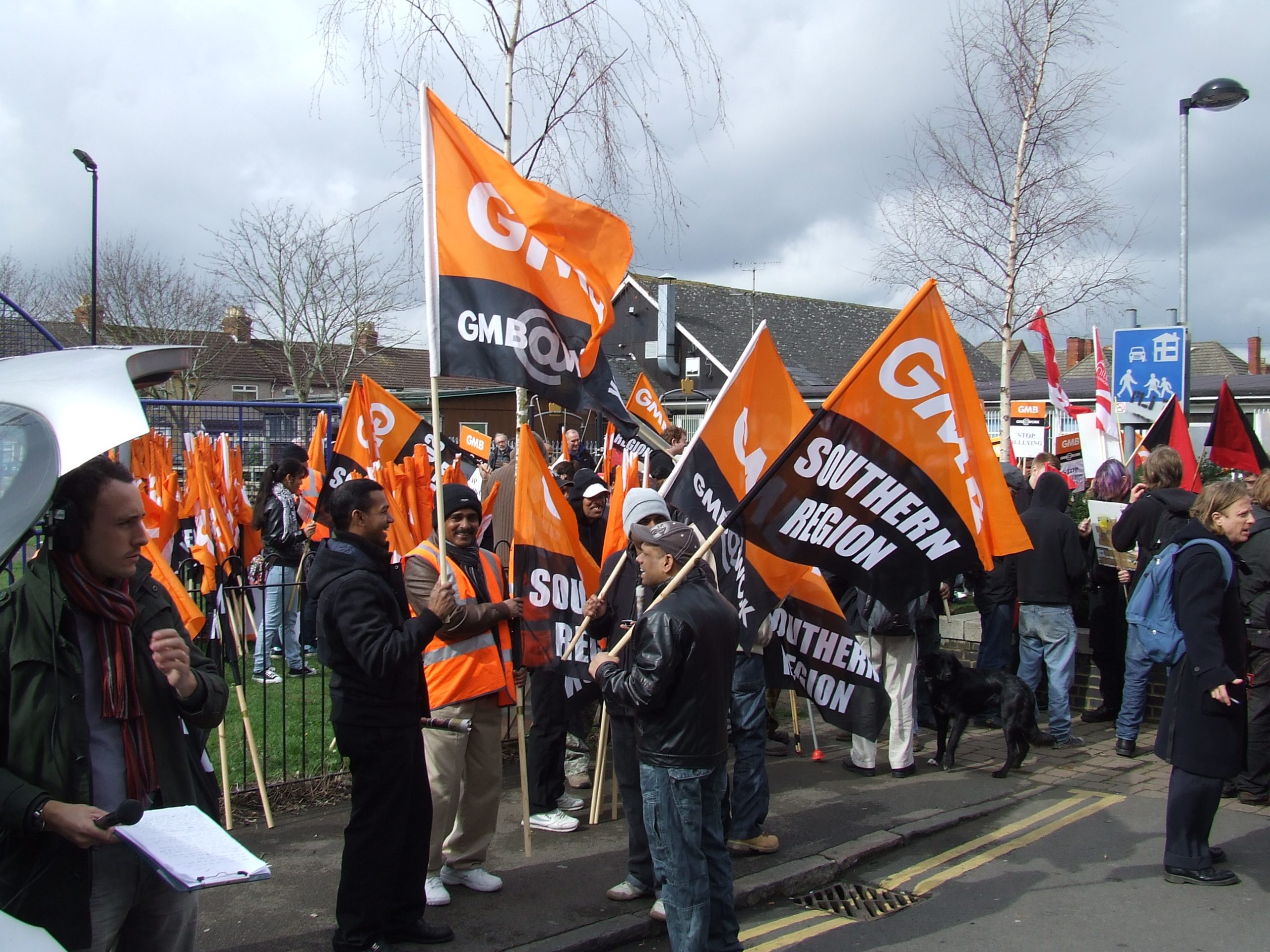
Socialist Party members in the GMB
General union GMB, the UK’s third-biggest union, held its annual congress 7-11 June. As Starmer’s Labour government crisis raged, from the president’s opening speech onwards, the justifications for GMB continuing to support Labour were drummed into the 600+ delegates. General Secretary Gary Smith said: “After 14 years of Tory chaos, we have a Labour government with a huge majority but struggling in power. They have made mistakes. The polls aren’t good, and the party leadership is subject to daily debate. We have an enduring relationship with Labour. It’s not a sentimental thing. It’s because workers need a political voice.”
But despite the argument that affiliation gives the union “a seat at the table” and that the union “challenges Labour when it falls short”, the reality is that there is no longer any real voice for the trade union movement in determining Labour’s policy. Just before congress, GMB members in local government, alongside members of Unison and Unite, rejected the pay offer in local government, opening up the possibility of industrial action. This is alongside continued austerity across public services and the retention of the Tory 50% strike ballot turnout thresholds.
Moving the Central Executive Council (CEC) statement on ‘Politics and the Labour Party’, vice president Sonya Davis was forced to recognise that Labour’s continued attacks on working-class people were fuelling the rise of Reform. “Too many working-class people feel unheard… That is dangerous ground. Because when people lose faith in mainstream politics others move in.”
Southern region delegate and Socialist Party member Ali Haydor spoke against the CEC statement. Motion 231 from Southampton called on congress to “launch a union-wide consultation about the best use of our union’s political fund, including the question of funding candidates outside the Labour Party who will fight to implement GMB policies.”
It also encouraged “regional councils/committees to organise members’ meetings at which members of the GMG parliamentary group … are invited to speak. This should include to what extent an MP’s voting record has been in line with GMB policy”. The GMB leadership boasts the largest parliamentary group of Labour MPs – then why no campaign by this group to force Starmer to repeal the anti-trade union laws?
Motion 235 from Reading and Berkshire called on the CEC “to undertake a consultation of the membership regarding whether to continue affiliation to the Labour Party”.
One argument put forward was that only Labour can hold back Reform. Ali said: “Many of our members voted differently, desperately looking for change.” Ali argued that Labour and Starmer are copying Reform’s policies, just a lighter version: “What’s not acceptable from the Tories and Reform should never be acceptable from the Labour Party.”
The CEC sought withdrawal of the motions in favour of the CEC statement. Southern region delegates and a sprinkling of others voted against, but the CEC’s statement was carried and the motions fell. However, this issue inevitably will be revisited as Labour presses ahead with vicious attacks against working-class people.
The failure of the leadership’s approach was revealed time and again in the discussions which followed. Motions and contributions on public services told tales of understaffed hospitals, care homes, and departments. Delegates blamed cuts and austerity. The CEC called for an increase in funding for local government and a council house-building programme – yet it won’t allow debate in the union on how to build a political voice to fight for those demands!
Motion 222, moved by the North West Gas L34 branch, called on the GMB to continue its fight for full nationalisation of the energy industry, but added that “until the political climate is ready to move towards full public ownership, GMB should be ready to adopt an interim position”. Isn’t this exactly an admission that the GMB does not have its own political voice?
Motion 293, moved by Socialist Party member Chris Baugh, was passed, calling on the CEC to establish a network for reps interested in campaigning on climate change to supplement the work of GMB structures in the energy and manufacturing sectors. Chris said: “There is no fundamental conflict between defending the pay, jobs, conditions and livelihoods of all workers in the gas and energy industry, and the GMB using its technical expertise, collective industrial power and political influence to develop its own agenda; not the Labour Party’s that offers no new jobs – a just transition to guarantee the pay, jobs and conditions of every worker”.
The same approach should be taken to defending GMB members in the defence industry, which was another feature of the congress, with then Labour defence secretary Jon Healy speaking. GMB should demand nationalisation under democratic workers’ control and management, in order to enable a workers’ transition to socially useful production that defends jobs, pay, conditions and skills.
“Many working people no longer feel they have a political voice… More and more workers are looking elsewhere… That is why this motion matters. It does not call on GMB to support a new party today. It does not call on GMB to break its political links tomorrow. What it does call for is discussion, democracy and consultation. A discussion about our relationship with Labour, a consultation on how our political fund is used, and a serious debate about whether working people need a new political voice rooted in the trade union movement. Other unions are already having these discussions. GMB members should not be excluded from this debate. If we believe in democracy, we should trust our members to have this conversation and decide what political path best advances the interests of working people.”
Ali Haydor, moving motion 231
