


Iain Dalton, Socialist Party National Committee
The National Shop Stewards Network (NSSN) was founded in 2006. Within two years, a world economic crisis had erupted. With it, a determination from the capitalist bosses to make the working class pay.
The 2010 general election brought about a Tory-Liberal Democrat coalition government. The election campaign had featured a bidding war by the main parties as to who would cut public services the most. This followed initial austerity measures which had already taken place under Gordon Brown, such as scrapping the 10% tax rate for low earners.
With no party winning a majority, the Liberal Democrats became junior partners to the Tories. In 2009, the now, new Prime Minister, David Cameron had declared “the age of austerity”, and the government committed to £110 billion in public sector cuts and tax rises.
In response, anti-cuts alliances, many based on trades councils, were established and held public meetings and protests, including on the date of the Budget on 22 June 2010, where the details of the distribution of the cuts were to be announced. These included 800,000 job losses, 158 court closures, pay freezes, cuts to housing benefit and VAT increasing to 20%.
The agenda of the NSSN’s fourth annual conference just days later was dominated by this issue. A statement, proposed by then NSSN Secretary Linda Taaffe, called for “…the maximum unity of the trade union movement in defence of the public sector and the welfare state, and support the call by the PCS union and others for the Trades Union Congress (TUC) to name the day for a national demonstration, preferably before the TUC conference in September 2010.”
The TUC leadership was far from taking such action, instead they actually invited Cameron to speak to Congress! The statement resolved: “If a demo is not called, the NSSN will call a lobby of the TUC in Manchester, urging the TUC to call a united national demonstration with a view to further organising a one-day public sector strike, as the beginning of a serious fightback against these vicious cuts.”
700 turned out in Manchester, with the late RMT General Secretary Bob Crow amongst the speakers. The TUC’s official composite came down for a national demonstration against cuts, without specifying a date, as well as support for co-ordinated industrial action between affiliates.
The PCS union, in which Socialist Party members played a leading role, had argued in its resolution for a definite demo date of 23 October. The TUC instead called for regional rallies on 23 October, marches were organised from below – with the NSSN playing an important role in the South West and elsewhere. In London the NSSN coordinated with FBU, PCS, RMT and NUT to organise a 4,000-strong march to an indoor rally.
In the Comprehensive Spending Review on 20 October, the government announced it was abolishing the Education Maintenance Allowance in England, which provides a means-tested weekly payment of between £10-30 for college students.
The review of Lord Browne, former boss of BP, into higher education, commissioned by the previous Labour government, also reported in the autumn, its main recommendation being to lift the cap on university tuition fees.
The National Union of Students (NUS) called a national demonstration against the proposals for 10 November 2010. This became the largest-ever student demonstration in the UK. 50,000 demonstrated in the capital, where, without a rally to end the demonstrations, students protested outside and stormed Millbank, the Tory Party HQ.
On the demonstrations, Socialist Students distributed tens of thousands of flyers calling for a national student walkout, on a date to be determined. The NSSN called for trade unionists to join a walkout, which eventually took place on 24 November, with demonstrations of several thousands in major cities.
As well as further national demonstrations, dozens of buildings on university campuses were occupied by students.
Missed opportunities
Belatedly, the TUC held a joint demonstration with NUS in Manchester in January 2011. This was infamous for the then NUS President being chased off the demo by students angry at the failures of NUS. Despite education workers marching with students, and striking electricians joining the 9 November unofficial national demo, much of the leadership of the trade unions missed the opportunity to link up the workers’ movement to this mass struggle of young people.
It was against this backdrop of missed opportunities for coordinated struggle that a special conference of the NSSN was called. A dispute amongst the leadership of the NSSN had broken out, with some, including the Socialist Workers Party, wanting to subordinate the NSSN’s campaigning activity against the cuts to pre-existing campaigns which did not demand councils refuse to implement cuts.
Campaigns such as the Coalition of Resistance and Right to Work, gave uncritical platforms to councillors, particularly from Labour, who said they were against cuts in principle, but still planned to vote for them in the council chamber.
The Coalition of Resistance had recently held a conference which featured limited participation from the conference floor, and all 22 proposed amendments to the conference declaration were remitted for further discussion.
Contrast this with the scrupulously fair debate held at the special NSSN conference on 22 January 2011, where both points of view on the steering committee were given equal time to introduce their argument and equal allocations of speakers in the debate, with conference co-chaired by one representative from either side. The conference voted overwhelmingly, by 305 votes to 89, for the NSSN to establish its own anti-cuts committee on the basis of opposition to all cuts. This body went to work straight away and called a demonstration in February to march on the Labour Local Government Leaders conference in London.
NSSN anti-cuts stance vindicated
The stance taken by the NSSN was soon vindicated when councils began setting their first budgets under the coalition government, as Labour councillors failed to put up any resistance to the cuts.
Instead of a national resistance, trade unionists were forced to fight borough by borough and service by service. The fight on this issue, drawing on the lessons of the Liverpool City Council in the 1980s, led to rebel councillors emerging in a number of towns and cities taking a stand to defend services.
But the legacy of this austerity remains today in the decimation of council services and council workforces shrunk by thousands.
When the TUC belatedly organised its demonstration for 26 March 2011, it received a tremendous response. Approximately 750,000 attended, one of the largest trade union-organised demonstrations in Britain.
A poll commissioned by the TUC showed 52% of the population supported the aims of the demo with only 31% opposed. Taxi drivers reportedly gave protesters free or discounted rides. Such was its size, the Unison contingent alone took an hour to pass by and the Usdaw contingent further back didn’t even get to the end.
But the question on people’s lips was: What next?
TUC leader Brendan Barber declared trade unions would not allow public services to be destroyed, but put forward no concrete steps of how that could be achieved. Unison’s Dave Prentis just called for local demonstrations. It fell to Unite General Secretary Len McCluskey and PCS General Secretary Mark Serwotka, then on the left, to raise the question of co-ordinated strike action.
The NSSN set up its own stage in Hyde Park Corner where lay reps and activists put forward the need for the TUC to prepare for a 24-hour public sector strike. University and College Union (UCU) members had already taken strike action earlier in the year over pensions, whilst PCS and NUT were balloting for strike action on that issue. The NSSN argued for a ‘coalition of the willing’ to come together to take co-ordinated action to pressure both the government and the other union leaderships to ballot for strike action.
In the end, four trade unions – PCS, NUT, UCU and, striking for the first time ever, ATL – took co-ordinated action on 30 June 2011 (J30). 11,000 schools were closed by the strike.
The new Labour leader, Ed Miliband, had a car-crash interview at the time, where he repeatedly declared the strikes ‘wrong’ in the same form of words, despite being asked different questions.
The NSSN conference held earlier that month had called on “supporters to offer maximum assistance to unions in the run-up to 30 June and on the day itself. This can include assisting in organising solidarity rallies and demonstrations where they have been organised; and to help initiate and organise them where they have not yet been proposed.” In some areas, such as in Stoke-on-Trent, the NSSN co-organised the strike rallies, whilst in other areas like Coventry, NSSN public meetings were held after the strike to discuss the next steps.
But the other main decision in the resolution at the NSSN conference was to again lobby the TUC Congress in September, this time renewing the call for “the TUC to coordinate strike action of public sector unions to defend public sector pensions.”
Lobby of the TUC
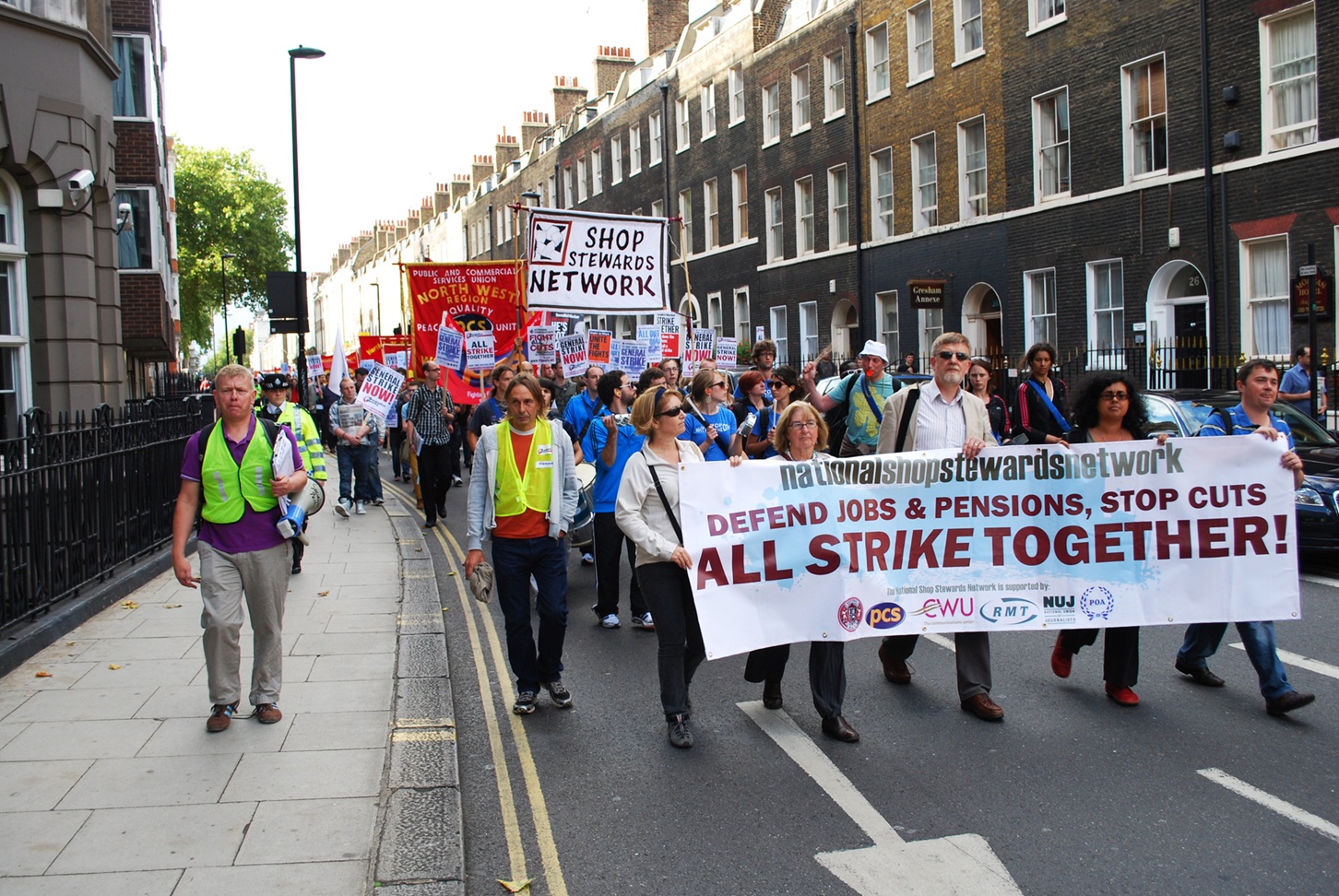
On 11 September, around 700 trade unionists marched on Congress House, the TUC HQ in London, demanding it name the date for co-ordinated strike action. Just a few days later, the TUC announced that a day of action, including co-ordinated strike action, would take place on 30 November (N30).
Huge momentum built up as one union after another announced ballot results and that they would be joining the action. Unison membership applications shot up by 126% after it announced its strike ballot result. Local strike committees were set up in some cities between unions taking part in the action to co-ordinate locally.
Feeling these tremors, the government tried to save face. Cabinet Secretary Francis Maude suggested workers take a 15-minute token strike on N30, “without loss of pay”. A GMB national officer responded: “We are asking members to vote for a strike, not a tea break!”
30 November strike
29 public sector unions struck on the N30, including many unions striking for the first time. An online poll on the Daily Mail website showed 84% support for the strike, before it was quickly deleted!
In mass marches and rallies that took place across the country, workers could feel their power, bringing city and town centres to a standstill. NSSN supporters, including Socialist Party members, spoke at many of the rallies, calling for further follow-up action to be called before the end of January. NSSN public meeting were held following the strike in a number of areas, including London and Liverpool, capturing the strength workers could feel they held after the day’s action.
The NSSN steering committee meeting in the aftermath of the strike agreed to push for 25 January 2012 as a further day for co-ordinated strike action – this had been agreed by Unison Scotland, as well as calling for co-ordination with strikes over pensions in the private sector, where action had taken place at Ford and Unilever.
But while workers were feeling their power and wanting to exercise it further, the leaderships of some of the big public sector unions were busy signing their members’ pensions away. Leading figures of Unison and GMB had met with the government and signed a ‘Heads of Agreement’ to call off further action, in return for the limited concession of over-50s being exempt from some of the changes. The NSSN called, at short notice, a lobby of the TUC public services committee as it discussed these changes.
In a far cry from its role today as an obstacle to industrial action, PCS Left Unity convened an emergency organising conference to discuss how to try to maintain the fight. At the time, Left Unity was the main left organisation in PCS, which Socialist Party members participated in. This emergency conference was called in London for 7 January, ahead of various meetings of union national and group executives.
The NSSN threw its energy and effort into helping to cohere together the union leaderships still prepared to fight on pensions, and giving confidence and direction to those in other unions to push back against their leaders.
Leaders of GMB and Unison argued that it was necessary to sign up to the ‘Heads of Agreement’ in order to be part of talks with the government, but neither Unite or PCS signed and were welcomed into the talks.
In the wake of the pensions defeat, some of the left union leaderships, disheartened by being left isolated, rather than fighting to rebuild necessary coordinated action to defend their members, became demoralised, looking for easier options. This was reflected in the limiting of strike action to London on 28 March 2012.
It had looked likely that the left unions, particularly NUT, UCU and PCS, who had all been part of the first coordinated action of J30, would take coordinated national action that day. But the NUT leadership pulled out, with pressure from below forcing it to be reinstated in London only. That left PCS, which had balloted its members on the basis of national co-ordination, to call off their action on that day in favour of seeking a new date where it could strike alongside other unions.
But it was just a handful of unions who took further action nationally. PCS, UCU, NIPSA, Unite in the health sector and RMT in the Royal Fleet Auxiliary all took coordinated action on 10 May 2012, as well as walkouts for gate meetings by POA members in prisons denied the legal right to strike. On the same day 20,000 police officers marched in London against cuts.
Pressure from the government in pressing its advantage in the wake of this defeat also contributed to the caution of many union leaderships over the next period. The government withdrew check-off facilities for collecting union subs in the civil service, and introduced new anti-union legislation, including the 50% strike ballot turnout thresholds that Labour has still not removed from the statute books.
Those anti-union laws were not able to destroy the basic strength of the trade union movement though, as demonstrated by the 2022-23 strike wave which saw the biggest number of strikes for a generation.
Today, workers are faced with trade union leaderships most of which are trying to use their authority to shield a Labour government from workers’ anger. The NSSN continues to play a vital role bringing together rank-and-file trade unionists and the most militant figures from the trade union leaderships. The task now is to organise pressure on the tops of the trade unions to lead the struggles against a new surge in the cost of living and the bosses’ attempts to make the working class pay.