



Socialist Party members in Unison
Over 1,300 delegates gathered for Unison’s 2026 National Delegate Conference (NDC), the first since the election of new left general secretary, Andrea Egan, elected after years of a lack of a national fight against austerity by Unison’s leadership.
This conference is the sovereign decision making body of Unison, the UK’s biggest trade union, with over 1.3 million members, and one of the Labour Party’s main affiliates.
But one thing that was not allowed to be debated, evidenced by 15 motions and rule changes on the issue being ruled out of order, was Unison’s relationship with Labour.
This relationship is entirely governed by members who pay into the Labour Link fund, which currently sits at just 13.7% of Unison membership. But even the Labour Link members themselves lack control – the decision to back Starmer as Labour leader was made by just 23 members, the National Labour Link committee.
The only place the Labour Link could be discussed the entire week was at a ‘Trade Unionists for a New Party’ fringe meeting during the Local Government conference.
Debate needed
Surrey County branch delegates tried to raise the Labour Link question at the beginning of conference, exercising the right to ask a supplementary question on the conference floor, wanting to know how low the Labour Link payer percentage could get before Unison would review Labour affiliation. This was blocked by the president.
Ellie Waple raised a ‘reference back’ seeking to enable discussion of motions dealing with the union’s relationship with Labour, and won support of nearly half the conference.
After much pestering, Surrey delegates were invited to have a conversation with an Assistant General Secretary on the issue. They explained that this ‘ring of steel’ had been in place since the formation of Unison and agreed it was a ‘Catch-22’-type situation. We were encouraged to join the Labour Link and change it from within!
If Unison’s Labour Link had a true influence on Labour, or if any of the affiliated unions did, then the Labour government would have scrapped Tory anti-trade union laws, enacted a real living wage, built council homes, renationalised services, and Unite wouldn’t have cut its affiliation fees by 40% (£580,000).
Andrea Egan stated in one of her speeches that Unison is a ‘member-led union’ – on Labour affiliation at least, it doesn’t look that way to the members.
Socialist Party members at conference attended the Green Party Trade Union Group fringe meeting and asked them about going into coalition with Tories and Lib Dems in some councils, and propping up New Labour in Newham instead of working with anti-austerity Independents.
Despite the ban on discussing motions, whenever Socialist Party members raised the need for Unison to be able to support candidates that support our policies, and the need for a new workers’ party, rooted in the trade unions, committed to ending austerity and cuts, we received applause from the conference.
Angela Rayner, former Deputy Prime Minister, suspended by Unite for backing the strikebreaking actions of Birmingham’s Labour council against the bin workers, was invited to give a speech at conference, with no criticism. Even though conference only found out that Rayner would be attending a few hours before, Socialist Party members were part of an impromptu walkout in protest.
Andrea pledged to open up a discussion about the relationship with Labour in her election manifesto, and members must keep up the pressure for this to be enacted.
An important topic discussed and intervened in by Socialist Party members was the worrying shadow of Reform UK. Many migrant workers in Unison are raising their fears of impossible living and working situations. An amendment submitted by Surrey County and passed at conference commits Unison to a campaign of ‘Jobs, Homes and Services, Not Racism’, and to lobby the TUC for a demo to this effect and against Labour austerity.
Fighting leadership
Andrea was elected because members want a fightback. She confirmed that she is only taking a social worker’s salary, and giving the rest of the £181,000 salary to the industrial action fund and Unison’s charity There For You. The workers’ wage is an issue campaigned for by the Socialist Party.
But for a left leadership to be maintained, and for the left to win next year’s National Executive Council elections, it is vital that under Andrea’s leadership an industrial and political fightback is mounted.
Electing more Socialist Party members onto the NEC next year, to join Socialist Party Scotland member Jim McFarlane, will be a vital part of winning a fighting strategy for Unison in this turbulent time.
Socialist Party members were able to intervene, putting a fighting way forward, in the discussions on low pay, the gender pay gap, housing, winning for members in the private sector, union organising and much more.
Angie Waller argued: “The strike wave a few years ago saw a number of women workers in health and education taking strike action. They were uniting around demands to save jobs, pay and services. We have to make that connection, that by fighting for inflation-proof pay rises, cutting the working week without loss of pay, and having affordable, good quality, flexible childcare alongside public services to meet our needs, then only then will we close the pay gap.”
Jim McFarlane, NEC member, argued for defence of Unison members in the private sector: “We now have over 200,000 members working in the private sector. The landscape of public service delivery has shifted through successive governments outsourcing everything. We need to send a clear message that we are fighting to bring those services back in-house.”
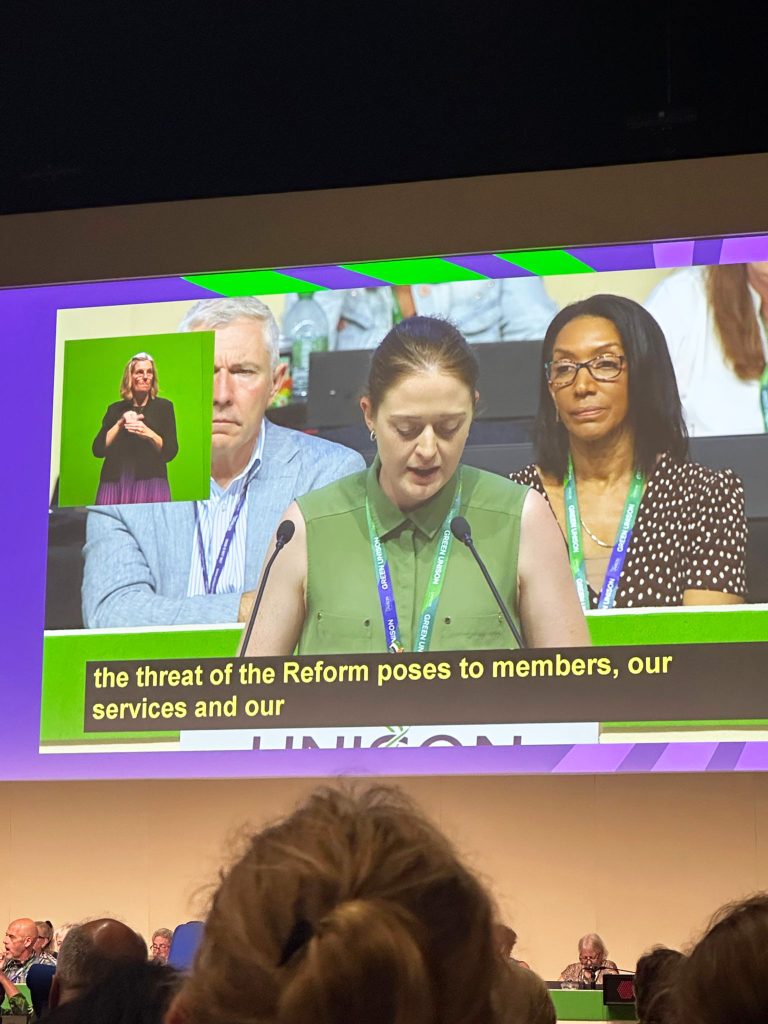
Fighting Reform – Jobs, homes and services, not racist division
“We know the threat Reform poses to our members, our services and union. We’ve already seen Reform-controlled councils attacking jobs, pursuing cuts in the name of efficiency, undermining equality initiatives and attacking climate measures.
“Working-class communities have lived through years of austerity, falling living standards and underfunded public services. Many people feel abandoned by politicians who promise change but continue policies that working-class people pay the price for.
“That’s why simply denouncing Reform will not work, nor will simply telling people to vote for anyone as long as it’s not Reform. Many workers who vote for Reform, possibly even some in our own union, are expressing anger at the political establishment.
“We must be seen to be leading the fight against austerity, against cuts and against declining living standards, whoever is implementing these policies. We must be at the forefront of building a workers’ party accountable to the working class and which is committed to fighting in the interests of the working-class majority.
“We should demand the rebuilding of all youth services that have been cut. Local councils should set needs budgets that reflect the real needs of their communities and be prepared to fight for the funding from central government needed to deliver them.”
Amy Sage, newly elected to the Police, Probation and Cafcass Service Group Executive
“The hostile proposals [on immigration] are not from the Tories, not from Reform UK. They are being implemented by a Labour government… The people targeted by these proposals are Unison members: they are care workers, teaching assistants, refuse workers, cleaners, administrators, social care staff, the very people who keep our local government services running every day.
“Our answer to exploitation and low pay is not deportation, it is trade union organisation. Our answer to division is solidarity. We must stand with migrant workers, but not silently. We must push the TUC to call for a national demo of jobs and homes, not racism.”
Saffy Hill-Chambers, Surrey County Unison