


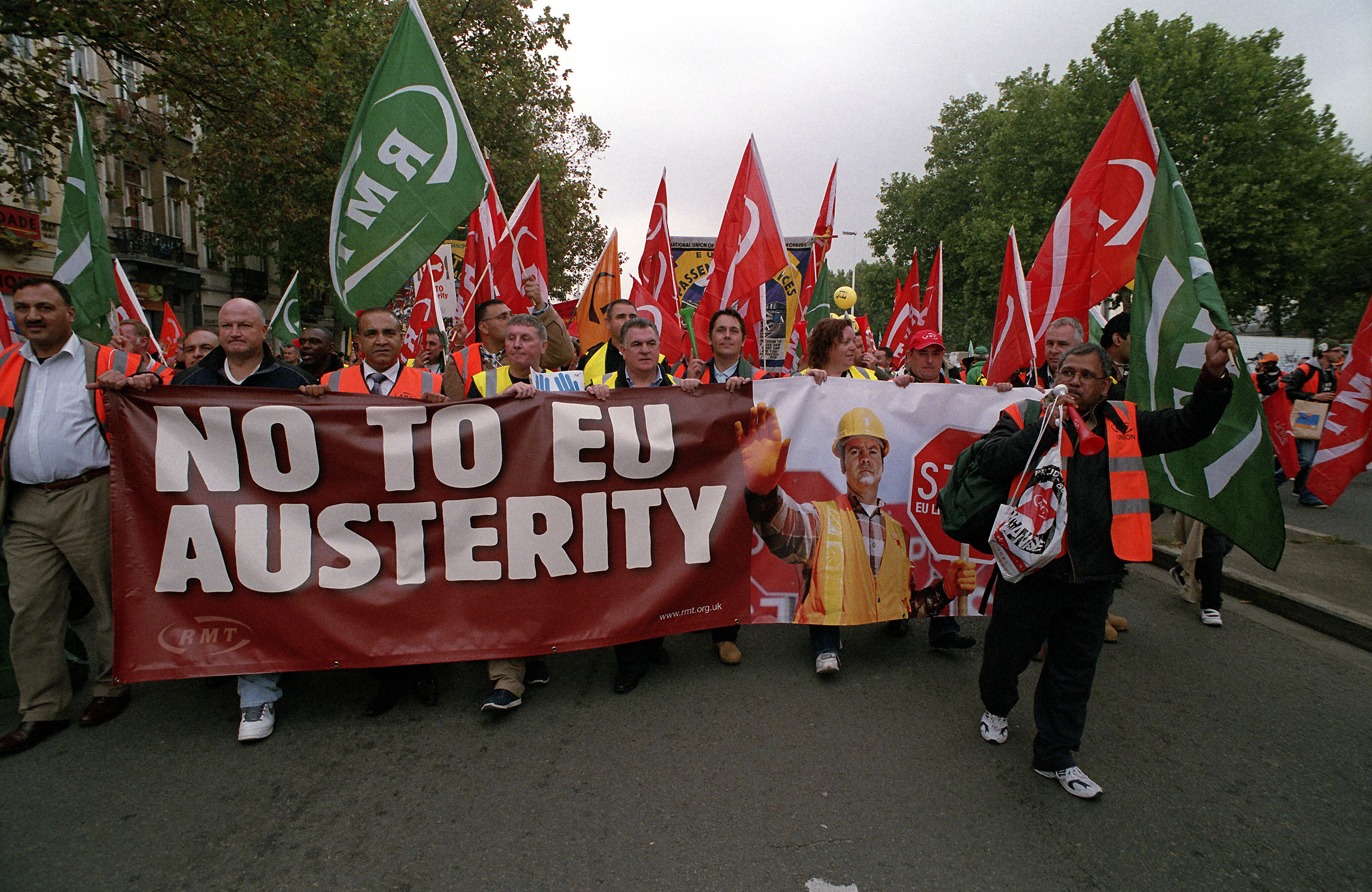
Helen Pattison, Socialist Party Executive Committee
Today, 13% of young people are NEET (Not in Education, Employment, or Training), it’s the latest headline-grabbing crisis for British capitalism. On top of this, millions are worse off in real terms than they were in 2008. Over 3 million people claim in-work benefits because of the predominance of low pay while the cost of living cranks up, pushing households further into poverty. Public services have been cut to the bone but, at the same time, the cost of long-term government borrowing has hit its highest level since 1998.
The ‘Brexit’ referendum on whether or not Britain should leave the European Union (EU) was ten years ago, and the vote to leave won 52% to 48%. Given how close the vote was, but also because political figures have come back to the question of EU membership again and again, it’s understandable for people to speculate if working-class people would be better off if ‘Remain’ had won.
A Remain vote would have allowed Britain to continue to have access to free movement of goods and labour to and from EU states. Many capitalist commentators argue that would alleviate today’s youth unemployment crisis, giving students the chance to work visa-free throughout Europe, as well as improving Britain’s economic growth with tariff-free trading and investment.
The official Remain campaign, with Tory then-prime minister David Cameron at the helm, said our public services would be better off inside the EU and a Leave vote would mean cuts in NHS spending. It wasn’t as if his party, under his leadership, had been in power since 2010 and led an austerity assault on the NHS and other services!
‘Free movement’
Posed as one of the most progressive elements of the EU was its allowing for ‘free movement’, which means that people in the EU could travel throughout the area without a visa. Young people today, trapped in the unemployment cycle, might wish they could travel to EU countries for work. But for young people in Spain in 2013, the reality of free movement felt like a different kind of trap rather than an opportunity. Their then immigration minister claimed that thousands of young people emigrated from Spain each week to other EU countries because of their ‘adventurous spirit’. The reality was that people were trying to flee the youth unemployment crisis which had reached 55%.
The ability to move for work didn’t fix the problem though and young people responded in protests across the country, as well as in other European cities. Hundreds of Spanish youth brought their suitcases into the streets under the slogan of ‘We’re not leaving, we’re being forced out’.
In London, many Spanish young people had ended up working in the super-exploitative hotel industry, forced to clean rooms in record times on the lowest pay. Today Britain’s youth unemployment crisis is hovering around the same as the EU average. It isn’t EU membership or not which will end the youth unemployment crisis. This will need a programme of investment in education at all levels, including free university education, and into public services to create good jobs.
It also wasn’t representatives from the EU who tried to prevent this super-exploitation, including bosses, who took advantage of workers for whom English wasn’t their first language. But Unite the Union does organise hotel workers, and in the 2010s fought to grow the union in the industry in London, including having multilingual material and meetings.
The ability to work anywhere is not a real freedom when work is scarce, on low pay, and bosses can count on workers from other countries not being unionised or potentially less informed on legal protections.
The EU treaties weren’t simply written to allow for workers to travel for work, they were written in the interests of big business and so specifically ignore national trade union agreements. This was the background of the Lindsey Oil Refinery workers’ strike in 2009. 1,000 UK workers at the refinery all had their pay, terms and conditions protected under a national agreement, but new workers from Italy and Portugal were to be hired under the EU’s Posted Workers Directive, and therefore without the much more favourable terms of the UK workers. This wasn’t ‘internationalism’, this was profit-hungry bosses looking to super-exploit migrant workers.
Not only were these workers hired on worse terms and conditions, they were made to live on a barge in Grimsby dock to be bussed into work each day. Cynically, politicians from all corners, including Labour then-prime minister Gordon Brown, attempting to sow division, called for “British jobs for British workers”. Initially taken up by some of the strikers, this was soon replaced – with the intervention of leaders in the strike committee, including Socialist Party member Keith Gibson – with leaflets and placards translated to appeal to the EU workers to join the union and fight together.
The employers were segregating workers based on their nationality and using divide and rule, as well as EU treaties, to try to drive down pay and conditions. The strike ended in a victory with no one losing their job. Instead, the trade union-agreed protections of the UK workers were extended to the Italian and Portuguese workers.
Well in advance of the EU referendum being announced in February 2016, establishment politicians had already begun a campaign of whipping up nationalistic and racist division. A 2014 survey found that as many as 81% of Polish people in Britain had experienced verbal or physical abuse or knew someone who had. Establishment politicians had no answers to falling living standards and public services other than to use EU workers as a scapegoat, blaming issues like ‘health tourism’ for growing queues in the NHS, and the unemployment crisis on workers from the EU.
During the referendum, both the official Leave and Remain campaigns whipped up divisive ideas, particularly around migrants living in the UK. The official Leave campaign was headed by Tories and ex-Tories; like the Remain campaign, it received a £600,000 grant during the referendum. But the Remain campaign, largely headed by David Cameron, also focused on the need to control immigration as a way to defend living standards. The board of ‘Britain Stronger in Europe’, which became the official Remain campaign, included disgraced arch-Blairite Peter Mandelson, Green then-MP Caroline Lucas, a retired British army officer, several Tories, and former TUC leader ‘Lord’ Brendan Barber.
The only way that the racist division could have been cut across, was through the independent involvement of the working class and its representatives into the political debate. At the time of the referendum, the Trade Unionist and Socialist Coalition (TUSC) campaigned against UKIP or any of the capitalist austerity politicians being granted leadership of the official Leave campaign, pointing out that they would see it as a green light to whip up anti-migrant ideas. It would also have undermined the official Remain campaign.
In the event, the whole of the referendum was dominated by capitalist politicians and figures wedded to Leave or Remain for their own class interests.
There is no doubt that leaving the EU has had an impact on the UK economy. Britain now sits outside of any major trading bloc, which would allow easy access to large markets for trade. The transition from within the EU to outside also had an impact. In 2021, DPD paused deliveries going by road from the UK to Europe because of confusion over the new paperwork that was required. Some estimate that the UK economy is 6-8% smaller than it would have been, and as many as 20,000 small businesses have stopped trading with the EU since the new regulations came into place.
But a bigger UK economy doesn’t necessarily mean that working-class people would be better off. And actually, there are more small businesses in the UK today than in 2012.
Since the economic crisis in 2008 and the election of successive austerity governments, our services have been strangled of funding and across much of the public sector there has been pay restraint. Those attacks started while Britain was in the EU and continued after it left.
But in the recent period there has been one thing that has pushed back against the diet of a real-terms pay squeeze. The biggest strike wave in a generation took place in 2022-23 with around 3.6 million days lost to strike action. Some of the winners from that strike wave were nurses, midwives and paramedics who won an improved offer in the NHS despite the Tory then-prime minister Rishi Sunak saying there wasn’t any money. University lecturers, teachers, BT workers, all won improved pay offers. Members of the RMT, outsourced workers in BEIS government department organised by PCS, bus drivers for Arriva, Stagecoach and Abellio, all got improved local or departmental offers too.
Today government debt is 93.8% of GDP. If that was a few percentage points lower because of stronger growth and, as a knock-on the price of government borrowing was a bit cheaper, the government would not simply be willing to offer public sector workers a fully funded real-terms pay rise!
Capitalism in crisis
Inside or outside of trading blocs such as the EU, capitalism has been in a historic crisis, many countries teeter on the edge of recession. Improvements in living conditions can and have been won, at least temporarily before the bosses try to claw them back again. But they have been achieved through the working class using its collective strength and its willingness to take action.
The 2022-23 strike wave also came at a time when the whole of the political establishment was increasingly unpopular. The EU referendum was part of this process too. David Cameron’s Tory Party was already deeply unpopular. In 2015, just a year before the referendum, he had won a 12-seat majority in parliament, winning votes from just 24% of the electorate. A lot of the Leave vote was a kickback against the majority of the capitalist politicians and figures who supported both Remain and vicious austerity. The EU negotiations and vote both helped splinter the Tory Party. Although it held itself together and in office for another eight years, in big part because of the fear that united sections of the capitalist class of a Jeremy Corbyn-led Labour government coming to power.
Most of all, the EU referendum – with the official Leave and Remain campaigns headed by pro-austerity politicians – exposed the need for the working class to take an independent political approach. The Socialist Party fought for this consistently, during the EU referendum and since.
Corbyn had won the leadership of Labour in 2015 and the Socialist Party put forward at every stage how he could have used his position to fight for a Leave deal in the interests of working-class people. For example, arguing to retain any positive EU legislation, such as around either workers’ rights in regards to migrants and the environment, while rejecting the drive for neo-liberalism or a leave deal in the interests of the rich.
Looking back ten years, it is easy to wonder if the EU referendum represented a turning point towards right-populist ideas. But actually, polling at the time showed that 75% of supporters of UKIP (led by Nigel Farage) wanted renationalisation of the railways, a policy forbidden by EU treaties but also put forward by socialists and left-wing campaigners.
Corbyn was able to win almost a million votes from UKIP at the 2017 general election, because of his anti-austerity programme which included the demand to bring back public ownership of vital services so they could be run for need and not for profit.
Building a workers’ voice
Today there is no mass political voice fighting in the interests of working-class people. A new wave of working-class and trade union activists are fighting for the building of that independent voice.
The fight for workers to be better off will not be determined by membership or not of the EU, but by struggle. The task of socialists is to help strengthen workers’ organisations, in the workplaces through the trade unions and with a party too. And to win over the mass of the working class to support for a socialist political programme based on nationalisation and democratic planning to meet need – linking to the struggles of the working class across Europe and internationally.