


Socialist Party statement
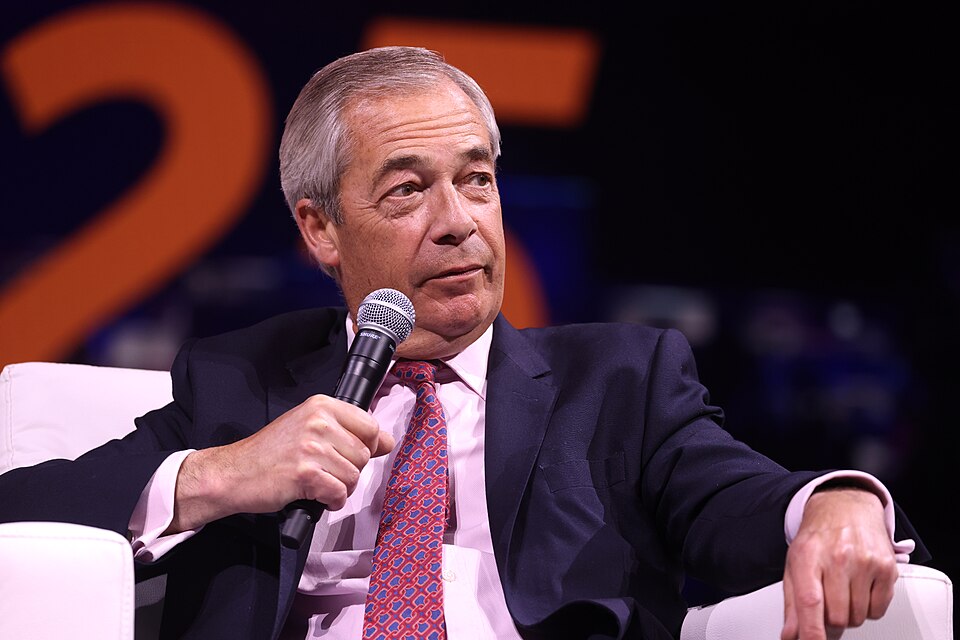
Nigel Farage resigned as an MP and triggered a by-election in a desperate bid to detract from his and his party’s mounting sleaze scandals. However, his attempts to frame the by-election as Reform versus ‘the establishment’ have been reduced to farce by the refusal of all of the parties of the capitalist establishment to take part. Instead, as establishment politician Chancellor Rachel Reeves put it, it seems he is going to spend his summer arguing with a bin.
But, for the workers’ movement, leaving opposition to Reform to Count Binface is no solution. Nor is the answer to support the parties of the capitalist establishment on the grounds they are trying to undermine Reform. It is the failing British capitalist system, and the political parties that defend it, which have created the space into which Reform is stepping.
Successive Tory and Labour governments have overseen a relentless squeeze on the living standards of the majority, while the wealth of the richest has consistently increased. According to Oxfam, the richest 56 people in the UK now hold more wealth than 27 million combined. At the same time the Tories and now the Labour government have peddled anti-migrant propaganda to divert attention from the real causes of society’s problems.
Nor are any of the establishment parties sleaze free. Remember the expenses scandal in 2009 – in which MPs from every party were embroiled, including the soon-to-be new prime minister Andy Burnham, or the Tories PPE gravy train for their mates during the pandemic, or Peter Mandelson and his association with the paedophile and sex trafficker Epstein. No wonder that some voters, desperate to oppose the parties of the establishment, and seeing them attack Farage, will believe Reform’s false claim to be ‘anti-establishment’.
This by-election is another indication of how vital it is for the trade union movement to discuss how the working class develops its own political voice as the only way to cut across Reform and their ilk. Some trade unionists may hope that Andy Burnham will transform the Labour Party from the safe representative of capitalist interests it has been under Starmer into a party of the working class. In reality, however, the fact that That Burnham is going to be ‘crowned’ without a contest, having garnered the support of 80% of the Parliamentary Labour Party, including its most right-wing elements, makes it clear that he, like Starmer, will defend the interests of the elite not the working-class majority. His pledges to stick with Reeves’s fiscal rules and rule on the basis of the 2024 Labour manifesto drive that home.
On that basis, Burnham will not make any fundamental improvements in workers’ lives and therefore the electoral ‘Burnham bounce’ will be short-lived. One opinion poll, conducted in late June, found that around a third of those who voted Labour in 2024 were more likely to consider voting Labour again with Burnham as leader. However, over half – 54% – said they would know in six months if Burnham was doing a good job, and only 19% were willing to give him longer than that. Having already experienced two years of New Labour government, it is no surprise that this is far less credit than was extended to Starmer. In July 2024, 62% of people told the same pollsters that it would take a year or two before they could judge if Starmer was doing a good job.
The discussion on working class-political representation is therefore more urgent than ever. It would be a mistake to ‘wait and see’ what Burnham does, allowing Reform to pose as the main opponents of a Labour government that continues with austerity. That is why the Socialist Party is calling for an urgent cross-trade union conference to debate working-class political representation.
Under the previous New Labour government, the late general secretary of the Rail Maritime and Transport Workers’ Union, Bob Crow, called such conferences. Nigel Farage has cynically lied through his teeth that he was friends with Bob Crow. In fact, it was the need to cut across the divisive and racist policies of the right which led Bob Crow to help found the Trade Unionist and Socialist Coalition, alongside the Socialist Party and others, as a step towards a workers’ party. A class fighter like Bob Crow, or any one of the workers on strike in Britain today, standing as a trade-union backed candidate in Clacton could transform the situation.
The Socialist Party, previously the Militant, has a proud record of public representatives of the kind that are desperately needed today: MPs that stood up to the establishment in deeds rather than empty phrases. Terry Fields, MP for Liverpool Broadgreen from 1983-1992, was sent to prison while he was an MP. His ‘crime’ was not corruption or sleaze, however, but taking part in a mass campaign of civil disobedience against the iniquitous poll tax, along with 18 million other non-payers. That campaign was central to the resignation of hated Tory prime minister Maggie Thatcher, whom – unsurprisingly – ex-stockbroker Farage “admires”. Terry Fields, along with Pat Wall and Dave Nellist, who were also Militant-supporting MPs, all only took a workers’ wage, donating the rest of their parliamentary salaries to the workers’ movement.
A working-class fighter of that type standing in this by-election could really begin to puncture Reform’s ‘anti-establishment’ bubble. A candidate that stood on a socialist programme, including trade union-backed policies like nationalisation of the privatised utilities – which is supported by a majority of Reform voters – a £15 an hour minimum wage, and mass council house building would engender enormous enthusiasm.
Without that, this by-election may end up being a farce, but it is also a call to action by the workers’ movement to ensure that Reform and their ilk face real ‘anti-establishment’ working-class opposition in the future.
