


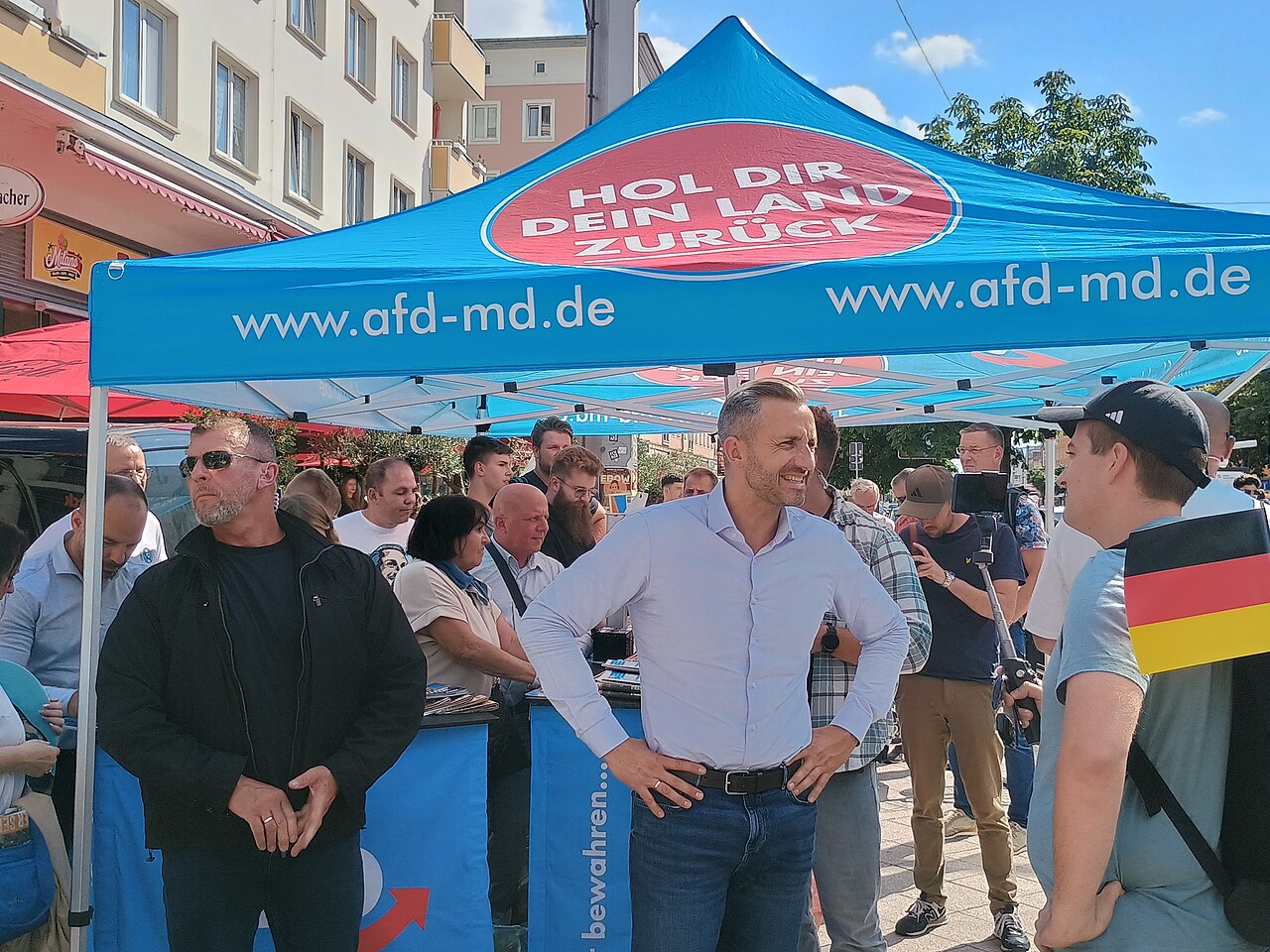
In the first of a series of state elections in Germany, the right-populist AfD won the largest number of votes, but short of an absolute majority in Saxony-Anhalt. As we go to press, they are in negotiations to run the state. Written before this election, Tom Hoffmann, a member of the Sol (CWI in Germany) federal executive, looks at the political earthquake unfolding.
Germany is facing a political earthquake. In the state elections in Saxony-Anhalt and Mecklenburg-Western Pomerania, the right-populist AfD is likely to emerge as the strongest force by a wide margin. In Berlin, this is also a possibility, albeit by a narrower margin as currently local opinion polls show that the left party, Die Linke, has a small lead. These elections will shake the CDU-SPD-led coalition national government, which has made it its mission to carry out the most severe social attacks on the working class in decades. However, they will also pose a challenge for Die Linke and the trade union movement, which must respond to the class struggle being waged from above and the threat from the far right. This will only succeed if they adopt an independent class standpoint.
The root cause of these political developments is systemic. Since 2019, German economic output has been stagnating. The primary reason for the crisis is the intensifying competition on the world market, particularly between the US and China, resulting in the German economy – which is heavily dependent on exports – losing its markets. Under capitalism, there is essentially only one way to solve these problems: to intensify the exploitation of the workforce. That is why capital and the government are demanding longer working hours and drastic cuts to social benefits, whilst companies are cutting hundreds of thousands of jobs.
For years, the German business newspapers have been calling for far-reaching ‘reforms’ to improve the profit conditions of German banks and corporations. From the perspective of those in power, the drastic changes in relations between capitalist states also demand a level of rearmament and militarisation that is unprecedented in the history of the Federal Republic.
The previous Social Democrat, Green, liberal ‘traffic light’ coalition government had already taken the lead with cuts and rearmament. Ultimately, it collapsed in November 2024 due to differing views on how these sacrifices should be imposed on the working class. Faced with rampant public dissatisfaction, it had exhausted its own capacity to implement such a programme.
The subsequent conservative/Social Democrat coalition government led by Friedrich Merz (CDU) and Lars Klingbeil (SPD) began its rule by using the outgoing parliament’s members to approve a massive rearmament package, because they feared that the newly elected parliament would not pass the measure with the majority needed to amend the constitution to allow this extra military spending. Among other things, tax breaks for capitalists and billions in cuts to the health service were merely the first steps in making the working class foot the bill. Now the retirement age is to be raised and the so-called ‘pension at 63’ abolished, housing benefit and parental allowance cut, working hours extended and many social benefits reduced.
It is therefore no wonder that the federal government and the Chancellor are facing record-low approval ratings. Between 75% and 80% of the population are dissatisfied. The only reason these figures are not even more disastrous is that the full extent of the government’s attacks has not yet sunk in. The fact that this dissatisfaction has not yet manifested itself in widespread resistance on the streets and in workplaces is because, regrettably, the trade union leaderships are obscuring the nature of this head-on attack.
The same DGB (trade union federation) leader, Fahimi, who as recently as June spoke of “completely misguided” reform plans, claimed in July that the coalition’s decisions sent “the right signals for employment, growth and relief”.
Crisis among those in power
Nevertheless, the federal government is far from being crisis-proof. The days when the CDU/CSU and the SPD could be described as a ‘grand coalition’ are long gone. This erosion is linked to the deepening crisis of German capitalism and the inability of the capitalist parties to implement any fundamental improvements in the interests of the broad masses.
The CDU/CSU and the SPD are under pressure from all sides. From above by capital: large corporations such as Audi and Siemens, together with business associations, demanded in an urgent letter that the announced reforms be implemented “as quickly as possible and without any compromises”. From below, by the working class and the middle classes, who are continuing to turn away from the parties in the polls. Consequently, from the right by the AfD, which benefits most from this discontent and is able to channel it into electoral support, even though its programme would amount to even greater attacks on the population. From the left by Die Linke, which is within striking distance of overtaking the SPD in the polls.
State elections
It is against this backdrop that this month’s state elections in Saxony-Anhalt (6 September), Mecklenburg-Western Pomerania (20 September) and Berlin (20 September) take place. They will serve as a barometer of the dissatisfaction and polarisation in the country and will exacerbate tensions within the government.
The AfD will, without question, be the main beneficiary of this. Its rise has not come out of nowhere; rather, it is able to capitalise above all on the frustration felt in parts of society that life is becoming ever harder and that people’s social security is increasingly under threat. Even though more of its voters have recently stated that they vote for the party out of conviction, the main motive remains giving ‘those at the top’ the middle finger. The AfD channels this justified frustration towards minorities, such as refugees and LGBTQ+ people, rather than towards the capitalist system and the true causes of social inequality, the housing crisis and the numerous problems in public services.
Marxists, however, also point out that elections are merely snapshots and can only reflect certain deeper-rooted processes in a distorted and limited way. It is difficult to say exactly how the elections will turn out and what consequences they will entail. In Saxony-Anhalt, a key question will be whether the AfD, which is currently polling at over 40%, can secure an absolute majority of seats. This would give it the opportunity to form a single-party government.
There are signs that this risk – and the fact that it becomes all the more likely if the SPD and the Greens fail to clear the 5% threshold – is mobilising voters to cast their votes for these parties with a clenched fist in their pocket, in order to keep the AfD out of government.
This could then lead to complicated coalition-building processes – as in Mecklenburg-Western Pomerania, where an absolute AfD majority is unlikely. This could prove a real test, particularly for the CDU/CSU, which formally rules out cooperation with the AfD and Die Linke – even though such cooperation with Die Linke is already being practised tacitly at state level in Thuringia and Saxony, amongst other places. Admittedly, the so-called ‘firewall’ against the AfD no longer exists in many local authorities either. However, there are strong indications that those forces within the CDU/CSU who do not yet want this at state level – and who have no interest in renewed mass protests such as those last spring, when the CDU/CSU passed anti-migration resolutions in the Bundestag together with the AfD – will prevail.
Nevertheless, the elections will heighten tensions within the governing parties, and it cannot be ruled out that they will result in a deeper political crisis. At the same time, the governing parties – and capital itself – have absolutely no interest in seeing their coalition fail. From capital’s perspective, ‘the job is not yet done’ and there is no viable or practical alternative constellation. From their perspective, new elections threaten to strengthen the AfD and Die Linke.
Die Linke
In Saxony-Anhalt and Mecklenburg-Western Pomerania, Die Linke will likely face the question of how to respond if the election of an AfD Minister-President looms, should it fail to put forward another candidate. If, in such a situation, the party once again enters into agreements or alliances with the CDU, or repeats its participation in government with the SPD in Mecklenburg-Western Pomerania, it will not halt the rise of the AfD, but rather fuel it. Past state governments involving Die Linke – or its predecessor the PDS’s tolerance of a red-green government in Saxony-Anhalt in the 1990s – have shown that this leads to Die Linke being viewed as part of the political establishment, thereby giving the AfD scope to present itself as a supposed alternative. In Thuringia, the AfD has gained seven percentage points since the last election; in Saxony, eleven. Sol (the CWI in Germany) is therefore fighting within the party to ensure that the socialist banner is not lowered in the face of the AfD’s strength, and that the policy of participating in governments with pro-capitalist parties – or of currying favour with the establishment – is brought to an end. Instead, a militant, socialist left would be the best remedy against the AfD’s continued rise.
In Berlin, Die Linke has the chance to become the strongest political force. This reflects the left-wing aspect of social polarisation, and many people associate it with the hope that this would lead to more social and just policies in the capital. However, the party leadership has set a course of sacrificing fundamental left-wing positions for the sake of the mayoral office and a red-green-red coalition government.
Class struggle from below is the right path
The outcome of the state elections will influence one another and the public debate. It is quite possible that there will once again be major protests against the AfD, a right-populist party with fascist elements. When millions took to the streets in recent years, this was an indication that, despite high approval ratings for the right-wing populists, we were not dealing with a one-sided shift to the right in society but rather with polarisation. However, these protests were neither sustainable nor successful, because they did not address the root causes of the AfD’s rise.
The central task of Die Linke and the trade unions is to focus on the social and political causes of the AfD’s rise and to counter the class struggle from above with a class struggle from below.
Should trade union leaders, out of fear that a fall of the federal government triggered by mass protests might strengthen the AfD, tone down their resistance against the latter and the government’s all-out attack on the working class, they would not only be doing the struggle against the far right a disservice. They would also make it clear that they prefer to use their influence and resources to (supposedly) ‘stabilise’ the capitalist system, rather than fulfilling their responsibility to build a political alternative for the working population. The CDU/SPD coalition and the AfD would benefit because the former would be granted a breather and the latter a fresh opportunity to present itself as the only opposition representing ordinary people.
Such a scenario – AfD successes, social protests with the handbrake on, and further successes by the Merz-Klingbeil gang in making our lives a living hell – could heighten a sense of frustration and demoralisation amongst some activists for a time. This is particularly true if corporate job cuts continue to be implemented without proper resistance. That is why militants must unite within the trade unions and fight for a change of course.
In such a situation, Die Linke must make it clear what class politics means. Instead of seeking an alliance with parties whose policies strengthen the AfD, it should draw up a plan on how resistance to the federal government’s policies and the threat from the far right can be successful. It should also take this plan into workplaces and trade unions. Nothing would be more disastrous than if Die Linke was once again to take the path of supporting pro-capitalist forces or seeking political alliances with them.
The social protests and the nationwide DGB (trade union federation) day of action on 26 September should be used to highlight the link between austerity policies, job cuts, rearmament and the rise of right-wing populism, and to unite the struggle against them. But it must not stop there, for demonstrations alone will not stop Merz and Klingbeil, nor the AfD.
After 26 September, the trade unions and the Left need a clear plan for the further development of a movement of the working people and a political alternative. If such a plan were pursued courageously and resolutely, it would have the potential to turn the country and the entire political situation on its head. What is needed, for example, is a nationwide demonstration before the end of this year, a march on the Chancellery in Berlin; proper strikes against job cuts and in the upcoming collective bargaining rounds; extraordinary works council meetings, right up to political walkouts against the government’s attacks and its planned ‘horror budget’, and possibly a 24-hour general strike; alongside the building of local, regional and nationwide alliances.
This must be combined with a programme that not only rejects cutbacks but also sets out how fundamental improvements for the majority of the population can be achieved. A programme that shows how society could be fundamentally restructured beyond the logic of capitalist profit.
The AfD has only become so strong, and the government has only been able to push through its attacks in this form, because there is no strong representative body, no socialist mass party of the working people. In times of capitalism’s multiple crises, of social and job cuts, wars and climate destruction, building such a force is becoming ever more urgent.
Who’s who?
SPD: social democrats
Die Linke: The left party
AfD: the populist right
CDU/CSU: conservative
Sol: CWI in Germany
DGB: Trade union federation
