


Bill North, Brighton Socialist Party
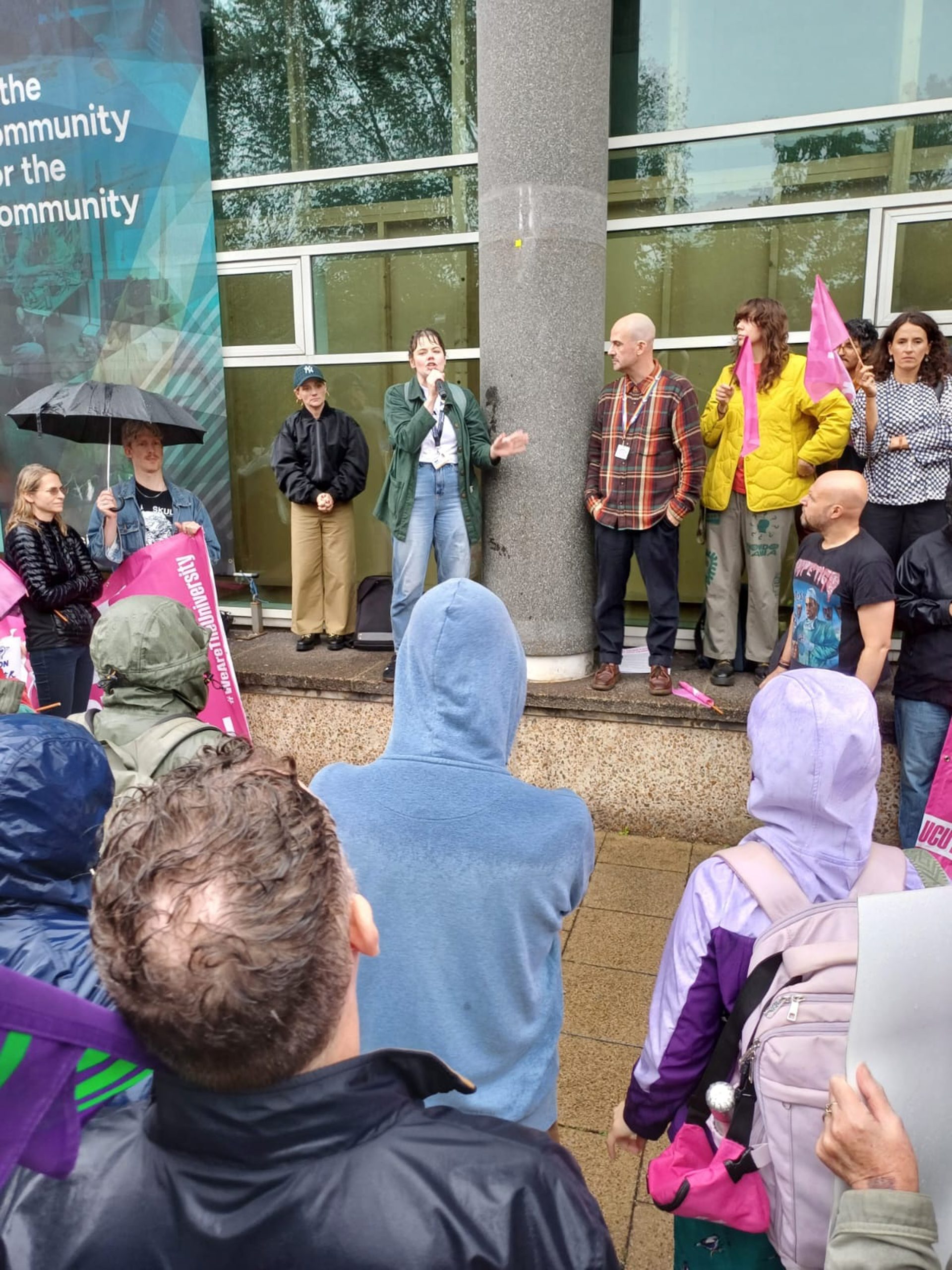
University of Brighton (UoB) trade unionists mobilised to oppose an all-out attack on their pay and conditions, with a protest on 15 September. Members of the University and College Union (UCU) and Unison were joined by locals, and delegates to the Trades Union Congress (TUC), which was meeting half a mile away in Brighton.
Management have given formal notice that they intend to terminate the recognition agreement with UCU and Unison, and collective agreements covering just about all aspects of employment – job descriptions, pay grades, sick pay, and parental leave.
Brighton UCU has said: “Derecognition would remove the university’s legal requirement to engage in collective bargaining, meaning there would be no standard contracts, and instead every individual employee would require an individually written and agreed contract. Instead of negotiating with staff representatives, university management would unilaterally dictate employee contracts and working conditions.”
A university spokesperson told media: “We greatly value… our trade unions… and we remain committed to working collaboratively with them.” Management are undoubtedly keen to work ‘collaboratively’ to impose pay cuts and longer working hours.
Like the rest of higher education, UoB faces a financial crisis. Funding from tuition fees is not sufficient to cover rising operating costs.
This is exacerbated by bureaucratic mismanagement of funds spent on new buildings meant to make the university more attractive to prospective students, instead of investing in staff.
But rather than campaigning for higher education to be fully funded by the government, the university management is attempting to shift the burden onto workers. Three years ago, UoB made over 100 staff redundant to save £18 million. This latest attack is being carried out in preparation for a new round of cuts to pay and jobs.
‘The powers that be’ at other universities are following events at Brighton with great interest – another reason why the vicious UoB bosses must be beaten back.
Unions must mobilise
All campus unions, student organisations, and the broader workers’ movement must be mobilised to resist this attack, including the possibility of coordinated strike action by university workers.
Socialist Party Scotland member Fiona Brittle spoke at the rally. Fiona is a member of the National Executive Committee of PCS civil service union.
She informed the protest that TUC Congress had just passed a motion committing it to organise a national demonstration demanding proper funding for the public sector, and coordinated strike action (see pages 4-5). UCU and Unison should now use their positions on the TUC General Council to demand that this is urgently carried out.
Over 90 universities have made redundancies in the last three years. This is a national issue. It needs a national campaign. UCU members voted for national action at the Higher Education conference this spring, but are now having to fight for that to be implemented.
This must be linked to demanding that the new Andy Burnham government implement UCU policy for fully-funded, free education, paid for by the super-rich – the only way out of the crisis. Forcing students, who already face a mountain of debt, to pay more through higher tuition fees is no solution.
University management will attempt to spin strike action or protest by workers as harmful to students. The opposite is true. Successfully stopping these attacks means defending the quality of teaching and facilities. Fighting student organisations could play an important role – spreading awareness and mobilising students to protest in support of workers.
