


Enact the PCS motion: Name the date for a trade union-led demonstration
Rob Williams, Socialist Party Executive Committee
“It means taking the Prime Minister at his word and working with him to re-industrialise Britain.”
Trades Union Congress (TUC) general secretary Paul Nowak set the tone at TUC Congress in Brighton, 13-16 September, a tone which most of the union leaders dutifully followed. The clear message was: ‘Create breathing space for Andy Burnham.’
Yet even in the rarified atmosphere of the TUC, at times the desperate situation that faces workers, their families and communities broke through.
One National Education Union (NEU) delegate said that her annual school departmental budget amounted to £4,000 – the same as it was 15 years ago! In real terms, that figure should be over £6,500. This could be multiplied many times over in all sectors and, in microcosm, this is the reality of 16 years of brutal austerity.
The nearly two decades since the 2007-09 Great Recession, triggered by the financial crisis, have been a catastrophe for working-class people. They have faced the huge cuts offensive of successive Tory-Liberal, Tory and now Labour governments, administered by councils of every party stripe.
Two years ago, newly elected Labour prime minister Keir Starmer confidently pronounced to TUC delegates: “I have to make it clear that this government won’t risk economic stability – and with tough decisions on the horizon, pay will be inevitably shaped by that… I call for the politics of partnership – business and workers, public and private.”
Inevitably, that meant governing in the interests of big business at the expense of workers. But in this period of capitalist crisis, any government that represents this bosses’ system will be a government of crisis, as Starmer discovered, thrown out by the anger and frustration of working-class people.
Political crisis
Such is the level of political crisis, Burnham stood as the Labour candidate in the Makerfield by-election as the opposition candidate to the Labour government, in order to be the new prime minister of the same Labour government!
In order to accomplish this, Burnham had to promise a ‘new direction’. Workers are waiting, some hoping against hope, that something better will be delivered, with his first Budget taking place on 28 October.
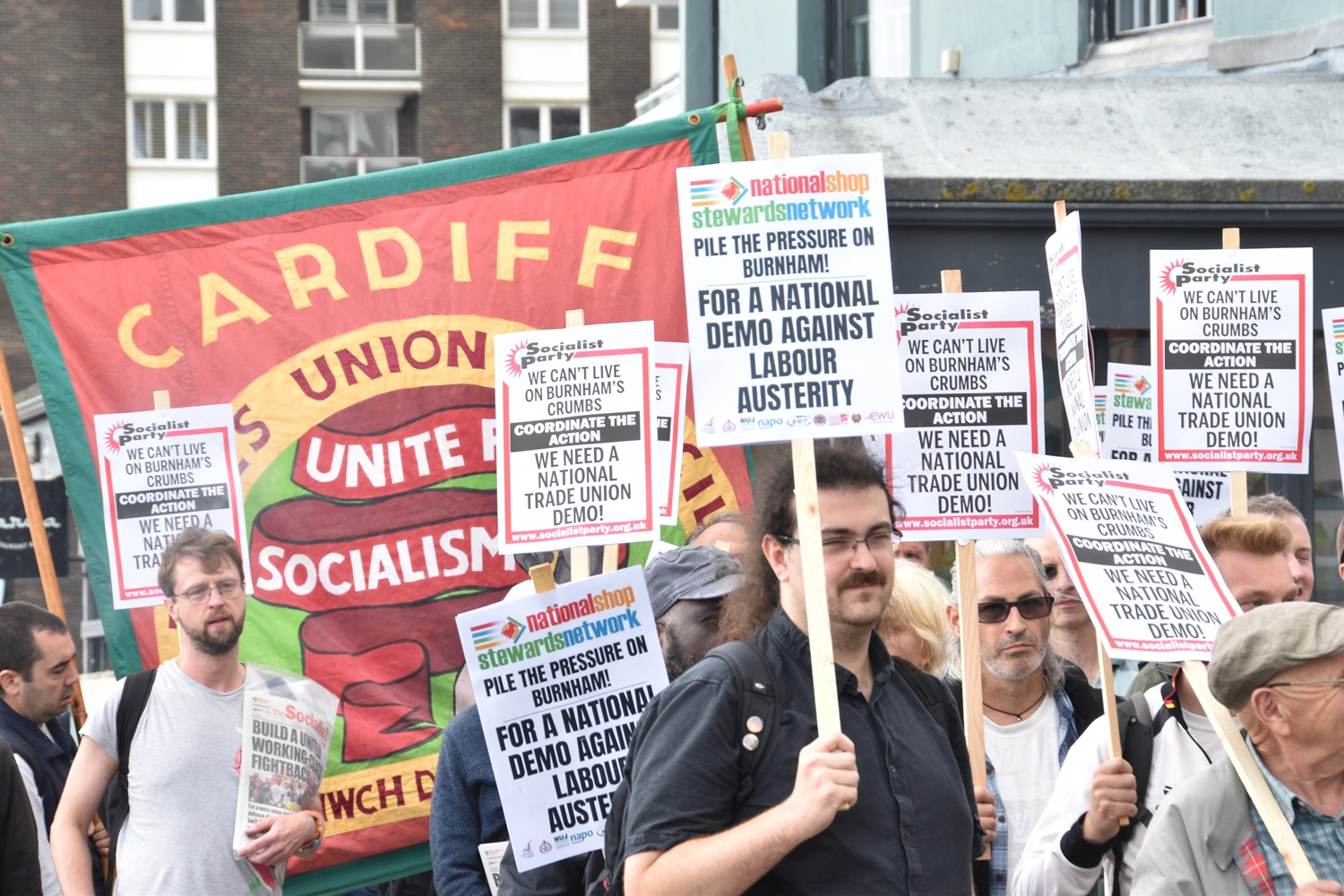
But the leadership of the trade union movement can’t reduce themselves to wishful thinking. The most militant delegates, many of them members of the Socialist Party, starting at the National Shop Stewards Network pre-Congress rally and lobby, argued that the union movement must mobilise in order to build pressure on Burnham to counter the agenda of the bosses, who are demanding that workers pay for crisis-ridden British capitalism.
It is essential that the unions take the lead, to ensure a united front is built, to overcome the attempts by the capitalists and their political representatives, including Burnham’s Labour government, to sow division, to pit worker against worker and even union against union. This is the strategy behind targeting the pension triple lock on the basis that young people are disadvantaged compared to older workers, supposedly on golden pensions!
Actually, workers of all generations are suffering from the bosses’ offensive. The unions have the responsibility to give a lead with a fighting industrial and political programme to build a united movement of struggle.
The civil service union PCS motion 34 set out such a strategy, calling on the TUC “to urgently call a national Saturday demonstration this autumn for investment in public services, against austerity and for pro-worker policies” and urging “all public sector unions to join a united campaign on pay, and, if needed, to plan for coordinated industrial action to secure real gains for workers.”
This was passed unanimously, but with a ‘statement of explanation’ from the TUC General Council, moved by Nowak, that it’s up to unions to coordinate action, and that a demonstration will be considered by the General Council based on ‘resources’.
Many delegates will be well aware that we’ve been here before – just last year to be exact! Then, a successful motion calling for a demonstration was tabled by the TUC Disabled Workers’ Conference and Trades Councils Conference, and then shamefully ignored by the TUC General Council. An opportunity for the unions to take a lead against Starmer’s hated government was missed, leaving a space for Farage and the far right to look to fill with their divisive poison.
‘Coalition of the willing’
The fighting unions must form a ‘coalition of the willing’ to demand, at the General Council on 21 October, that such a demonstration is called before the end of the year. Those unions that are set to undertake national strike ballots in the next few weeks (PCS, NEU and further education members of the University and College Union UCU) should take the lead, and approach other unions with a fighting record. But at the same time, they should prepare to take the initiative should the General Council again act as a barrier.
Two years ago, when Starmer came to the TUC, we identified two trends in the unions and the workers’ movement – partnership with the bosses, or fight for workers. Starmer, at the zenith of his authority after being elected to end 14 years of Tory governments, was allowed to lord it over the Congress, peppering his speech with the need for the unions to go into partnership with the bosses.
Now, with Starmer unceremoniously ousted, hated by workers for implementing policy in the interests of the capitalist bosses, many of the union leaders are determined to give Burnham space and time. They are well aware that under pressure from the cost-of-living squeeze, workers’ patience is wearing thin.
Burnham didn’t address Congress because his father had passed away; Labour cabinet minister Louise Haigh deputised for him. Some union leaders praised her speech and welcomed the Employment Rights Act. But despite passing Composite 2 on strengthening employment rights, which demands that the government deliver its election promise two years ago to scrap the 50% strike ballot threshold brought in by Tory David Cameron in 2016, in the question and answer with Haigh there was no mention of this. Similarly, with another demand in the composite, that the POA’s right to strike for prison officers be restored.
Also, on that very Tuesday lunchtime, UCU and Unison organised a protest outside the University of Brighton, less than a mile from Congress, against the brutal threats of management to derecognise both, and to give notice to terminate all collective agreements, including pay scales, hours, grades, annual leave, and a whole range of terms and conditions. For all the welcoming talk of union leaders, this is the vicious reality that still takes place on Burnham’s watch.
But there is another trend, one in which Socialist Party members, at all levels of the union movement, play a critical role – fighting for militant industrial action and a socialist political programme, and a union-centred political vehicle to stand up to the big business parties.
This struggle is developing across the union movement and within each union. The three unions, PCS, NEU and UCU, that are balloting members for national strike action, agreed this position in opposition to their respective union leaders. Tellingly, not one of these unions’ general secretaries mentioned these impending ballots from the Congress rostrum! Instead, it was left to rank-and-file delegates to make the announcement.
This shows that nothing is automatic, as many of the union leaders move might and main to try to prevent action against Burnham’s fledgling government, just as they did in 2024, when they used the authority they had gained during the strike wave to assist Starmer in ending the pay battles.
Yet, right now is exactly when such a struggle should take place, to fight for workers’ interests against the demands on Burnham from the bosses. NEU Executive members will be scrutinising the apparent concession on the funding of teacher pay, announced by NEU general secretary Daniel Kebede at the close of TUC Congress. But the main lesson is that being prepared to take action can force the government to make concessions.
The Blairites and Starmerites that fill his cabinet and advisory team show where Burnham is really coming from. He was comfortable in sending Angela Rayner, now his Secretary of State for Housing, Communities and Local Government, to Congress.
Sitting on the platform, Rayner had one nervous eye on the Unite delegation who, with many other union delegates, refused to join in with a standing ovation, and with good reason. At last year’s Unite policy conference, an emergency motion was overwhelmingly passed, drafted and moved by Socialist Party delegates and close allies, that suspended Rayner and the cutting Labour councillors from Unite membership because of the vicious fire and rehire of the heroic Birmingham binworkers, to slash their wages by £8,000.
That motion also committed Unite to open up a discussion about its relationship with Labour. Socialist Party members in the union argue for that debate to start, so that Unite and all the unions can grapple with how to fill the yawning vacuum with an authentic and independent political voice for workers, to put forward the policies that workers desperately need.
The election of Burnham as the crisis of UK capitalism deepens, amplifies rather than negates the need for such a discussion about a real workers’ political alternative.
The building of such a political force along with, and to strengthen, militant industrial action, are the main tasks for fighting trade unions and members.
Institute of Cancer Research strike win
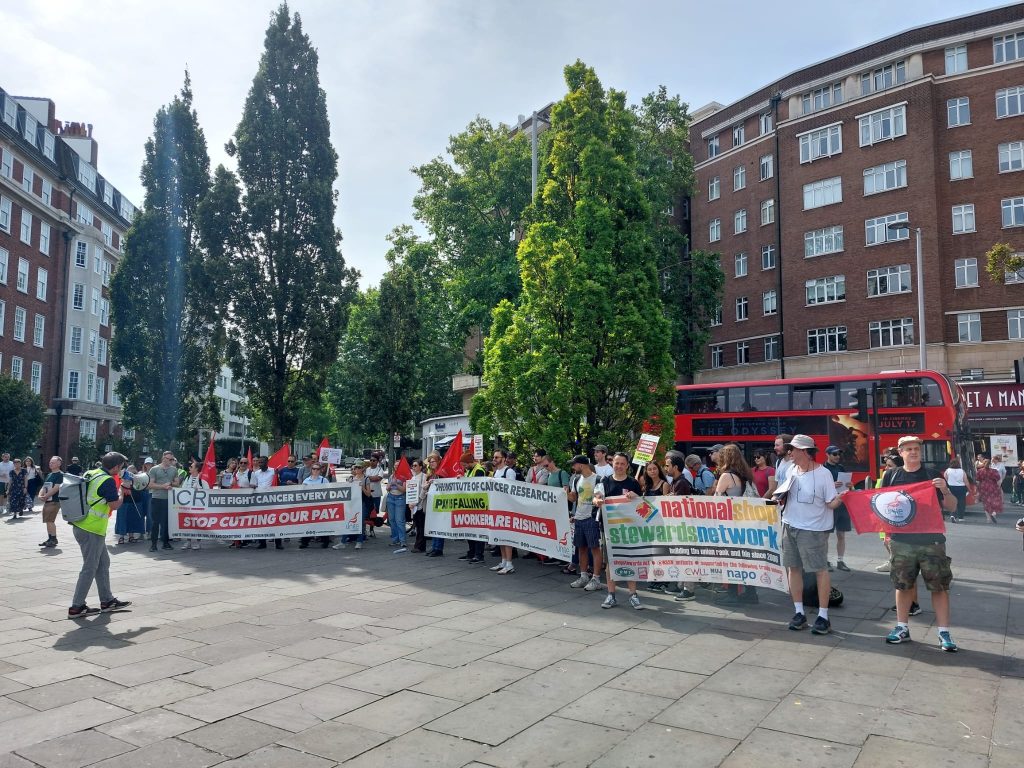
Unite members at the Institute of Cancer Research have returned to work victorious after 68 days of strike action.
Bosses’ plans to downgrade the pension scheme have been scrapped, the staff canteen is to be reinstated, and all staff have won an increased pay offer. Management had offered 3.75%. Now, Unite says, workers will see an average increase over two years of 17.2%. The lowest paid will see rises of up to 52%.
Legalease workers strike against low pay
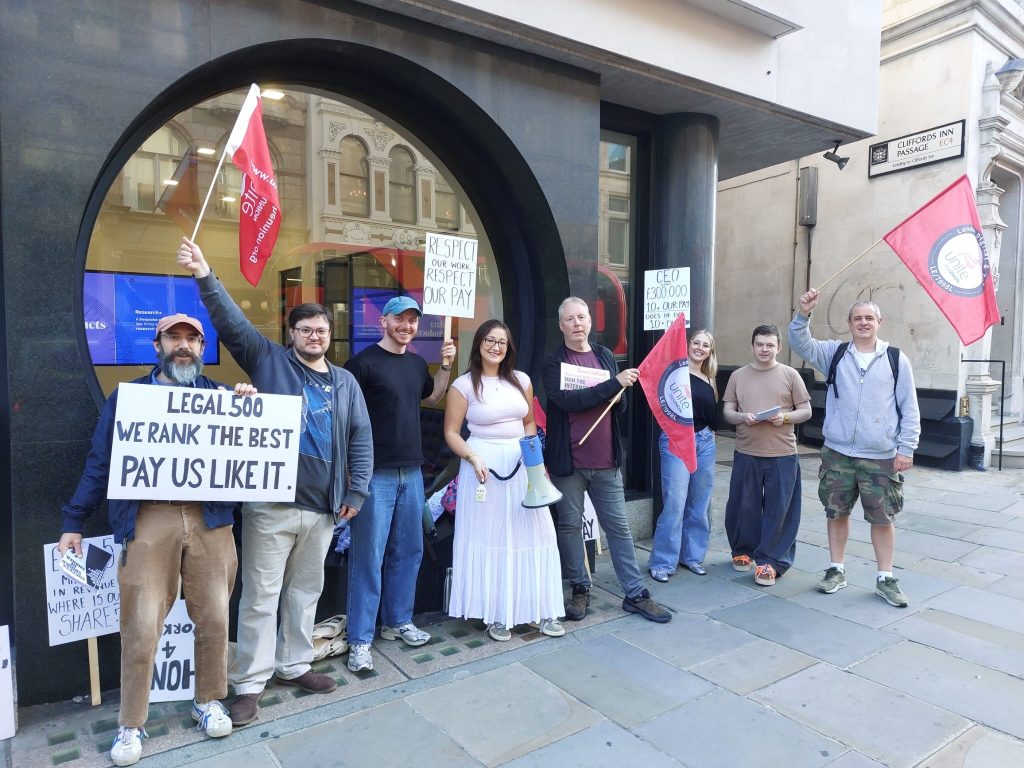
Workers organised in Unite at Legalease, the law publishing and research company which produces ‘Legal 500’, are striking over low pay. A 3.4% offer from the bosses has been rejected and strike action has been taking place since 14 September, with this round continuing until 25 September.
