


Editorial of the Socialist issue 1384
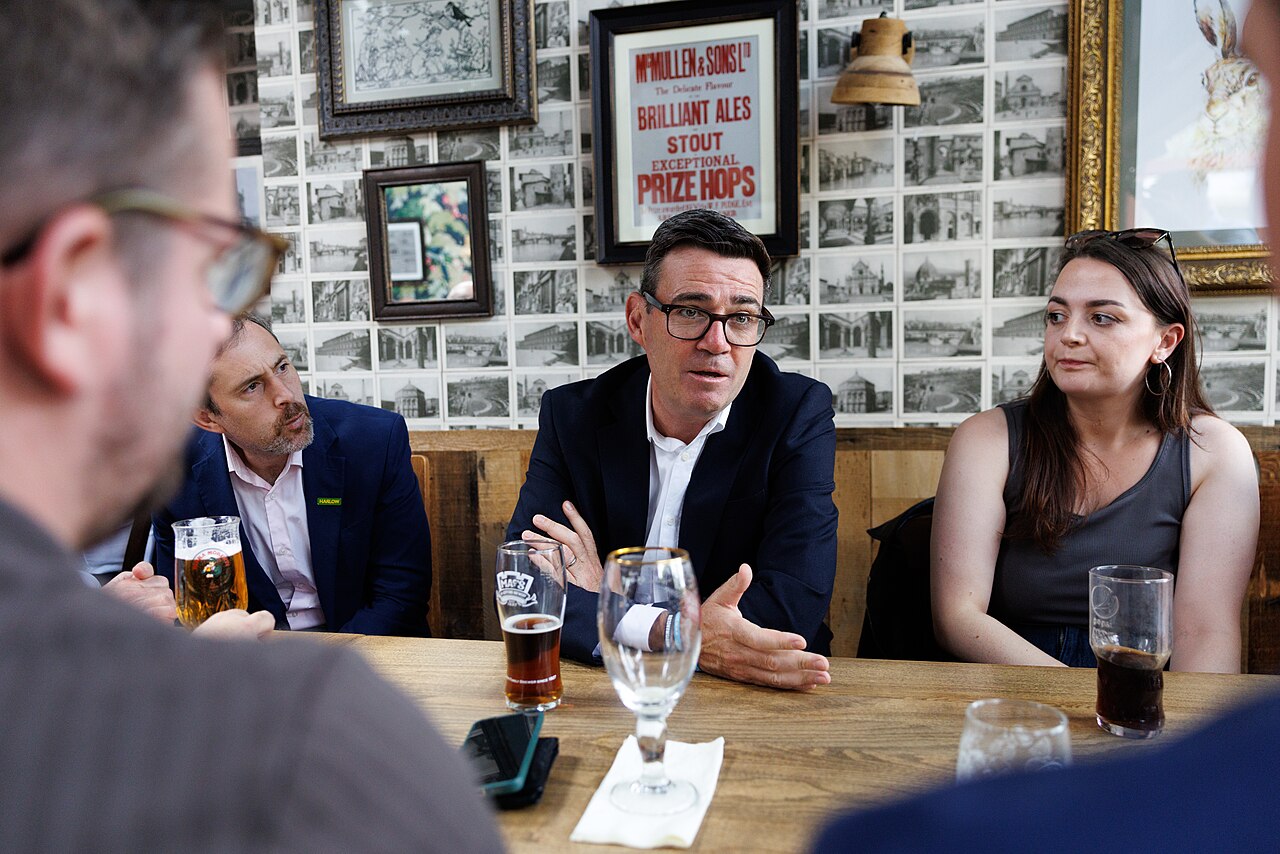
Andy Burnham takes to the rostrum in Liverpool at Labour Party conference as the Socialist goes to press.
He does so with opinion polls seemingly improving, albeit from a position of ‘absolutely dismal’ for his Labour Party at the time of Starmer’s departure. To put things in perspective, according to the polls, if a general election took place today, over 100 Labour MPs would lose their seats.
Of course, that is as if polls are accurate – which they increasingly aren’t. And that things aren’t volatile and unstable – which they increasingly are! That there is the possibility that the ‘Burnham bounce’ could be rudely punctured by a defeat in the Holborn and St Pancras by-election on 8 October is proof enough of its fragility. On the other hand, while a Labour win will be presented as evidence of the existence of a ‘bounce’, this is a constituency that has been held by Labour since its creation and which Keir Starmer won with a 30 percentage point majority a little over two years ago.
Labour’s misnamed ‘landslide’ election in 2024 was in fact achieved with the lowest share of the vote for any ‘single party’ government since the first world war. This May, Labour failed to win in Wales for the first time in a century, while 58% of its council seats in England were lost. Its ‘projected national vote share’ was just 17% – the lowest ever.
So too, the other of the main capitalist establishment parties – the Tory party – has been wrecked. British capitalism’s two-party system has been smashed apart by working-class anger, fuelled by austerity and falling living standards. Labour’s base of support among the working class has been crumbling for decades, and was dealt huge blows by Starmer’s willingness to attack pensioners and those on benefits, on behalf of the capitalists.
Substantial change, more than ‘hope and vibes’, would be needed to stop that process of destruction, let alone begin to repair the damage.
Bosses call for more attacks
Meanwhile, the capitalist class is demanding more cuts. Work and Pensions minister Pat McFadden told conference he is on a ‘moral crusade’ revisiting the issue of benefits cuts that Labour was forced to U-turn on last year, and it is crystal clear that the pensions triple lock is on the chopping block for future attacks.
A majority of the capitalist class would like to give Burnham as much ‘breathing room’ as possible to make changes that can bring some political stability. So far, much of the assistance he has been given by sections of the capitalist establishment has been in the form of attacks on Nigel Farage and Reform – as well as, to a lesser extent, his current main competitor from the left, Zack Polanski.
But as far as economic breathing room is concerned, things are not so much in their gift. The cost of government borrowing has consistently been on an upward curve. Not because of any of the actions of the Burnham government. But because of global economic turmoil, and Britain’s particular vulnerability to it. British capitalism is held in low esteem by investors internationally.
British industry
Chancellor John Healey spoke about “a new age of industrialisation” at Labour conference. But recent weeks have seen Jaguar Land Rover – described by Burnham as the “jewel in the crown of British industry” – announce plans to cut 4,000 jobs. The JLR supply chain supports around 180,000 jobs.
Last year, the government handed £1.5 billion over to JLR after it was a victim of a cyber-attack. Why now, a year later, are 4,000 job cuts being announced? The trade unions should be demanding that the JLR books are opened to inspection by workers and the unions.
Action is needed to save all jobs at JLR and its supply chain, but government bailouts and subsidies do not guarantee that. For example, the government’s £500 million subsidy for Tata Steel to shift production at the Port Talbot steelworks ultimately meant over 2,000 job losses.
We need nationalisation
The demand must be for nationalisation, with compensation to safeguard workers’ pensions investments and other small shareholders – not to bailout the big bosses. In public hands, under workers’ and trade union democratic control and management, investment could be planned to safeguard jobs and union-agreed pay and conditions, including the possibility of switching production to other socially useful industries.
Contrast that to the kind of ‘greater public control’ touted by Andy Burnham, for example for utilities, which would leave ownership – and therefore ultimately control – in the hands of the profiteering, polluting bosses.
For years, Thames Water has existed on the brink of collapse. Privatisation is widely acknowledged as having been an utter failure. And yet it stays in private hands. Unwilling to take ownership from the profiteering investors for fear of retribution from the markets, and unable to buy them out because that would be too much government spending for the markets to stomach. The government is paralysed by the confines of the capitalist system, and British capitalism’s parlous condition.
Bounce vs the bond markets
Famously, at a Labour conference fringe meeting a year ago, Burnham characterised Britain as being “in hock to the bond markets”. And it is – for every £12 spent by the government £1 goes to paying debts, and rising. But now he is in the driving seat, what is his government planning to actually do about it?
At conference, Burnham announced plans for a future ‘National Care Service’, but only if Labour gets a second term and after the ‘fiscal headwinds’ have subsided. A big if, and on the assumption that events won’t make the headwinds even stronger.
As much as a big portion of the British capitalist establishment would like Burnham to maintain a ‘bounce’, anything that threatens to take any power or wealth from sections of the capitalist class can provoke a reaction. Measures to fund reforms by making the working class – or sections of it – pay, however, the bosses can accept!
Anything that would take enough off the capitalist class to transform or reverse the decades-long underfunding of services and stagnating living standards would provoke huge resistance from the capitalists and could only succeed in being implemented on the basis of mobilising a mass movement of the working class in support. To deal with the inevitable economic sabotage would require measures such as capital controls and nationalisation of the banks and big monopolies – to be democratically run in the interests of the working class and to finance investment to meet need.
To state the obvious, that is not what this Labour government has in store. The 28 October Autumn Budget certainly won’t be labelled ‘austerity’, but it also won’t fundamentally change the austerity status quo.
Unite the Union is taking a motion to Labour conference calling for the government to unfreeze the income tax thresholds and bring down the energy price cap, suggesting these could be paid for by windfall taxes, including on bank’s profits, for example. Any motion passed at Labour conference, however, has no way to determine policy.
Still, some measures such as those are not ruled out. After all, in their last few years in office even the Tories used an energy price cap and windfall taxes. That wasn’t enough to stop the development of the biggest wave of strikes in a generation.
Workers’ struggle remains
Now, most trade union leaders would have liked to have used the existence of a new prime minister with warm words about ‘change’ and cost of living breathing room to simply draw a line under nationwide strike action developing. It is telling that has not been possible.
Civil servants in PCS are preparing to ballot for strike action. FE teachers in UCU are too. That the NEU has paused its strike ballot of teachers after the suggestion from government that their two-year pay award is to be funded can and should be seen as evidence that the members’ preparedness to fight has forced concessions. Socialist Party members are fighting on the NEU Executive for this to be used to spur on the campaign for more, including demanding more money from central government (see pages 6-7).
In all those disputes, Socialist Party members elected to the leadership bodies of those trade unions, working with others, have been central to ensuring that members’ desire for action has found an organised expression. A counterpressure to that from the union leaders who would like to do all they can to themselves give Burnham breathing space.
Pressure from the members for action against a Labour government continuing to oversee squeezed living standards and crumbling, underfunded public services, is not going to diminish. Big clashes between the working class and the Labour government continue to be posed, including in the short term. And from those clashes conclusions will drawn among broader layers about the need for the trade union movement to develop its own political voice – a mass workers’ party, armed with socialist policies.
