


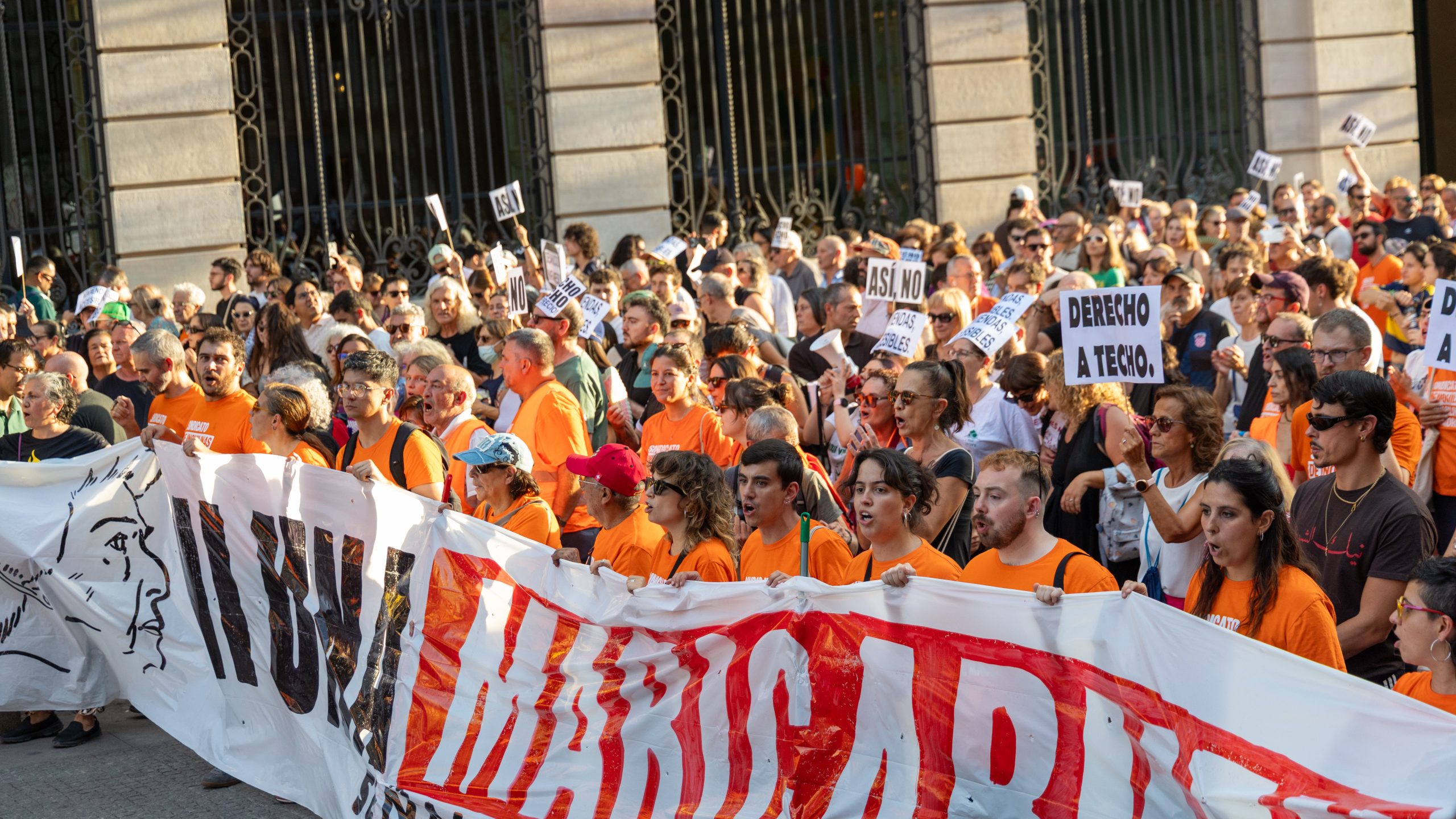
Spain has been rocked by mass protests. Now, under pressure, trade union leaders are preparing to name the date for a 24-hour general strike. Unable to pass housing reforms though parliament as concessions to the mass movement, the prime minister has been forced to call an early general election. The body of caretaker lawmakers that serves until the election on 29 November is set to pass the reforms. Paul Kershaw, Chair of Unite Housing Workers’ branch and Socialist Party member, reports. First published in full online at socialistworld.net, 3 October
The brutal eviction of the 87-year old disabled woman, María del Carmen Abascal, known as “Maricarmen”, who had been living in her Madrid flat for 71 years, sparked fury across Spain. She was carried out of her home on a stretcher by riot police after her housing block had been tear gassed.
The state machine violently backed Urbagestion, the investment fund that increased her rent by over 400%. On Maricarmen’s limited pension, this was simply not affordable. But the huge popular response has shocked the politicians and capitalists who have retreated as the mass movement spreads.
There had been repeated attempts to proceed with eviction which were thwarted by the housing movement. After legal battles, the Supreme Court ruled in March to end her lease because in their view, she was not sufficiently disabled to require support.
On Wednesday 23 September the eviction was carried out. Over 500 supportive neighbours organised by the tenants’ union camped out to peacefully stop police entering the building. The police arrived at 6am with 15 vans, a helicopter and dozens of police to violently disperse the crowd.
Maricarmen was carried out and taken to hospital. Images of the eviction sparked outrage and there were protests in cities nationwide. Up to 300,000 people marched through Madrid on Saturday 26 September and there are protest encampments in Madrid’s Puerta del Sol square, and similar movements in other cities. In some ways, these encampments echo the 15-M movement, the huge wave of anti-austerity protests and public square occupations in 2011 following the impact of the global financial crisis of 2008.
The huge response has terrified the ruling class and won significant but limited reforms. Urbagestion, the landlord, now says Maricarmen can move back under her old rent.
The mass movement forced promises of reforms from the ‘progressive’ PSOE government that it failed to deliver during more than eight years in government. They include protections against eviction until 2030, curbs on investment funds buying residential property until 2028, automatic lease extensions until 2028, more strict control of short-term rentals and support for first-time buyers.
But they don’t go as far as the ‘Maricarmen decree’ drawn up by the Madrid Tenants’ Union, which calls for a ban on ‘Vulture funds’ – speculative investment funds – buying housing, a law against evicting vulnerable individuals without offering alternative housing, a further curb on price rises, a freeze on rents and automatic renewal of leases. Tenants’ union representatives have demanded its full implementation and discussions in the encampments have moved on to more fundamental change. There are calls to expropriate the vulture funds and Sumar, the smaller party in the governing coalition, has called for Maricarmen’s building to be expropriated.
Housing commodity
In capitalist economies housing is a commodity, tradable for profit. In the wake of the global financial crisis, government policies around the world gave this an added twist. The banks were rescued and quantitative easing drove rising house prices by transforming the housing market into a primary outlet for what has been called a ‘global wall of money’ seeking safe investment. Liberalised financial systems facilitated vast amounts of capital moving around the world in search of profit, and house prices were increasingly decoupled from wages and workers’ ability to pay.
In the absence of mass workers’ parties, the neoliberal policies driving this process were not seriously opposed by any mass party. Financialisation has gone through various phases since then, but the essential features of high housing costs, badly managed rental property and insecurity persist. Taking over empty homes and expropriating the corporate landlords – with compensation on the basis of proven need – along with nationalisation of the banks are essential measures for a sustainable plan for genuinely affordable and secure housing.
Trade union members have been active in the movement and unions, including the largest ones (CCOO and UGT), have given official backing. They said they were holding off calling a general strike awaiting the result of voting on the housing reforms in congress. But the unions should be pressing to go beyond the temporary measures from the government rather than waiting on a parliamentary vote.
Attempts to put through emergency housing reforms collapsed after Congress rejected both government decrees. The government needed support from Catalan populist Junts to pass the measures, but the party withdrew its backing at the last moment. Opposition parties PP and Vox also voted against both texts, leaving the minority coalition without a path to approval.
The defeat dealt a significant blow to Pedro Sánchez’s government, intensifying calls from the opposition for early elections. Meanwhile, protests continue across Spain, with housing groups organising demonstrations in dozens of cities and demanding stronger protections against speculative investment and rising rents.
Linking the enormous potential power of organised workers to the protesters in Puerta del Sol and other squares would lead to an unstoppable movement. It will be crucial to hammer out a programme for real change through democratic debate.
Across Europe, struggles are developing against the capitalist housing crisis. Struggles such as these, and the debates around strategy and programme they produce, have the potential to lead to new mass parties worthy of the working class.
In Spain, one tenants’ union statement this week states that a “historic window of opportunity has opened to reverse decades of the commodification of housing. That is why we need to step up the pressure.” Another states: “This is just getting started.”
Build international youth strike 20 November
‘Fight for our futures, not their wars’, a Europe-wide day of youth walkouts is taking place on 20 November. With 20+ other youth organisations from across the continent, Socialist Students is taking part. The strikes are being organised by two youth organisations taking part in the mass movement in Spain, as well as two student organisations in France. The German school strike organisation which led tens of thousands walking out in September have now also announced 20 November as another strike day.
