


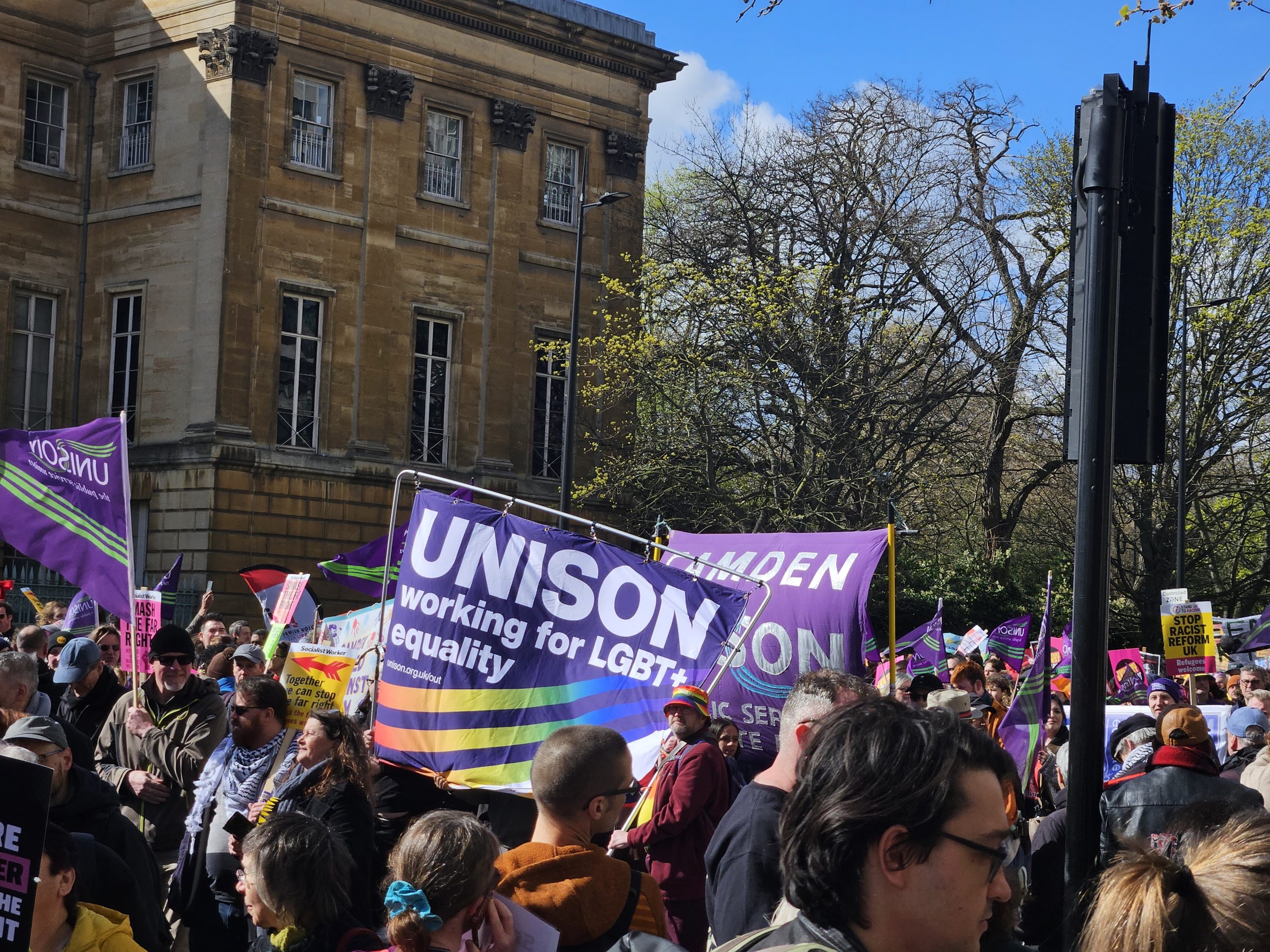
For a united campaign against attacks on trans rights, women’s rights and all workers’ rights
Statement from Socialist Party members in Unison
On 5 August 2026, the unelected Certification Officer published a decision on a complaint about the democratic nomination process for UNISON’s 2025 National Executive Council elections. This raises the question of who decides how a trade union organises – the members acting through democratic structures, or an unelected state official?
UNISON has an opportunity to blaze a trail, showing how unions can lead the united fight for LGBTQ+ rights and women’s rights as part of the struggle to defend all jobs, pay, services, and conditions from employers threatening the gains won by workers. A strong and united union campaigning to defend all its members must resist pressure to roll back equality gains.
We call on members to take action in defence of our union.
- Call on general secretary Andrea Egan to stand firm against interference in our union democracy and challenge the Certification Officer decision. Sign here to add your name: (google form)
- Share this statement and ask your branch to circulate it to all members.
- Schedule a branch discussion on the campaign for UNISON to be a fighting union on behalf of all members.
Members decide our policy
In investigating a member’s complaint, the Certification Officer did not take UNISON’s democratically established approach into account. The complaint concerned a disabled trans woman member, a young activist who was nominated by at least seven branches for a disabled women’s seat
The Officer concluded that UNISON had breached Rule D 2.6. They said that for the purposes of the Equality Act 2010, a person’s sex remains their biological sex. But UNISON’s Rule D 2.6 does not refer to the Equality Act. The union’s reserved women’s seats date from its formation in 1993, 17 years before the Act. Even in 2010, the Equality Act made no reference to ‘biological’ sex.
The Certification Officer’s decision explicitly acknowledges that “it is not to be assumed that all the terms of the contract will be found in the Rulebook alone and as such some terms may be informed by the trade union’s custom and practice”. Yet UNISON’s established practice was disregarded in the Officer’s decision. Trans women have long participated in UNISON women’s conferences and self-organised events and have stood for reserved seats. This reflected equality policy debated, tested and reaffirmed across the union’s democratic bodies which should continue to be implemented.
Unison must appeal the Certification Officer’s decision and reject attempts to override the members’ democratic decisions.
Resist division
In 2026, UNISON boycotted Labour Women’s Conference after restrictions on trans women were introduced, with a UNISON spokesperson saying: “The union has decided against sending a delegation to Labour women’s conference this year…because the party’s restrictions on access run counter to UNISON’s policy on trans equality.”
The Certification Officer is appointed by the Secretary of State on a salary of £125,000, not elected by trade-union members. Its role is a product of decades of anti-union law, including the Tories’ Trade Union Act 2016 which also introduced turnout thresholds designed to make strike action harder as shown in the recent local government ballot.
Trade unions have never accepted that every law or court ruling is fair. Workers have at times defied legal restrictions when basic rights were at stake. UNISON is proud that its union branding colours, green and purple, refer to the struggle of the suffragettes which famously included civil disobedience in the fight for women’s rights.
The Equality Act has not ended women’s inequality. The Act has specifically not prevented austerity from disproportionately impacting women both as low-paid workers and as users of public services. By contrast, collective trade union organisation has delivered concrete victories.
Defending women and defending trans and gender diverse people are not separate struggles. Trade unions can unite members. UNISON’s 2025 women’s conference reflected this approach, backing campaigns on the gender pay gap, women’s health, childcare and trans solidarity, while affirming that women’s rights are not diminished by trans people gaining rights.
There must be no stepping back from this position. The immediate challenge is to campaign to defend democratically agreed policies. The danger is that if unions retreat on their own equality policy in the face of unfair decisions and guidance, they will be less prepared to resist employers seeking to use the Supreme Court ruling to override existing equality gains unions have made in the workplace. A struggle is needed.
The union must defend its established approach and preserve unity in the face of these attacks. In UNISON, for example, ‘Black’ is an agreed political term. This may also need to be defended against interfering state representatives likely to seek further division – especially if they are not resisted now.
Accepting the Certification Officer’s decision transgresses the union’s own rules which are explicit in opposition to discrimination and inequality, including on grounds of gender and gender identity.
UNISON should not change the way it organises women’s conferences and elections. The union must see this challenge as an attempt to weaken our power in preparation for situations where employers attempt to impose divisive or discriminatory practices. Defending union unity is vital.
Union reps need support to challenge transphobic and homophobic behaviour while also fighting sexism, pregnancy discrimination, unequal pay, unsafe conditions, and cuts to services supporting women. Union organisation can allow for negotiated solutions based on the different needs of workers and service users rather than leaving decisions to management.
They will seek to use division to weaken us. We must strengthen our unity to resist all the attacks on our rights and conditions.
If you agree please, sign here