


Mira Glavardanov, Enfield and Lea Valley Socialist Party
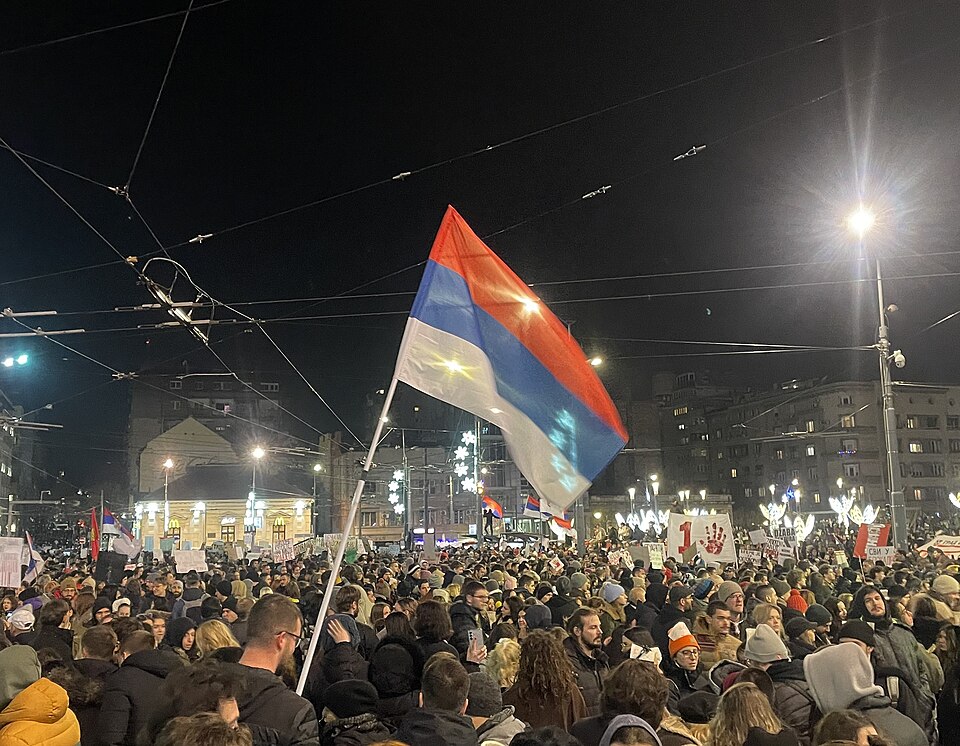
After 14 years, Serbia’s right-wing authoritarian President Aleksandar Vučić is beaten. He conceded defeat in the general election less than two hours after the close of the ballot on 25 October. This came as a surprise to many as big police contingents were gathering around the parliament building and other key centres of power in the capital Belgrade. But this time the opponent was simply too strong for Vučić to attempt to rig the vote, claim victory and use force. The opposition Student List (SL) was set up by the student movement that began exactly two years ago. The Student List won with 53% and a 14% lead.
The student movement began after the collapse of a concrete canopy at the railway station in the city of Novi Sad, in November 2024, killing 16 people. It was the consequence of dodgy contracts, shabby work and profiteering. The student protests that followed quickly became the strongest movement that the country had seen for decades. It was grassroots, democratically organised in student plenums (assemblies), where students made decisions about university blockades, organised huge protests in the cities and towns, and marched between the towns, visiting villages and talking to rural populations who otherwise had limited access to information.
Widely embraced as a hopeful and reinvigorating force, the movement began mending deep-seated wounds stemming from the post-Yugoslavia era and civil war, years marked by hardship, dashed expectations, and widespread public cynicism. Student plenums inspired neighbourhoods to also organise in assemblies, taking initiatives in local and national issues.
Vučić’s regime was badly shaken by the student protest movement but it didn’t fall. This is because the most powerful force was missing, the organised working class. Students called on workers to join them in strikes many times but, although many workers supported the students and attended protests as ordinary citizens, apart from teachers no other section of organised workers took action. This was in many cases due to fear of losing jobs, especially in the public sector where jobs were dependent on the support of the ruling clique, and due to close ties between some union leaders with the regime.
After months of mass protests, students raised the demand for an early general election. Previously, Vučić had been extremely keen on elections, calling them every year simply because he was addicted to winning (by any means), believing in his own invincibility and irreplaceability. But not this time. It took almost a year and a half before he finally called the election.
Many on the left correctly saw the danger of limiting an essentially anti-establishment movement into the framework of parliamentary politics. Once the election was called, most correctly gave support to the Student List, even if conditional.
The students have made history; never before has a grassroots student movement stood in an election and won. However, they will only continue their history-making if the electoral win results in profound systemic changes, brought about inside and outside of the parliament.
The Student List was entirely created by students but chose not to have any students as candidates on it. Of its 250 candidates. the majority are university lecturers, scientists and farmers (several known anti-lithium mining activists), and workers. The ideological mix is wide, as it is among the students themselves.
In a period of low class consciousness and general political confusion in most countries that has lasted for decades since the fall of the Berlin Wall and the ‘triumph of capitalism’, the alternative to the capitalist system is still difficult for many to see. Although that is changing, at least among youth who indicate support for some type of ‘socialism’, in many countries.
It is the same in Serbia, and this is certainly a factor determining the character of the Student List and its programme. But there are additional important factors. The Student List stood against what is seen as a corrupt regime that was enriching itself while working people are among the poorest in Europe. The regime gave away resources to foreign mining companies while bullying the local population, and advertised workers as cheap labour to foreign companies, all of which is essentially the behaviour of a government that serves foreign big capital. Any struggle to defend homes from mining, or a struggle for higher wages, is a battle against big capitalist interests, even if not seen as such at that point.
Student List programme
The programme of the Student List has many progressive commitments, such as raising all wages, including the minimum wage; limiting temporary contracts to twelve months; paid maternity leave; making strikes easier to organise, including a general strike; the protection of the environment; bans on privatisation of water and stopping further privatisations of public assets; good relations with the neighbouring countries; solidarity with all oppressed peoples, notably Palestinians (Vučić was a close Netanyahu ally and partner in the arms trade); and more.
This is to be welcomed, even though the programme of the Student List is not explicitly anti-capitalist. Any attempt to put the programme into practice will result in confrontation with big capital, foreign and domestic. It will be a learning curve. Corruption, bullying, and profiteering is part of the capitalist system that rules in most corners of the world. Vučić didn’t attempt to resist the diktat of big capital and its institutions; he acted as its manager while enriching himself and his cronies, while ruthlessly suppressing discontent.
The job of the new government will be difficult, in unravelling the extent of the corruption of the previous regime, and in implementing any progressive changes. After the students called for resignations of top figures in the police, intelligence and judiciary, the chief of police has been arrested and senior figures in state television have resigned. To form a government, the students will need to decide on a figure to act as prime minister. And, because Vučić stood down as president to stand in these elections, a presidential election is scheduled to take place before the end of this year.
Sweeping change can be achieved on the basis of mass mobilisations by the student movement and wider, and most importantly by organised workers who should now feel more confident. It will help that a miner (from a still state-owned mine whose workers were instrumental in toppling Miloševic) who opposed Vučić’s regime and who fought against the corrupt leadership of his trade union, was on the Student List list and will become an MP.
Europe-wide protests
The election in Serbia happened at the same time as students and young people are protesting all over Europe. There have been some reports of solidarity messages between them, and of exchange of ideas with the Albanian students involved in mass protests.
It is important for young people in the Balkans to realise that they all have the same enemy, which is the capitalist system itself. The example of the French students should show to both Serbians and Albanians that the system doesn’t provide good education and a decent life even in the “developed” capitalist countries.
It is still remarkable that most Serbian students never showed any pro-EU leaning; they refused to carry EU flags and distanced themselves from the pro-EU official opposition (or any other opposition). This is quite unique for a country that is not a member of the EU, where a pro-democracy movement is fighting against an authoritarian regime. The reasons are partly historical. NATO’s bombing of Serbia in the 1990s and the remaining anti-Western powers’ sentiment, and the more recent EU attempt at getting lithium from Serbia that would have resulted in horrific pollution and trampling on human rights, are all key factors explaining the attitude of most Serbs towards the EU.
The pro-EU opposition party got 0.3% of the vote. Even though this election was seen as a referendum between the students and Vučić and many people didn’t want to risk wasting their vote, this is still an incredibly low result for the pro-EU party.
It is positive that Serbian people, in general, have no illusions in the EU, which is a bosses’ club. This anti-Western capitalist mood needs to be channelled into developing a programme for a democratically managed planned economy in Serbia, to stop the exploitative foreign “investments”, renationalise the industries looted after the break-up of Yugoslavia and the disastrous restoration of capitalism.
There is a general feeling that the people have ‘got their country back’, where young people want to stay and build their lives. But under capitalism no country belongs to its people because the working class has next to no say, in a economy based on private ownership.
What next?
The student plenums that have taken place have included wide-ranging political discussions and debates. These democratic forums can continue to be used to digest the experience of the Student List government in power and to continue to determine and decide its policy.
It is important that the student movement, as well as neighbourhood assemblies, continue to self-organise beyond parliamentary politics too, to act as a strong lever on the new government, demanding pro-student, pro-farmer and pro-worker policies, and also to continue to develop as separate political forces. Genuinely independent trade unions, democratically run and combative, need to be forged.
Most importantly, a party of the working class with a strong base in workplaces, communities, universities, colleges, and schools, with bold socialist policies that can make a class appeal to small farmers and middle classes and can also appeal to the wider Balkans working class, needs to be urgently built to ensure the potential of the mass struggles are realised.
The next chapter in Serbian politics is going to be very challenging but also offering big opportunities.
