


Interview with a youth striker and organiser
Helen Pattison is the Regional Secretary of London Socialist Party. As a teenager, she walked out against the Iraq War in 2003. Since, she has been a socialist organiser helping to build for walkouts over tuition fees in 2010, against academisation, against Trump’s state visits to the UK and as part of the Fridays for our future youth climate strikes. Helen spoke to the Socialist.
When was your first walkout and what was it like?
It was against the Iraq War. I was at secondary school. I remember knowing that something that I disagreed with [the invasion of Iraq] was going to happen and that the idea was being floated of people walking out.
And I did start talking to my friends who also opposed the Iraq war about the idea of joining.
We must have been talking about it in art class, actually, because I knew my art teacher was also against the Iraq war. And she said to us that we could use some of the old art materials to make banners if we wanted. From that, we organised a lunchtime to meet up in the art department and made banners for the walkout!
I remember talking to someone in my history class during which the walkout was meant to start. It had been planned to start at a certain time of the day.
I remember being a bit nervous, thinking if were we really going to do this?
But I think the thing that made me and him decide that we really were, I remember looking over and making eye contact. Me and him sort of being like, ‘right, this is when we should stand up, we’re going to walk out of this class’.
In the backs of our minds was the horrors of the situation that was being posed with a war beginning, and thinking that we did not want to live in that kind of world. And so me and him stood up and walked out. Other people joined from my class too.
I remember really vividly that we could hear chairs scraping on the floor above, and all around the building. Other people were going to walk out with us. And so, suddenly, in the middle of a lesson, the halls were full and hundreds of us were leaving the school building!
What’s the first piece of advice that you would typically give a young person getting in touch with you for help organising a walkout?
I think the thing that I say to everyone is there’s always more people than you think who are angry at the situation and therefore the job is to find them.
People say to me something like: ‘I’m angry about this, but no one else in my school is angry about it.’
From my experience, usually hundreds of other students are angry too. It might be you’re the only person that you know of. But that’s the thing, there’ll always be more, you’ve just not met them yet!
So, for example, preparing for one of the N20 walkouts in a North London school, we’re leafleting for a meet up on 6 November, ahead of the walkout taking place.
We’re advertising it to people to say: ‘if you’re interested in helping or being involved, come along. Come to the square and meet with us so that we can organise together’.
What other things can people do to prepare ahead of the day itself, have you got any examples of things that have worked in the past?
Banner making is a good one. I think the first step is an organising meeting. Meet other people who are interested in doing it. But then, definitely a banner making session.
It’s a little bit of fun, and it is also an opportunity to talk politically with people, to discuss what the walkout is about and why they want to be involved.
In the past, students from different schools have made banners with their school’s name on to kind of represent themselves when they go on to take part in a bigger rally. You can march behind your banner on the day!
I remember when we were opposing academisation of a school in South London, the students organised a ballot. We just got a box that we, you know, put vote on, taped it up and had voting sheets asking: ‘Do you want your school to become an academy or not?’
The headteacher had done an assembly to tell everyone why they thought the school should become an academy. This was an opportunity for the students themselves to say what they thought about the future of their school, rather than just being lectured.
It was an opportunity to show that actually the students did understand what becoming an academy meant and they didn’t want it.
When the walkout took place, students had confidence that the majority supported the cause.
On the day itself, when you turn up at school or college ready for the walkout, what is the number one thing to remember to do to be prepared?
I think definitely can get your hands on a megaphone. That way you can keep people together. I think meeting at the school is a good idea. It’s like when workers on strike picket a workplace, it’s because they want to persuade other workers to join them.
It can be scary, but mostly its exciting. The point is, you want to make sure that people know it’s today and that we are actually doing this. You can use the megaphone to remind people what we’re doing and show that we’re doing it collectively. That there is a group of us is doing it all together.
After that, it’s good to have a plan of what you’re going to do. Are you going to have a rally in your high street and then make it make your way to a city centre protest? Are you going to march to other schools or colleges to encourage them to join?
At every stage, the megaphone can be used to give the opportunity to people to say why they’ve walked out. It’s a collective movement, but people will be motivated and angry for lots of different reasons.
There will be some people who are planning their walkouts, but are also a little bit worried about repercussions from teachers or the school telling them that they shouldn’t be taking part. What would you say about how that can be overcome?
First, one of the arguments we do get told is that ‘school is too important to miss’. But that’s why we’re protesting! We’re fighting for properly resourced schools, a decent future, and it’s necessary to take this action.
The best way to prevent repercussions is to do things collectively. So doing some of the preparatory stuff is the first defence, including talking to teachers now, explaining that the biggest trade union for teachers – the National Education Union (NEU) – has given the day its backing. The NEU has said that it doesn’t think that students who walk out should be punished.
But also, again, going back to the example of the anti-academy walkout, it was the student leaders who were targeted by the headteacher. So we publicised when one of the student leaders was taken into the headteacher’s office and told off, and we had a collective response. The students had a sit-down protest.
20 November is the big day, but if anyone who takes part is picked on, then the protests will continue to defend them!
Is there anything you can think of you would like to add?
Well, today I’ve been helping students organise at Imperial College London. We’ve been told by one student we have met that they were already planning to join. We have met one student from Thailand who has been telling us about the protests she has been involved in there.
This really is a movement representing generational anger about a system that does not meet our needs. It’s going to be a really important day of strikes and protests that we’re part of in the UK – but also all around Europe and all around the world too!
When Britain’s youth have walked out
1985 school strikes against Thatcher’s YTS
The first big strikes took place in Glasgow, organised by the Labour Party Young Socialists with Militant (the Socialist Party’s predecessor in the lead). “A general strike swept through Clydeside schools, bringing 20,000 pupils out… They gave Thatcher a defiant message – “We’re not having YTS job conscription” (Militant). The Glasgow Daily Record described it as the “biggest show of pupil power ever in Britain”.
From there, a School Students’ Action Committee was formed to call a national school strike. ‘A quarter of a million school students have given a crushing answer to the Tories’.
2003 Iraq War Day X
In the run-up to the invasion of Iraq in March 2003 mass protests swept the world including in Britain. Socialist Party members played a leading role organising youth walkouts on ‘Day X’, the day the invasion began. Even before the day, school walkouts were breaking out.
On the day, in Waltham Forest, east London, ‘It all started at 8.45 when 200 school students from Kelmscott School walked out… Not long after they were joined by a similar number from Walthamstow Girls School… Together they marched chanting and shouting from school to school in the borough.’ Similarly events like these took place nationwide. Internationally, millions protested.
2010 student movement
In Autumn 2010, Britain was swept by protests. Towards the end of November and December, student protests, walkouts and occupations were taking place several days a week in different locations. For example, in London on 24 November: “From 11am waves of chanting, angry and determined students poured into Trafalgar Square. Some in school uniforms, many carrying homemade placards, they were all clear: ‘These cuts are unfair and we will fight them’.”
Climate strikes 2018-19
On 15 March 2018, in 1,000 cities and 100 countries, millions went on strike and demonstrated against the huge threat to the environment and human populations posed by rapid climate change. This was the second of monthly school student protests, with Greta Thunberg as a key figure.
Walkout against Trump 2025 (and 2018)
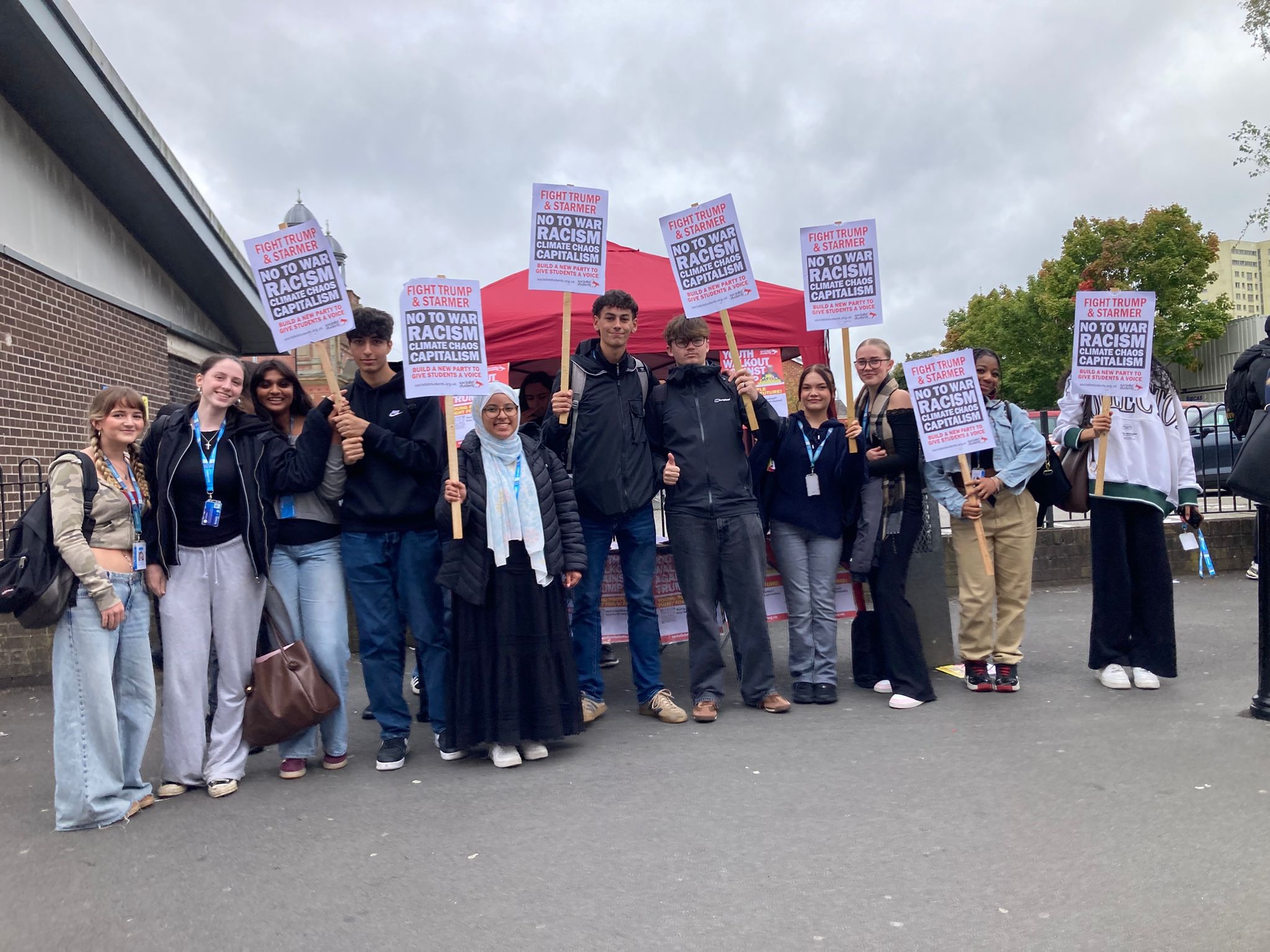
Hundreds of school and college students walked out to protest Donald Trump’s state visit to the UK on 17 September 2025, organised by Socialist Students.
In 2018, school students at a number of schools in London responded to the call of Socialist Students and Young Socialists to protest – and walk out. There were walkouts and protests in Southampton, Leicester, Birmingham, Leeds, Hull and beyond.
