


Marco Tesei, UCU NEC member, personal capacity
The National Executive Committee (NEC) of the University and College Union (UCU) met on Friday 7 November. It had not met since 19 June.
In the interim, the crisis engulfing post-16 education has remained unchanged, despite the arrival of a new Labour prime minister promising radical change. Dozens of universities are either facing or at risk of insolvency, thousands of jobs and courses are being axed, and vital support services, pastoral care and campus facilities are being slashed. In short, both higher and further education institutions (HE and FE) are suffering the combined effects of chronic government underfunding and the ‘wild west’ of corporate, profit-driven decision-making.
Meanwhile, also, the number of young people not in education, employment or training (NEETS) – around 1 million – has not come down. The number of apprenticeships available to college students has continued to fall. The bleak prospect of 40 years of university loan debt for students remains as dark as ever.
It is already very clear. Burnham has no answers to the crisis in post-16 education. Moreover, his regional devolution plans now cast more fears than hopes over further and adult education. Industrially, will they land us in legal quagmires that make collective bargaining even harder than it is already?
Serious discussion and decision-making around these issues, and the kind of fightback needed, should have characterised last Friday’s NEC meeting, especially given the strong appetite for a determined response among both HE and FE UCU members.
At both sector conferences members have consistently voted for a coordinated, sector-wide fightback. Instead, they have faced determined efforts to evade implementing those decisions by Jo Grady’s supporters in both sector committees, including by members of the ‘UCU Commons’ grouping.
In FE, delegates at their sector conference in May voted for an aggregated strike ballot to win binding national bargaining and pay parity with schoolteachers. In HE, delegates at the counterpart conference voted for nationally coordinated strike action to stop the swingeing job cuts, alongside opening a dispute directly with the Secretary of State for Education.
Angered by the refusal of the HE Committee to implement HE conference decisions for a national fightback, local branches requisitioned a Special Higher Education Sector Conference (SHESC) three weeks ago so the grassroots could thrash out dispute proposals.
An aggregated ballot of FE England colleges and adult education institutions – called for in a motion moved by a Socialist Party member, and the very first in FE in UCU’s 20-year history – is now about to be launched. This is happening despite efforts of the FE Committee majority and the general secretary, and also UCU’s top unelected FE official, to undermine the membership’s decision.
As for the university workers’ SHESC, delegates reiterated their wish to take on the Secretary of State for Education, the ultimate culprit for the crisis. Post-16 education may be in crisis, but UCU members’ determination most definitely is not! Look also at the dozens of university branches currently in dispute or facing vicious attacks – like Goldsmiths, Brighton, and Nottingham – where members are putting up valiant resistance.
Unfortunately, instead of harnessing members’ fighting energy to take policy forward and unify all our battles into a single bold strategy, the overstuffed agenda at the NEC meeting did everything it could to avoid discussing the most urgent issues. Changes to UCU’s standing orders and to the disciplinary procedure for members were given priority over a discussion about the fighting fund, which the president (a Grady ally) cut short before it could reach a satisfactory conclusion.
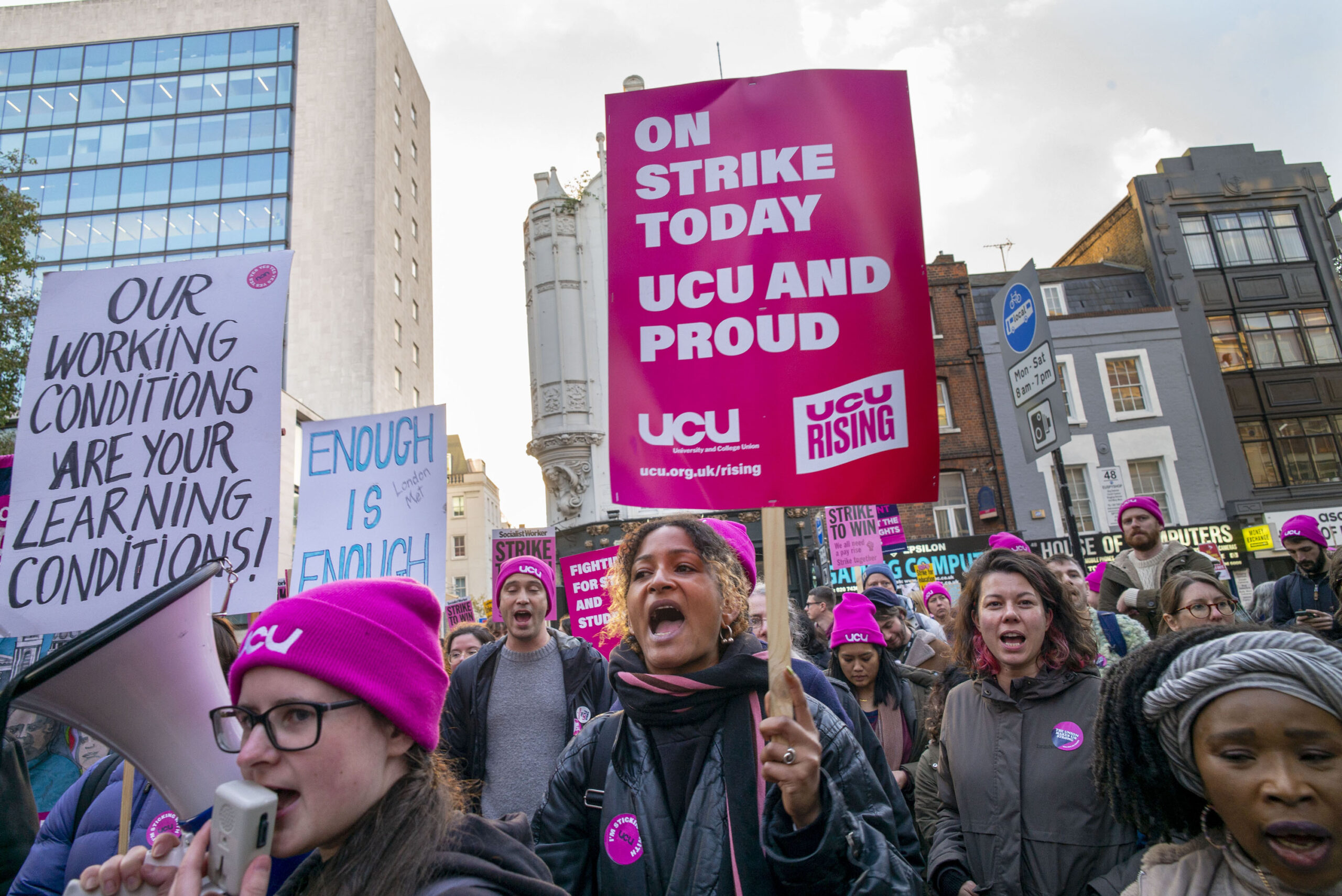
The International Youth Strike and UCU’s own day of action on 20 November, surely of importance in promoting post-16 education’s revolt against austerity and war, were relegated to a brief mention in the general secretary’s report and a single, brief contribution from an NEC member.
Two motions submitted by Socialist Party NEC members – one instructing the general secretary to pressure the TUC to implement PCS Congress Motion 34 for a Saturday demonstration against austerity, the other promoting maximum coordination with and support for students on 20 November – remained unheard, as motions were relegated to the final agenda item.
In the general secretary’s Q&A session, one NEC member’s request to give a short first-hand report on the 5 November French protests, and on students’ inspirational role in them, was rejected by the president on the grounds of the long agenda. Fortunately, Jo Grady’s personal intervention at the end of questions reversed this decision and, for a brief moment, the mass strikes currently raging across Europe – with students and educators to the fore – got a platform. Yet the massive working-class eruptions across Europe, which are so inspirational for our own workers’ and youth movements, remained only a faint rumble in the background throughout the day’s proceedings.
UCU members are faced with a vicious struggle against austerity and the devastation of the sector, and must fight also to apply pressure to a union leadership that wants to avoid a confrontation with Burnham’s government.
It is clear that in the upcoming National Executive Committee (NEC) elections we need to elect a fighting leadership that will back members in action.
Even in FE, where we are on the verge of a national ballot, it has been the work of fighting reps – with Socialist Party members to the fore – which has doggedly got us to this point. As reps, our cross-branch networks must work to overcome excuses the leadership may seize upon to ensure as many branches stay in the ballot as possible.
In HE, Socialist Party members in UCU will continue to argue for a sector-wide struggle. Local branches cannot sustain the onslaught of job cuts indefinitely. Only a collective fightback can hope to reverse the tide and bring the government to heel.
Last but definitely not least, we have 20 November. On this day, thousands of university, college and school students could take to the streets in protest, inspired also by the role their counterparts have been playing across Europe. This must be a true ‘day of action’ for UCU too, helping student events and protests, and adding our own voices to the chorus of ‘Fight for our future, not their wars’.
