

Vote Socialist |
|
| Vote Socialist: because nobody pulls our strings |
TONY BLAIR has finally called the election. Socialist Party candidates
will present a positive socialist alternative to counter the same old
cynical pro-big business policies of Labour, Tories and Liberals.
Socialist candidates promise to fight to reverse the disastrous privatisation of rail and the proposed privatisation of London Underground. And they will reverse the 4% a year increased taxation Labour has imposed through stealth taxes. |
| Get Tough On The Nazis |
Leicester, Oldham, Bermondsey...Get Tough On The Nazis! NEW
LABOUR and the Tories are competing with each other to be 'tough on crime'
and 'tough on asylum-seekers'. New Labour have continued the Tory policies
on asylum and immigration, law and order and attacks on jobs and living
standards.
Some Tories have crawled out of the racist woodwork in the run-up to the general election, giving fascist organisations like the National Front and the British National Party encouragement to venture out into the streets. SIMON, from south London, explains how the fascists are being countered as they attempt to organise another march in Bermondsey |
| An alternative to the lesser of two evils |
BOOKMAKERS PUT Labour as high as 40-1 on to win the forthcoming general
election. Polls estimate Labour could get a majority of over 200 on the
current projections of how people will vote.
New Labour, it seems, can sit back till 7 June waiting for victory to fall into their laps. The current joke in Labour's inner circles is that their anticipated victory is all down to the efforts of one man - Billy 'Bandwagon' Hague. |
| Son of Star Wars | Stepping up the nuclear arms race: ANTI-NUCLEAR protesters and millions of working-class people will oppose George Bush's new defence strategy, based on the National Missile Defence system (NMD - dubbed 'Son of Star Wars'). By Chris Newby. Some government heads also oppose it. They fear that George W "Dysfunctional" Bush could rekindle the nuclear arms race. |
| May Day 2001: Detained but defiant | THE MONOPOLY board game was the theme of London's May Day protests. Cyclists met at King's Cross opposing the private rail companies and demanding decent public transport. In the Strand, Coutts Bank - whose clients include the Queen - was the focus for protests against the banking industry. Cardboard hotels were erected on Park Lane to draw attention to homelessness. By Manny Thain |
| YSA: Challenging capitalism, challenging the state | YOUNG SOCIALIST Action (YSA) played a significant role in this year's anti-capitalist May Day protests in London. By Zena Awad and Kieran Roberts. Not only did they oppose capitalism but also put forward a clear socialist alternative to the profit-driven system which young people want to abolish. |
| Tory pre-election blues | THE TORY Party is in disarray. The party's right-wing racist policies are showing up leader William Hague as a desperate politician who'll plumb any depths to win votes - but very unsuccessfully! A month before a general election is probably due, some opinion polls predict that the Tories could face their worst showing since 1832. By ROBIN CLAPP |
| A merging of forces beneficial to the working class? | ON 1 May the membership of the Socialist Workers Party (SWP) in Scotland wound up its separate organisation and became part of the Scottish Socialist Party (SSP). PHILLIP STOTT, of the International Socialists [the Marxist wing of the SSP and the Scottish section of the Committee for a Workers' International (CWI)] explains how they argued that such a move, without resolving major political differences between the SWP and SSP, would lead to a weakening rather than a strengthening of the SSP. |
| Philippines - People Power III? | DAYS OF angry street demonstrations in the Philippines capital Manila culminated in an attack on the presidential palace in the early hours of 1 May. After seven hours of battles with the police using teargas, water cannon and live ammunition, four people were dead, over 100 injured and hundreds more arrested. By Clare Doyle |
The Socialist 11 May 2001 [Top] [Home] [News] [The Socialist]Join the Socialist Party To get the full story subscribe to The Socialist
Vote Socialist
...because nobody pulls our strings
TONY BLAIR has finally called the election. Socialist Party candidates will present a positive socialist alternative to counter the same old cynical pro-big business policies of Labour, Tories and Liberals.
Socialist candidates promise to fight to reverse the disastrous privatisation of rail and the proposed privatisation of London Underground. And they will reverse the 4% a year increased taxation Labour has imposed through stealth taxes.
Socialists will ensure that money is taken from big business and the wealthy to pay for more teachers and other public-sector workers, reducing their working hours and increase their pay. A socialist alternative means ending the growing wealth gap and eradicating the poverty stemming from it.
Socialists will introduce a £7 an hour minimum wage and build new social housing for workers in London and throughout Britain. We will urgently provide proper investment into public services - not the privatisation "get rich quick for fat cats" schemes.
Socialists will fight the jobs massacre being carried out and argue that any firm threatening redundancies should be taken into public ownership and run under democratic workers' control and management.
But despite Labour's rhetoric about realising that "Labour has not done everything people want" and fighting the election as "if it was on a knife edge", Labour will complacently continue its pro-big business policies.
But at this election a working-class alternative will be provided by Socialist Party members and nearly 200 other socialist candidates who will not be doing the bidding of big business but defending the interests of working-class people. We will not have big business pulling our strings.
Socialist Party members will campaign to reverse the disastrous Thatcherite, pro-big business policies of both Labour and the Tories before them and shift the balance of wealth and power in favour of working-class people.
If you want to end Labour and Tory cynicism, apathy and sleaze then vote Socialist.
Go to our Election Campaign pages
The Socialist 11 May 2001 [Top] [Home] [News] [The Socialist]
Join the Socialist Party To get the full story subscribe to The Socialist
Leicester, Oldham, Bermondsey...
Get Tough On The Nazis
NEW LABOUR and the Tories are competing with each other to be 'tough on crime' and 'tough on asylum-seekers'. New Labour have continued the Tory policies on asylum and immigration, law and order and attacks on jobs and living standards.
Some Tories have crawled out of the racist woodwork in the run-up to the general election, giving fascist organisations like the National Front and the British National Party encouragement to venture out into the streets.
SIMON, from south London, explains how the fascists are being countered as they attempt to organise another march in Bermondsey:
EXCELLENT WORK is being carried out in Bermondsey and Surrey Quays by the Socialist Party and Youth Against Racism in Europe (YRE).
The National Front (NF) are planning to march for a third time in this part of south London on 12 May, despite widespread and growing opposition from the local community.
A former racist housing policy has meant that Bermondsey is a predominantly white working-class area. The collapse of the thriving dock industry, high unemployment and decades of under-investment has led to poor housing and other facilities.
People are also worried about crime and the development of other social problems. Against this background, the NF hope to find a sympathetic ear amongst the disillusioned working-class.
But the Socialist Party and YRE have been campaigning, talking to local people and putting forward a socialist solution to the neglect of the area and an alternative to the fascists' ideas.
The vast majority of people are opposed to the NF and its planned march.
Many people understandably thought the march should be banned, so we explained that any ban by the police or the council could also be used against working-class people campaigning on other important issues like job losses, privatisation, school closures and cuts in services.
We argued that only organising and mobilising the local community onto the streets to confront the fascists would prevent them from marching.
We pointed to the success in Welling in 1993, when the mobilisation of 50,000 people led to the closure of the BNP headquarters.
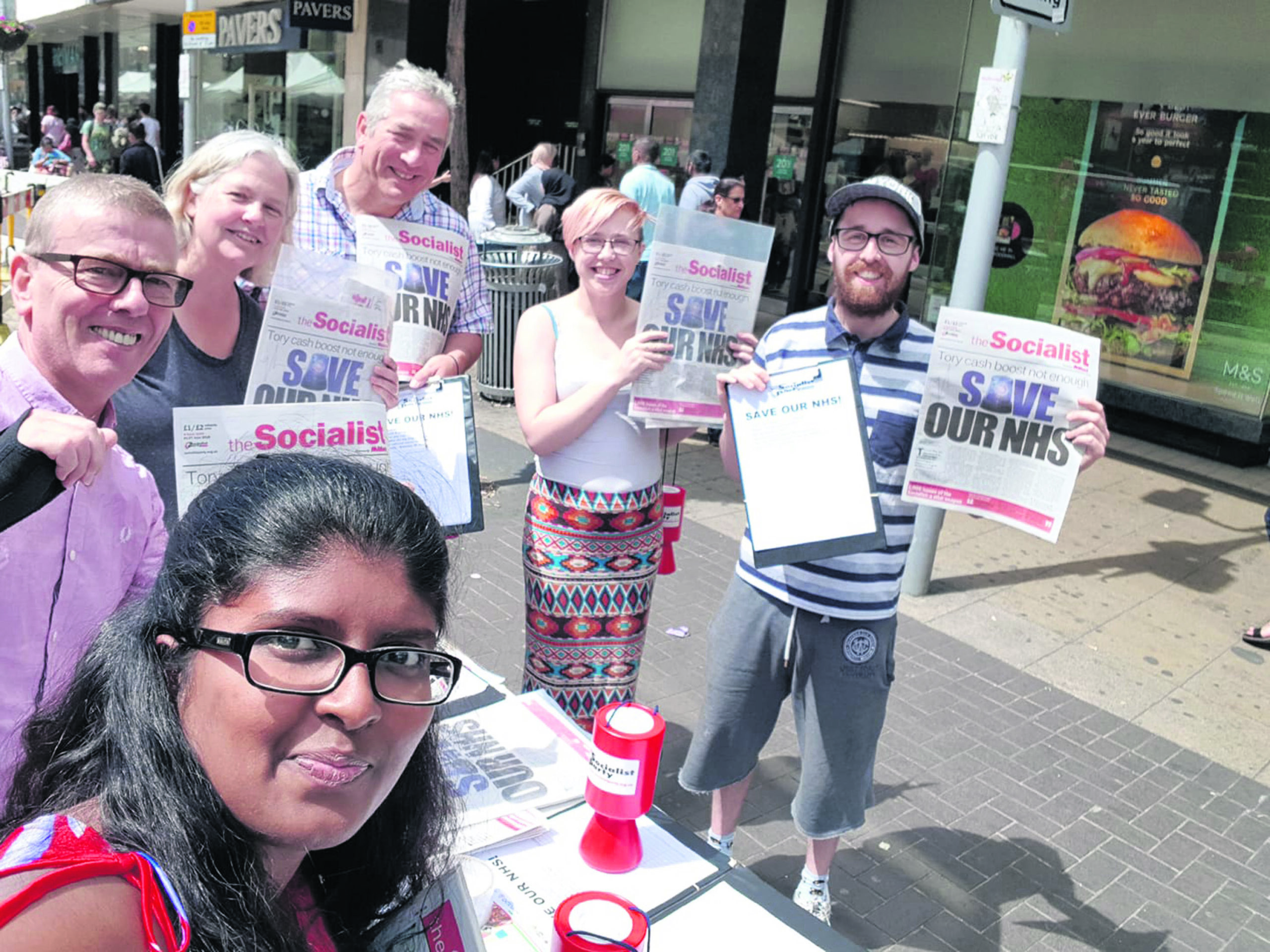
The people of Bermondsey are clearly open to socialist ideas. This was shown when, on one afternoon recently, four Socialist Party members set up a stall, sold 39 papers and collected over £30 in fighting fund in just 1 1/2 hours.
We also collected many names of people interested in joining the Socialist Party.
- Don't rely on police bans - only mass action will stop the Nazis from marching.
- Scrap the Asylum and Immigration Act and all other racist laws.
- End discrimination on the grounds of race, sex, sexuality, disability and all forms of prejudice.
- For a socialist society and economy run to meet the needs of all.
The Socialist 11 May 2001 [Top] [Home] [News] [The Socialist]
Join the Socialist Party To get the full story subscribe to The Socialist
An alternative to the lesser of two evils
BOOKMAKERS PUT Labour as high as 40-1 on to win the forthcoming general election. Polls estimate Labour could get a majority of over 200 on the current projections of how people will vote.
New Labour, it seems, can sit back till 7 June waiting for victory to fall into their laps.
The current joke in Labour's inner circles is that their anticipated victory is all down to the efforts of one man - Billy 'Bandwagon' Hague.
If Labour is so assured of victory, why then does it also seem so defensive and panic stricken? Labour's talk about needing to mobilise apathetic voters, ending cynicism and complacency etc and fighting the election "as if it were on a knife edge" does not reflect a party at ease with itself.
When you go beyond the headline figures of recent opinion polls, a disturbing picture emerges for both Blair and New Labour.
A recent Mori poll warned that this election could see a turnout of 60%-65% - lower than even in the previous lowest turnout, the post-war 1918 election. The same poll also said that Blair has a lower personal rating than the disastrous Neil Kinnock had in 1992 and has the same negative rating as Major in 1997.
Mori comments: "For the first time in four elections both the prime minister and the leader of the opposition are viewed negatively by the British public."
Yet, despite all this Labour are likely to win because they will be seen as the "lesser of two evils" over the Tories.
But, as Ralph Nader said in the US presidential election the choice of the lesser of two evils means you still end up with evil. Though many workers still fear a return of the Tories, seeing them as worse than Labour.
Although both parties are now capitalist parties, there is a difference between Labour and the Tories in the same way as there is a difference between a liberal and right-wing capitalist party.
But such issues are subordinate to the need for the working class to take a step towards creating a genuine new mass working-class party to represent their interests.
Cosmetic plans
PEOPLE INCREASINGLY see through Labour's plans on education, health, rail etc as cosmetic ones which don't bring any improvement.
Who can trust a government where officials knew of the failings that led to the Hatfield rail disaster two years in advance but did nothing? Voters' perception is that Britain is rapidly going down the pan.
They feel the economic outlook is now gloomier than at any previous time in the last four years. In a move that is not out of synch with Labour's authoritarian streak, Blair talks of ten-year plans to reform and invest in the public sector.
But the experience of many public-sector workers of the first four years of New Labour will be enough is enough.
Former Labour deputy leader Hattersley bemoans the fact that Labour may have an even larger majority and believes they need a 'small' majority of only 50 to make then become a radical government.
But it is not the size of Labour's majority or the ineffectiveness of the disastrous, flatlining Tories that decides Labour's agenda. It has been its pursuit and continuation of Thatcherite, policies to undermine working-class living standards for the benefit of the capitalist class that means Labour will not be 'radical'. For working-class people this election will be a chance to look at what needs to be built to challenge New Labour beyond 7 June.
There will be hundreds of socialist candidates challenging Labour at this election, of which Socialist Party candidates will advance the clearest programme.
Building a creditable vote for those candidates could show that a longer term new mass working-class opposition can be built to put forward a socialist alternative for the benefit of working-class people.
The Socialist 11 May 2001 [Top] [Home] [News] [The Socialist]Join the Socialist Party To get the full story subscribe to The Socialist
Son of Star Wars
Stepping up the nuclear arms race
ANTI-NUCLEAR protesters and millions of working-class people will oppose George Bush's new defence strategy, based on the National Missile Defence system (NMD - dubbed 'Son of Star Wars').
Chris Newby
Some government heads also oppose it. They fear that George W "Dysfunctional" Bush could rekindle the nuclear arms race.
Last summer, under Clinton's administration, the government's top analyst on missile proliferation said that NMD would set off "an unsettling series of political and military ripple effects... including a sharp build-up of strategic and medium-range nuclear missiles by China, India and Pakistan and the further spread of military technology in the Middle East".
This new initiative (estimated cost $240 billion) will virtually double US defence spending, delighting the US defence industry.
The top four missile contractors have given more than $7 million in donations and contributions since 1997 to key members of Congress, and spent an estimated $18 million on lobbying.
Bush's defence secretary Donald Rumsfeld has close links with missile defence contractors. He's an adviser for the Centre for Security Policy (centre of the Star Wars lobby).
NMD is unreliable as well as expensive. It's failed two of its previous three intercept tests. The system at this stage will combine satellite warning systems with ground or sea-based interceptor missiles. The technology doesn't yet exist to destroy missiles from space and probably won't do so for at least eight years.
Bush also wants to tear up decades-old arms treaties, claiming that the main threat now comes from such states as Iran, Iraq or North Korea, not Russia and China.
A 1998 US congressional report said that within five years North Korea and Iran could acquire a ballistic missile capable of reaching the USA. A key person on this panel was Donald Rumsfeld - coincidence?
Meanwhile Bush has slashed hundreds of millions of dollars of aid to nuclear safety projects in Russia, which try to secure nuclear stockpiles against theft and retrain Russian nuclear scientists.
Bush claims that NMD is a defensive strategy but if it can neutralise other states' nuclear weapons, this allows free rein for the US's own offensive capability. Other states, notably China, seem to view it in this light and talk of increasing their nuclear arsenal as a result.
The NMD project will involve upgrading Fylingdales early warning system in Yorkshire (at a cost of billions). Is New Labour's recent support based on promises of lucrative defence contracts as well as its slavish support for US imperialism?
Wasted resources
Even if NMD was stopped, working class people can have no faith in nuclear arms agreements between capitalist governments which regularly support repression of workers' rights and living conditions.
The Socialist Party condemns all such spending as a huge waste of resources that could otherwise be used to develop the living conditions of everyone on this planet.
A socialist society would turn the skills of all workers and scientists in the defence industry to socially useful projects such as new developments in healthcare.
The Socialist 11 May 2001 [Top] [Home] [News] [The Socialist]
Join the Socialist Party To get the full story subscribe to The Socialist
May Day 2001: Detained but defiant
THE MONOPOLY board game was the theme of London's May Day protests. Cyclists met at King's Cross opposing the private rail companies and demanding decent public transport.
Manny Thain
In the Strand, Coutts Bank - whose clients include the Queen - was the focus for protests against the banking industry. Cardboard hotels were erected on Park Lane to draw attention to homelessness.
Overall, around 10,000 people participated. Predictably, the media focused on scenes of violent confrontation which, in reality, were few and far between. The vast majority were there to oppose the capitalist system's wrecking of the planet.
Ranged against us were masked and heavily tooled-up aggressors in uniform - at least 6,000 according to press reports. The police had widely publicised their strategy - zero tolerance. Baton rounds (plastic bullets), gas and even sniper units were reportedly on standby.
The New Labour government, London Mayor, Ken Livingstone, and the police claim the state's brute-force tactics were a success.
But these events will further undermine already discredited establishment politicians and their system. 'Red Ken' spent May Day under the protection of the Special Branch and only ventured out in a chauffeur driven Jaguar.
Police cordon
The World Bank HQ in New Zealand House, Haymarket, was the focus of protests against Third-World poverty. Protesters waved dollar signs daubed with red paint.
Socialist Party members distributed fat-cat $100 bills advertising Young Socialist Action meetings. The predominantly young crowd enthusiastically discussed how to take the movement forward and the socialist alternative to capitalism.
Around 2pm, the protest marched down Regent Street towards Oxford Circus, and into a Metropolitan Police trap. A public address system had been set up on the roofs of buildings. Journalists were installed in first floor windows - perfect for photos of violent and riotous behaviour.
The tube station was blocked off and out of reach. We were surrounded by police.
This containment policy was outrageous. Outside on a cold, rainy day, there was no access to water, food, toilet facilities or welfare provision. The mood was angry but remarkably peaceful.
A monotonous police announcement was regularly transmitted: "You are being held to prevent a breach of the peace and damage to property." An admission that no peace had been breached, no damage done.
Under these adverse conditions, the Socialist Party's experience of leading mass movements - such as Liverpool city council's struggle in the 1980s, the anti-poll tax movement and anti-fascist campaigns - was crucial.
Illegal detention
Lois Austin played an outstanding role. She phoned Socialist Party councillor Dave Nellist and Tony Benn, MP, to alert them to the situation. The Socialist Party office sent out press releases.
We relayed news back to our fellow detainees, spreading the word that we were not alone.
We received advice that this was an illegal detention. The chanting increased: "We Are Being Illegally Detained"; "We Want Out"; "Arrest The Police".
Lois led a delegation to the police demanding our release. At around 9pm the police opened up an exit on the north side, allowing people to leave one-by-one - photographing and searching protesters as they went.
It took over an hour to clear the area. Socialist Party members walked through as a united contingent.
Many people congratulated Lois on the great work she had done: "You're the most organised group," was a common theme expressed. This was from people who participate in a movement which prides itself on its anti-organisation/leadership stance.
More and more people are seeing the need for organisation. We have to promote this idea, explaining the democratic deficiencies of networking movements: and to counterpose the need for a mass, democratically organised and accountable movement and leadership.
It would be wrong to tailend the movement by regurgitating basic anti-globalisation demands. Slogans are vital in attracting people to our banner. But many, especially young people, want a lot more.
They have a burning hatred of this system and are looking for ideas and programme with which to defeat capitalism. The Socialist Party clearly promotes the only viable alternative - socialism.
The Socialist 11 May 2001 [Top] [Home] [News] [The Socialist]
Join the Socialist Party To get the full story subscribe to The Socialist
YSA: Challenging capitalism, challenging the state
YOUNG SOCIALIST Action (YSA) played a significant role in this year's anti-capitalist May Day protests in London.
Zena Awad and Kieran Roberts
Not only did they oppose capitalism but also put forward a clear socialist alternative to the profit-driven system which young people want to abolish.
Such an intervention was crucial as a mood is growing toward socialist ideas. This was demonstrated by many young people taking our leaflets, buying all kinds of material from us and signing up for more information, or joining us.
YSA then held a highly successful meeting a day after the protests, under the title 'Opposing Capitalism, building the Socialist Alternative.'
Despite the fact many were still recovering from the previous day's ordeal in Oxford Circus, 35 people turned up to hear speakers from the YSA, Socialist Party and Committee for a Workers International (CWI - the international which the Socialist Party is part of).
Lois Austin spoke first about the need to build a socialist alternative and the need for May Day protesters to link up with workers to change society.
She also talked about the police's outrageous tactics around Oxford Circus when they blocked in 4,000 protesters for over seven hours. Not only was this a blatant infringement of the protesters' rights, we believe it was also unlawful.
We do not believe that the police should get away with this unchallenged. That is why we are organising a civil action against the police for unlawful detainment.
A barrister spoke at the meeting detailing the legal position. He is willing to represent a mass action by people encircled in Oxford Circus.
We also have the details of many who want to be part of a case against the police. If you know about what happened to them please give statements to YSA.
Vanessa Fatton, from Socialist Alternative, the US section of the CWI spoke about the growth of radical movements and anti-capitalism in the US in the last couple of years.
Clare Doyle spoke from the CWI about some of the different May Day events CWI sections around the world were involved in.
She also described the Quebec protests, in which she participated, and the police's brutal response to the protesters there.
The meeting highlighted the growth of an anti-capitalist consciousness and a determination by many young people to build an alternative to capitalism.
The Socialist 11 May 2001 [Top] [Home] [News] [The Socialist]
Join the Socialist Party To get the full story subscribe to The Socialist
A merging of forces beneficial to the working class?
ON 1 May the membership of the Socialist Workers Party (SWP) in Scotland wound up its separate organisation and became part of the Scottish Socialist Party (SSP).
PHILLIP STOTT, of the International Socialists, the Marxist wing of the SSP and the Scottish section of the Committee for a Workers' International (CWI), explains how they argued that such a move, without resolving major political differences between the SWP and SSP, would lead to a weakening rather than a strengthening of the SSP.
THE INTERNATIONAL Socialists would welcome such a development if it represented a genuine change in the past methods and approach of the SWP.
There is, however, no evidence of this. On the contrary, while the signpost under which they are operating may be changing the methods of the SWP show no signs of doing so.
We argued that there should be a period of joint collaboration and discussion between the two parties prior to the SWP joining.
This was rejected by the SSP leadership, some of whom were former members of the CWI and who had played a role in the past in helping to build a serious Marxist force in Scotland, which brought us into collision with the SWP on every decisive question.
The SSP leadership have the attitude that the SWP involvement will automatically strengthen the SSP.
U-turn
THE ENTRY of the SWP into the SSP comes as part of an abrupt change in the orientation of the SWP after decades of refusing to participate with other Left forces.
We recognise the potential benefits of uniting the Left in a broad socialist party like the SSP.
At the same time the programme, methods and approach of the different forces that make up such a party are of decisive importance.
For years the SWP refused to participate in elections and castigated socialists who did as "electoralist" and "reformist".
This criticism was primarily aimed at the CWI who as Militant, Scottish Militant Labour and Socialist Party in England and Wales and Ireland, have the most successful track record of any party on the Left in election work.
The SWP refused to take part in the Socialist Alliances when they were first established in Scotland, England and Wales.
They executed a U-turn in the run up to the London Assembly elections in 2000. But this was accompanied by an attempt to undemocratically dominate the alliances.
For example, the SWP backed a motion to ban the selling of socialist newspapers on public activities of the London Socialist Alliance (LSA) during the London Assembly elections that the LSA stood in.
In Scotland, the SWP have accepted the "guidelines" drawn up by the SSP executive that insist that no platform should sell its publications in public other than the official SSP paper.
We insist on our right to make our ideas available to the working class and the youth.
The SWP campaigns and front organisations, such as the Anti-Nazi League and the current Globalise Resistance campaign, lack genuine democratic structures.
Model campaign
COMPARE THIS to the approach of the CWI (then Militant) who established the anti-poll tax unions - a model of democratic involvement and policy making decisions by the membership.
The SWP interventions in strikes and workers' struggles has earned them a bad reputation, including in the Timex strike, for "band wagon jumping", ie identifying a popular issue but refusing to see it through to the end.
During the poll tax struggle when 14 million people in Britain were not paying the poll tax the SWP opposed mass non-payment.
The SWP's action programme which demands "tax the rich", without calling for the nationalisation of the major sectors of the economy, is a concession to Left reformism. The SWP's involvement into the SSP can reinforce the reformist programme of the SSP.
The SWP therefore will not automatically strengthen the SSP. The CWI will continue to fight for the SSP to adopt a Marxist programme and approach.
The involvement of the SWP however, will mean we will be counterposing our programme to the SWP, as well as to the current SSP leadership.
This is an edited version of an article which appeared in International Socialist, the paper of the CWI, Scotland.
Details PO Box 6773, Dundee DD1, e-mail cwi@cableinet.co.uk. Tel 01382 833 759
Socialists airbrushed out
WRITING IN the 'communist' Morning Star (3 May), Scottish Socialist Party MSP Tommy Sheridan said: "We launched the Scottish Socialist Alliance five years ago, which was made up of members and organisations from the Labour Party, the Communist Party, the environmental movement, the socialist movement and individual socialists."
This version of history airbrushes out the pivotal role of Scottish Militant Labour (the former CWI section in Scotland) in establishing the Scottish Socialist Alliance, the precursor of the SSP.
The Socialist 11 May 2001 [Top] [Home] [News] [The Socialist]
Join the Socialist Party To get the full story subscribe to The Socialist
Philippines - People Power III?
DAYS OF angry street demonstrations in the Philippines capital Manila culminated in an attack on the presidential palace in the early hours of 1 May.
Clare Doyle
After seven hours of battles with the police using teargas, water cannon and live ammunition, four people were dead, over 100 injured and hundreds more arrested.
A state of rebellion - "two steps away from martial law" - was declared by the president, Gloria Macapagal Arroyo. A little over three months earlier, on 20 January, she had been sworn in to her post in a highly 'unconstitutional' ceremony on the streets of the capital after days of mass demonstrations called 'People Power ll'. (See CWI pamphlet, January 2001).
It was the arrest of former President Joseph Estrada on April 25 that had angered his supporters and brought them onto the streets. Millions still see 'Erap', as they call him, as the legitimate leader of the country.
Estrada has claimed he will return to the presidency and continues to challenge the legitimacy of the transfer of power. Although, under his presidency, which lasted for just 31 months, nothing improved for the mass of his poverty-stricken supporters; he manages to maintain the myth that, because he comes from their ranks, he is their champion.
By Sunday 29 April, the crowds on the streets demanding his release from prison numbered over 100,000. Many began talking about 'People Power lll'. Much of the media tried to present the confrontation as a revolt of workers and poor against the middle class and business leaders around Arroyo. But the situation is more complicated.
Many workers actually supported the ousting of Estrada, which laid the basis for Arroyo's accession to power. But Arroyo is no friend of their class. She comes from an aristocratic background and is trained in the policies of neo-liberal capitalism. Her policies cannot solve the massive economic ills that beset the Philippines.
Poverty
One-third of the 75 million population lives on less than a dollar a day and 60% define themselves as poor. Basic trade union rights are denied to the millions of workers who labour in atrocious conditions. Many workers are involved in bitter strike struggles over jobs and pay as well as basic union rights.
It is clear that by no means all workers and radical youth support Estrada. Although he was the candidate of the 'Left' for president in May 1997 and got the biggest ever majority for the post, many workers and their organisations see him as yet another politician out for himself and his cronies, but locked in a power struggle with the Arroyo clan.
Akbayan, a party coming from the "communist" stable, has made the mistake of continuing to actively support the incumbent president's camp against Estrada.
The BMP - Filipino Workers' Solidarity organisation - with over 100,000 members in many important factories, issued an "Appeal to the toiling masses" on April 27 saying: "While Gloria is a true-blue elitist, Estrada is more so a demagogue and a bogus champion of the working man and the down-trodden". Quite correctly they declare that: "The hope of the working class and poor rests on our own movement, in the independent movement of the toiling masses".
Arroyo appears at present to have the full support of the army, which was instrumental in bringing her to power but is now involved in a fight for her political survival.
A general election is due on 14 May and Arroyo needs to win a majority to carry through her tough 'reform' programme of privatisation and deregulation, dictated by the IMF and her big business backers. The latter are said to be happy with her handling of the situation, but the Philippines currency and share prices have taken a battering.
In the present climate, investment - local and foreign - will be sparse. On the basis of capitalism, there is every prospect of one unstable regime succeeding another in quite rapid succession - a series of governments of crisis.
If powerful political trade union organisations like the BMP and the 'Left' parties of the Philippines linked their struggle against both wings of Philippine capitalism with a programme of socialist demands, they would make enormous headway. They could give heart to the youth, to the workers and poor of the country that at last they would be the ones making the decisions about their future.
The Socialist 11 May 2001 [Top] [Home] [News] [The Socialist]
Join the Socialist Party To get the full story subscribe to The Socialist
THE TORY Party is in disarray. The party's right-wing racist policies are showing up leader William Hague as a desperate politician who'll plumb any depths to win votes - but very unsuccessfully! A month before a general election is probably due, some opinion polls predict that the Tories could face their worst showing since 1832. ROBIN CLAPP takes a look at: Tory pre-election blues
WHEN YOUR election advertising agency admits that the public have an "ingrained distrust" of your policies and your former deputy prime minister confesses to having had doubts about whether he could vote for you, things must be pretty bad.
That's the position Hague and the Tories find themselves in. Michael Heseltine later tried to downplay his momentary crisis of faith, but wherever you look Tory voters and MPs fear a wipe-out at the polls.
Expecting defeat, Widdecombe, Portillo and others are sharpening their knives for what will probably be a very messy battle for succession.
Hague's obituaries are already being rehearsed. Former Tory London mayoral candidate Steve Norris says he feels "increasingly detached" from the "rather unpleasant core of the party".
Even disgraced Tory peer Lord Archer pitched in, responding to Hague's flirtation with racism by witheringly describing the Tory party as one which "would give Blacks and Asians a pat on the head but not invite them into their homes".
This is all a far cry from the optimism at the time of Hague's accession. The uncaring, sleaze-laden years of Thatcher and Major were to be replaced by a Tory commitment to embrace the 'centre ground' of politics.
Image-makers despatched Hague, complete with baseball cap, to the Notting Hill carnival where he talked soothingly of "compassion" and "inclusivity", while looking forward to the day when the his party might have a Black leader.
In similar vein, Shadow Foreign Secretary Francis Maude suggested that one day the Tories might even have a gay leader.
Four years on the picture is very different. Despite widespread disappointment with Blair's pro-market policies, opinion polls stubbornly refuse to turn in the Tories' favour.
They are still hated by millions of workers and seen almost as a species of war criminal. Their attempt to repackage themselves has bombed, leading them to embark sharply to the right - they are trying to recapture the two million lifelong Tories who stayed at home in 1997.
Hague's speech to the Harrogate spring conference articulated this desperate strategy of attacking all things foreign, bashing the EU and warning in thinly veiled tones of the social dangers of accepting a further influx of asylum seekers.
Raking the embers of xenophobia, Hague conjured up the vision of Britain under a second-term Blair government: "Let me take you on a journey to a foreign land... the royal mint melting down pound coins... our currency and our ability to set our own interest rates gone forever. The Chancellor returning from Brussels carrying instructions to raise taxes still further..."
According to Hague, a Labour victory would remove the need for further elections, because Blair would allow Brussels to take over Britain.
Turning to asylum seekers he pledged to lock them all up: "We will assess the validity of asylum seekers within weeks, not years. And, where applications are unfounded, immediate deportation will follow." After this speech, race hate crimes increased threefold in March.
Pandering to prejudice
HAGUE'S SPEECH summed up the Tories' new position after New Labour stole their traditional policies on law and order, taxation and privatisation. Hague chooses to play on the fears of sections of the middle class by painting a picture of little England struggling to retain its sovereignty from rapacious Brussels and hordes of social security-grabbing foreigners.
Hague's pandering to prejudice knows no boundaries. Rejecting their new-found tolerance with indecent haste, he opted to demonise homosexuality in debates over Section 28.
After initially accepting the Macpherson report that investigated the Metropolitan Police's behaviour following Stephen Lawrence's murder, they later denounced it as a further example of the "power of the liberal elite."
Even the tragic killing of Damiola Taylor was used opportunistically by Hague, who waded in again around the issue of New Labour's alleged softness towards crime and - implicitly - race.
Now he has allowed Tory backbencher John Townend to play the race card blatantly and only stopped when black Tory peer Lord Taylor of Warwick threatened to defect to New Labour.
This lurch rightwards will not save the Tories. It is designed to consolidate their hard core vote and minimise the expected election defeat. They pin their hopes on 2.5 million middle-income swing voters, the so-called "pebbledash" voters.
But their recovery in the urban areas, especially London, is non-existent. Many of these target voters remain repelled by them, a fact picked up by most 'Fleet Street' papers including the Sun which now calls for a Labour vote.
No party has come from so far behind in the polls so near an election and won. If Labour is to lose 90 seats and thereby its overall majority, the Tories require a 7.3% swing. A Mori poll in April put Labour 18 points ahead.
Polls also show that more Tory supporters are dissatisfied with Hague than satisfied. A Guardian/ICM poll showed that only 49% of even Tory voters thought Hague was the best future prime minister for Britain.
With an average age of over 60, their depleted ranks are thoroughly demoralised. More than 75% of them expect defeat and over one-third believe Hague should go now. From having 12,000 councillors in 1979, they have just over 6,000 today.
Following defeat, the Tory men in suits will come calling on Hague and his resignation as leader is probable. Michael Portillo, the former darling of the right, has begun to reposition himself as the 'moderate' 'one-nation' candidate for a subsequent contest!
Portillo resigned from the Thatcherite caucus 'No Turning Back' group in December and has begun wooing the Tory One Nation group, under an umbrella around "Mainstream".
The right's candidates will include Ann Widdecombe, famed for her attacks on New Labour's supposed weakness on crime. Yet even former Tory Chancellor Ken Clarke has complained that Labour's Jack Straw would be too extreme for a Tory cabinet.
Economic plans
THE SPENDING plans announced by New Labour and the Tory Party are almost identical. Shadow Chancellor Portillo has promised that a Tory government will match Gordon Brown's spending on health, education, defence, policing and transport.
This isn't such a bold claim. According to the Institute for Fiscal Studies, spending under New Labour has so far increased at a lower rate than under the last Tory government.
As the Economist sarcastically commented: "These tiny differences in spending are hardly proxies for titanic ideological differences."
Like Gordon Brown, Portillo mistakenly believes recession will pass Britain by and that the economy will continue to grow at 2.5% a year over the period 2001-2004.
Overall the Tories plan to increase public expenditure by £8 billion less than Labour in this period and they claim that even by doing this they can match Labour's key spending pledges by tightening up on social security fraud, reducing government bureaucracy and reforming housing benefits.
Selling off Channel Four and the endowing of universities so they are no longer funded by the state would raise more money.
Having originally denounced the Children's Tax Credit, Portillo has embraced it and pledged an extra £200 a year for parents of children under the age of five. These measures and the usual headline-grabbing tax cuts are seen as policy pluses, in an area where in truth you can hardly distinguish a difference between the parties.
Mirror image
THE TORY party faces practically a mirror image, a virtually identical establishment capitalist party, in New Labour. The Tories can attract little support at present but New Labour apes their policies, even outdoing the Tories on viciousness to asylum seekers.
With a world recession approaching fast, disillusion with Labour will grow even faster. The Tories could in future turn to more and more blatant anti-EU xenophobia and to scapegoating black and Asian workers for lost jobs and lowered living standards.
If there is no mass socialist alternative pointing out the real culprits - the capitalist system - their poisonous arguments could win support amongst sections of society. The Socialist Party is fighting for that socialist alternative - join us.
Hague's rage against Europe
THE TORIES see no contradiction between denouncing the loss of sovereignty to the European Union (EU) and eagerly embracing US President George W Bush's latest military plan, which would involve upgrading American bases in Yorkshire as part of a renewed Star Wars project.
The Tory Daily Telegraph even raises the prospect of Britain leaving the EU and joining NAFTA, the North American Free Trade Alliance. While Europhile Tory MPs like Heseltine and Clarke reject this as the rankings of madmen, the Hague leadership has gone further than even Thatcher in challenging Britain's membership of the EU.
The foot and mouth epidemic stopped Hague from taking his "Save the Pound" soapbox into the countryside, but the Tory leadership now pledges to renegotiate Britain's entire relationship with Brussels at June's European summit in Gothenburg.
They demagogically claim they will close off the "one-way street towards a European superstate" by renegotiating the CAP, the Common Fisheries Policy and last December's Nice treaty.
Once again playing the xenophobic card, they say they will introduce legislation ensuring that the European Court of Justice cannot override the will of the British parliament.
The Socialist 11 May 2001 [Top] [Home] [News] [The Socialist]
Join the Socialist Party To get the full story subscribe to The Socialist