

Callum Joyce, Southern and South East Socialist Party
Britain is bankrupt – or so the bosses’ politicians try to tell us. 14 years of austerity have decimated our public services and left us with crumbling infrastructure. The Progressive Economy Forum think tank estimates that if austerity had not been carried out, an extra £540 billion would have been spent on public services by 2019.
Local government has suffered hugely – £15 billion a year has been cut in funding to local councils since 2010, leading to half of all councils warning that they will be unable to continue funding all but the most basic services and will face effective ‘bankruptcy’ in the next five years.
While the Labour ministers plead poverty, they refuse to point to the colossal wealth that has been hoarded by a tiny minority of super-rich billionaires. The Sunday Times Rich List for 2024 – a who’s who of exploiters and speculators – reports that the 350 richest individuals and families in Britain now have a combined wealth of over three-quarters of a trillion pounds!
In 2023, Shell and BP made £22 billion in profit between them, aided by the huge rise in energy bills for most households. The water companies have racked up £60 billion of debt since they were privatised in 1989 while hiking bills – not to pay for investment in infrastructure, as is obvious from the repeated pollution scandals, but to churn out £72 billion of profit in the same period!
Working-class people have paid to line the pockets of the super-rich and are continuing to do so. Oxfam estimates that the wealth of the richest globally increases by £1.9 billion every day! Clearly it’s not a question of whether or not the wealth is there, but of who owns and controls it, and how it’s used. So how can we make the super-rich pay?
Working-class struggle
The organised working class has already given a glimpse of how industrial struggle is a means to fight against the disparity between rich and poor getting even worse. Hundreds of thousands of workers taking part in strike action over the last two years were able to win improvements on the paltry pay offers initially given by the government and private employers. Workers were told there was ‘no money’ – until it became clear that workers weren’t taking ‘no’ for an answer!
RMT members in London forced New Labour mayor Sadiq Khan to cough up an extra £30 million of funding to avert further strike action on London Underground. The Scottish Trades Union Congress estimates that industrial action by workers in Scotland alone won an extra £4.4 billion worth of pay and pension improvements over two years – £3 billion better off than they would have been if they’d accepted the initial offers to them. Between August 2021 and August 2023 Unite, Britain’s biggest private sector union, won an additional £400 million for its members across 900 different workplace disputes.
While no deal won during the strike wave was perfect, united action was able to limit the extent to which inflation further impoverished workers and enriched the big bosses.
Tax the super-rich
Industrial action is not the only way that wealth can be won from the super-rich. Unite the Union has raised the demand for a 1% wealth tax on the richest 1% in Britain, which it estimates would raise £25 billion. This alone would be enough to restore the funding cut from local government or to provide a 10% pay rise for public sector workers as well as increasing staffing levels within the NHS.
In another struggling sector, the University and College Union has called for an ‘education levy’ to help plug the gap in higher education funding. It says increasing corporation tax to 4.3% would raise £17 billion, which could be used to scrap tuition fees while injecting billions of pounds of extra funding into universities.
A motion raised by Unite at the recent Labour Party conference calling for the reinstatement of the winter fuel allowance and a tax on the 1% to pay for it was passed by delegates – but has not been adopted as government policy. Starmer and his cabinet are not even required to follow the decisions of their own supposedly democratic conference!
Labour is planning to go ahead with abolishing the ‘non-dom’ status for individuals in Britain who register their permanent residence as being abroad for tax purposes. This allows them to avoid paying tax in Britain on money that they make abroad. In fact, this loophole is so egregious that even the Tories pledged to abolish it when they were still in power, following the revelation that Rishi Sunak’s wife had avoided paying millions of pounds of tax through the scheme!
The abolition of this scheme will be welcomed by many and the government originally estimated that it could raise around £1 billion by doing so. They are also increasing the windfall tax on energy companies from 75% to 78%, which is set to last until 2030. Again, this is welcome. But these measures in no way signify that Starmer is willing to take on the super-rich. The amounts of money raised are nowhere near enough to reverse the damage inflicted by Tory austerity.
The windfall tax on energy companies was in fact originally brought in by the Tories after the huge profiteering during the cost-of-living crisis. Few people would accuse the Tories of trying to take the wealth off the super-rich!
The role of a capitalist government – regardless of which party is in charge – is not just to allow big business to do whatever it likes, but to try and rein in any ‘excesses’ by big business that could undermine the capitalist system or provoke discontent from the working-class population.
That’s the real motivation behind these small measures to clip the profits of these big companies. In the end however, the profits being made are still at record levels and the super-rich capitalists will be allowed to continue making them.
Super-rich resistance
However, even these minor measures are facing resistance from a layer of the super-rich. The Financial Times reported earlier in the year that tax advisors across Europe have faced a rush of inquiries from British millionaires and billionaires considering leaving the country once the non-dom status is abolished. There are rumours the government may even cancel plans to scrap the non-dom status after worries that it will no longer raise the money estimated once those who would be liable to pay tax have left. In response to the continuation of the windfall tax, energy companies BP and Shell have also threatened to withhold further investment in the British economy in protest.
Not all of these companies and individuals who have threatened to withdraw their money would necessarily do so, but it shows how much resistance there is even to very minor measures aimed at taking a small portion of wealth off the super-rich. Behind their threats lies the fear that even small steps could raise workers’ expectations and open the floodgates to them demanding more radical measures.
Cooperation with other countries to stop tax dodging is unlikely to yield serious results either. Earlier this year, over 140 countries attempted to agree to a deal that would make it easier to tax multinational companies. The hope would be that this would reduce the ability of companies to threaten withdrawing investment if there are less low-tax alternatives for them to run to. But already this has run into trouble as the US, the world’s biggest economy, is declining to take part.
Why would US capitalism agree to measures that might undermine its own domestic businesses, especially when it is faced with the rising threat of competition from Chinese capitalism? In a period of increasing polarisation and political fragmentation, it is completely utopian to imagine that global cooperation on the scale needed to implement serious international tax reform would be possible.
Pro-capitalist Starmer
All of these factors underlie why Starmer refuses to consider any serious measures to properly fund public services by making the super-rich pay. He fears a repeat of what happened to Liz Truss during her time as Prime Minister when her unfunded tax cuts for the rich triggered a crisis of confidence in British capitalism in the international markets, and a subsequent huge drop in the value of the pound – events which ultimately led to her resignation. Any measures deemed too ‘radical’ or risky (for their profits that is) by international markets could lead to a repeat of this scenario and another economic and political crisis for Starmer, something he is desperate to avoid.
But he also fears working-class resistance. And that is the key factor that could potentially push Starmer to encroach further on the wealth of the super-rich than he would like to – up to a point of course. It’s not for nothing that Starmer and Reeves granted above-inflation pay rises to many public sector workers after coming into government – the threat of continued strike action and working-class resistance is factored into their calculations.
It is not excluded that under the pressure of a mass movement Starmer could implement more far-reaching policies in an attempt to cut across a growing mood of working-class opposition. But that wouldn’t represent any change of heart by Starmer or the capitalists – it would simply be them buying time to try to avert a threat to their system. They would then quickly look to recoup any losses through cutting wages, slashing jobs, withdrawing investment and so on.
This period is not like that of the post-war boom from the 1950s to the 1970s, where much higher tax rates were tolerated by big business for a prolonged period without as much of a backlash. Given the more favourable economic situation of more sustained growth and the different global balance of forces – not to mention the very large and powerful trade union movement in Britain at that time – the capitalists were willing to grant concessions, as long as they could maintain profits at the same time. Now however, stagnation and economic uncertainty are the norm. Desperate to maintain their profits in this more difficult period, the capitalists will not tolerate long-running concessions in the way that they did in the past.
Socialist nationalisation
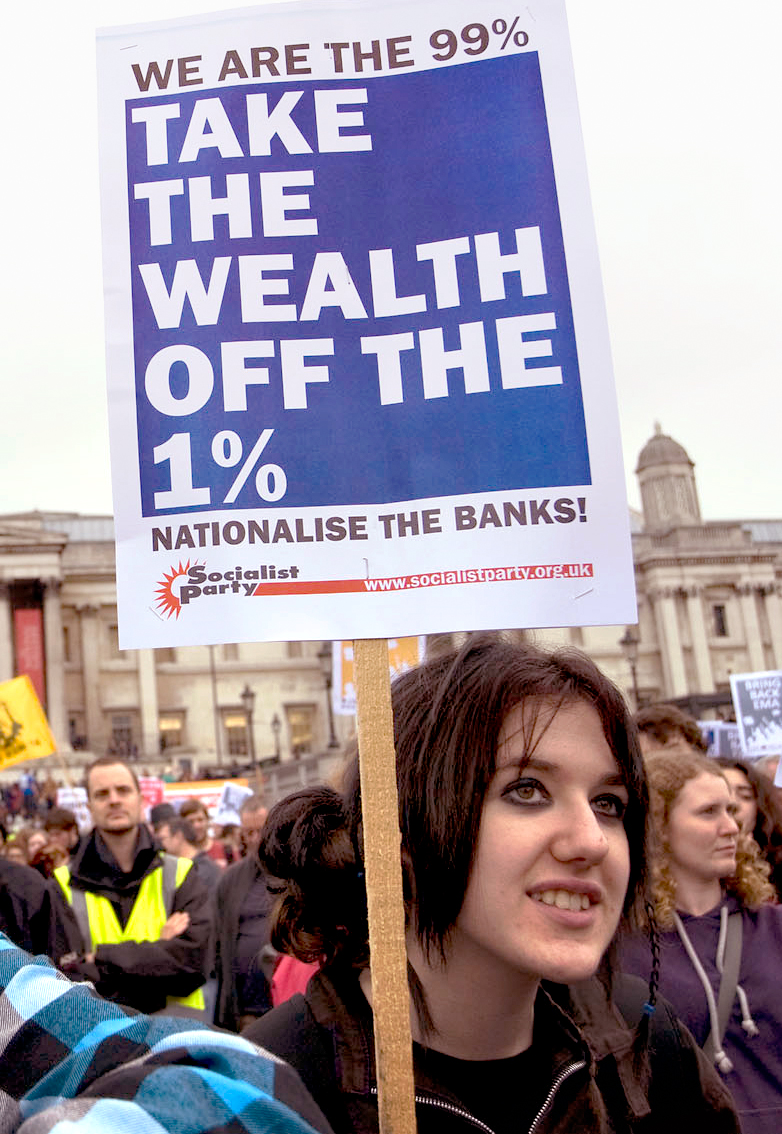
Socialists however, do not accept this as a reason not to fight to take the wealth off the super-rich. We support any measures, however limited initially, that fight to use society’s resources in the interests of working-class people. Fear of provoking a backlash from the capitalists is not a reason to avoid going ‘too far’, ‘too quickly’, but highlights the need for a clear programme and strategy to stop attempts at economic sabotage by big business and to place the wealth in society – along with the big companies and banks that produce it – firmly under the democratic control of the working class.
A workers’ government would need to bring the top 150 monopolies into public ownership through a rapid programme of nationalisation – with compensation only paid on the basis of proven need – to ensure that the main levers of the economy continue to function and cannot be held hostage by their capitalist owners.
Nationalising the banks and the big financial companies too would open up access to huge reserves of wealth, but crucially would allow the implementation of capital controls to block any attempts by the super-rich to remove their wealth from the country without permission. Socialist nationalisation would not involve decisions being made by unelected government officials, but by elected representatives of workers and service users in each industry, with full control over how they are run. All representatives would be regularly elected and subject to recall, as well as only being paid the same wage as their fellow workers.
Any further attempts to sabotage the economy or stop the workers’ government would need to be met with mass mobilisations of workers and young people through their own organisations to defend the government, and to ensure that its socialist programme doesn’t just remain on paper but is actually put into practice.
Using the existing wealth as part of a proper economic plan to massively raise the living standards of the whole population – increasing wages, expanding public services, building low-cost, high-quality housing – would be a huge inspiration to the workers’ and poor masses of other countries globally.
Working-class solidarity, and the struggles of the working class to take power internationally, would be necessary to effectively stop any attempts at sabotage or intervention by foreign capitalist powers as well.
Organise and fight for socialism
Of course all of that will simply remain as an idea, unless the working class is organised and fighting for it. Importantly, that includes having its own political party fighting for its own interests. The authority accrued by the trade union movement over the course of the strike wave – not to mention their material resources and millions-strong membership – means they are in prime position to take concrete steps towards the formation of a new party of the working class and young people.
Members of the Socialist Party would fight for any such organisation to adopt a socialist programme which permanently takes the wealth off the super-rich to democratically plan its use for the benefit of the whole population.
Every month seems to bring a new crisis for Starmer and a new set of attacks against the working class. More and more people will draw the conclusion in this period about the need for independent working-class political representation and will look to join the struggle for a world free from poverty, oppression, and exploitation. If you want to fight for those ideas as well – to discuss, organise, and campaign – then join the Socialist Party today.
