


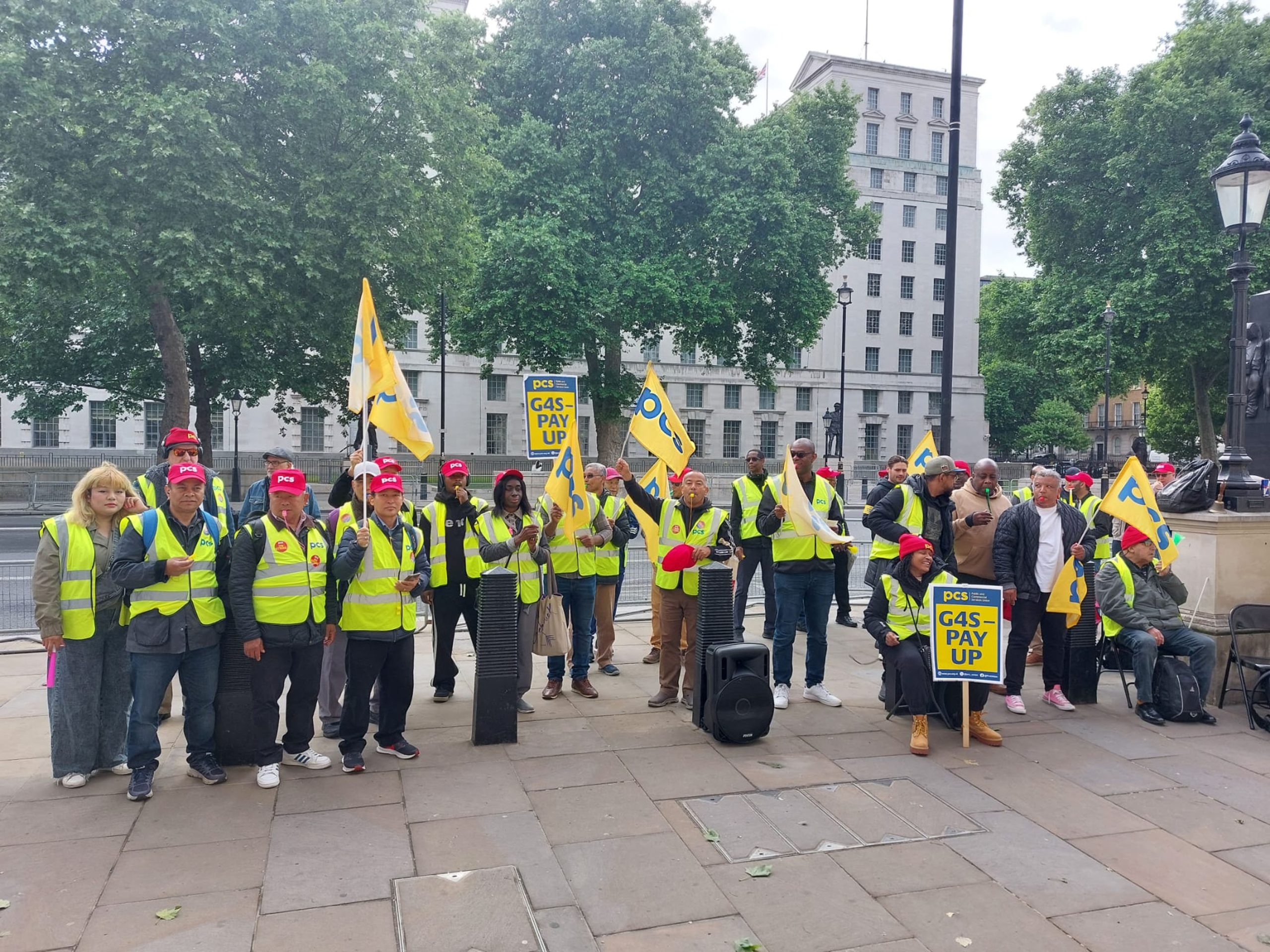
Socialist Party members in PCS
The Annual Delegate Conference of the Public and Commercial Services (PCS) union, the largest civil service trade union, closed on Thursday 22 May. Despite the efforts of the leadership, delegates across all of the employer-specific conferences and at the national conference defiantly declared their determination to fight against cuts to jobs and pay, closures of offices, and restrictions to flexible and hybrid working.
Westminster departments face 15% cuts, and these have already begun to land. In the Cabinet Office, 1,200 job cuts have been announced. The government has announced a renewal of efforts to cut London jobs by 12,000. A ‘review’ of arm’s-length bodies means cuts are also likely there.
Delegates vote for fighting strategy
Despite efforts by the general secretary, Fran Heathcote, to talk down a “shopping basket of demands”, conference passed motion A383 that laid out most clearly the attacks on civil servants, and the consequences for devolved government workers and privatised members working on facilities management contracts. Of central importance, the motion set a deadline of mid-September for the commencement of a ballot for strike action.
A fight on these questions is of paramount importance. Socialist Party members on the union’s National Executive Committee (NEC), in concert with left allies, have been making this point for a year. Flattered by personal discussions with ministers and unwilling to stand up to Starmer, the general secretary has done nothing to prepare the union for a fight, despite motions calling for this being agreed by the NEC in July 2024 and January 2025.
Civil service pay remit
Barely an hour after PCS conference closed, the Labour government announced a civil service pay remit for 2025-26 of 3.25%, with leeway up to 3.75% for the low paid. This provides a percentage figure by which each department can increase its total pay bill.
PCS president Martin Cavanagh and Heathcote, on behalf of the ruling misnamed ‘Left Unity’ group, have leapt to claim that this is a success, even though it falls short of RPI inflation, and there is no new money – pay rises must be found within existing budgets.
This announcement was not made without discussion with representatives from the trade unions. Yet the union’s NEC was not informed of any such discussions, and nor was PCS conference.
In the elections to the union’s NEC that took place just before conference convened, a reduced turnout saw all votes fall, but particularly for the left candidates (see ‘PCS: Socialists gear up for battle despite elections defeat’ at socialistparty.org.uk). The majority won in 2024 by the Broad Left Network (in which the Socialist Party participates) and its allies, which was blocked all year by Cavanagh ruling by presidential decree, was lost.
The opposite happened in the ‘block vote’ elections for other important committees; the left vote count went up.
Democracy
Importantly, the left won two seats on the National Standing Orders Committee (NSOC), which is a vital step in re-opening PCS to democratic debate in future. This year, undemocratic measures by the leadership-dominated NSOC were in full swing.
To avoid giving the floor to the left opposition, conference broke with usual practice and motions passed by the outgoing NEC to conference were not moved by outgoing NEC members.
The ‘guillotine’ section of the agenda, which permits any motion missed due to time to be put back on the agenda, was abolished this year. Having the guillotine section limits the effectiveness of the NSOC putting motions they don’t like low down the agenda, and of the chair calling in lots of speakers on other motions to deliberately run out of time.
Cavanagh and the leadership’s conduct at conference has given delegates a taste of how they ran the NEC over the previous year.
Battle ahead
The last year has been disorientating for many activists across PCS. The left NEC that was elected in May 2024 quickly found that, without the post of president or two-thirds of the seats (we won 19 out of 35), it could be ignored by the president and general secretary. The communications of the union, including branch briefings, were used by the president and general secretary to try to discredit the NEC.
PCS activists were left waiting for a serious campaign to defend jobs and pay, while on the surface of it, it looked like the union’s leadership was arguing among themselves.
But now a deluge of cuts is coming, and the re-elected Democracy Alliance/Left Unity majority and its unwillingness to fight will be rapidly put to the test. PCS must be ready with a national campaign, or more will come. Inextricably linked to this is the battle to render the leadership accountable to the members and to their elected reps – the battle for a fighting, democratic PCS.
To all PCS reps and members fighting the cuts and fighting for equality at work and in the community, we urge you to join the Broad Left Network in PCS, and to get involved with the Socialist Party to unite working-class struggle across all of the trade unions.
Trans rights: fight for working-class unity
Given the continuous attacks against workers, including most recently on trans rights as a result of the Supreme Court ruling, many would think that a union conference would support and fight for the rights of all members.
Instead, PCS general secretary Fran Heathcote and national president Martin Cavanagh, on the eve of conference, issued offensive and inflammatory ‘statements’ to all delegates about the use of toilet facilities, and a premature, biased interpretation of what the law requires.
Doing this under cover of legal advice that wasn’t produced, they also refused to print at least 25 motions including those that reaffirmed support for trans rights. These motions set out a clear response to the Supreme Court ruling, which, if carried, would unite all members across the union.
Delegates refused to adopt standing orders (conference rules), instead attempting to get the motions back on the agenda. Each attempt (‘reference back’) would have won a majority vote from the conference floor. The president, Martin Cavanagh, said he was unable take a reference back on the motion as it has been removed under legal advice.
Again and again, conference refused to adopt standing orders, therefore the conference could not open and proceed to the agenda. After over two hours of votes, a majority agreed to adopt standing orders via a card vote (where each branch has a voting strength equivalent to its membership).
