


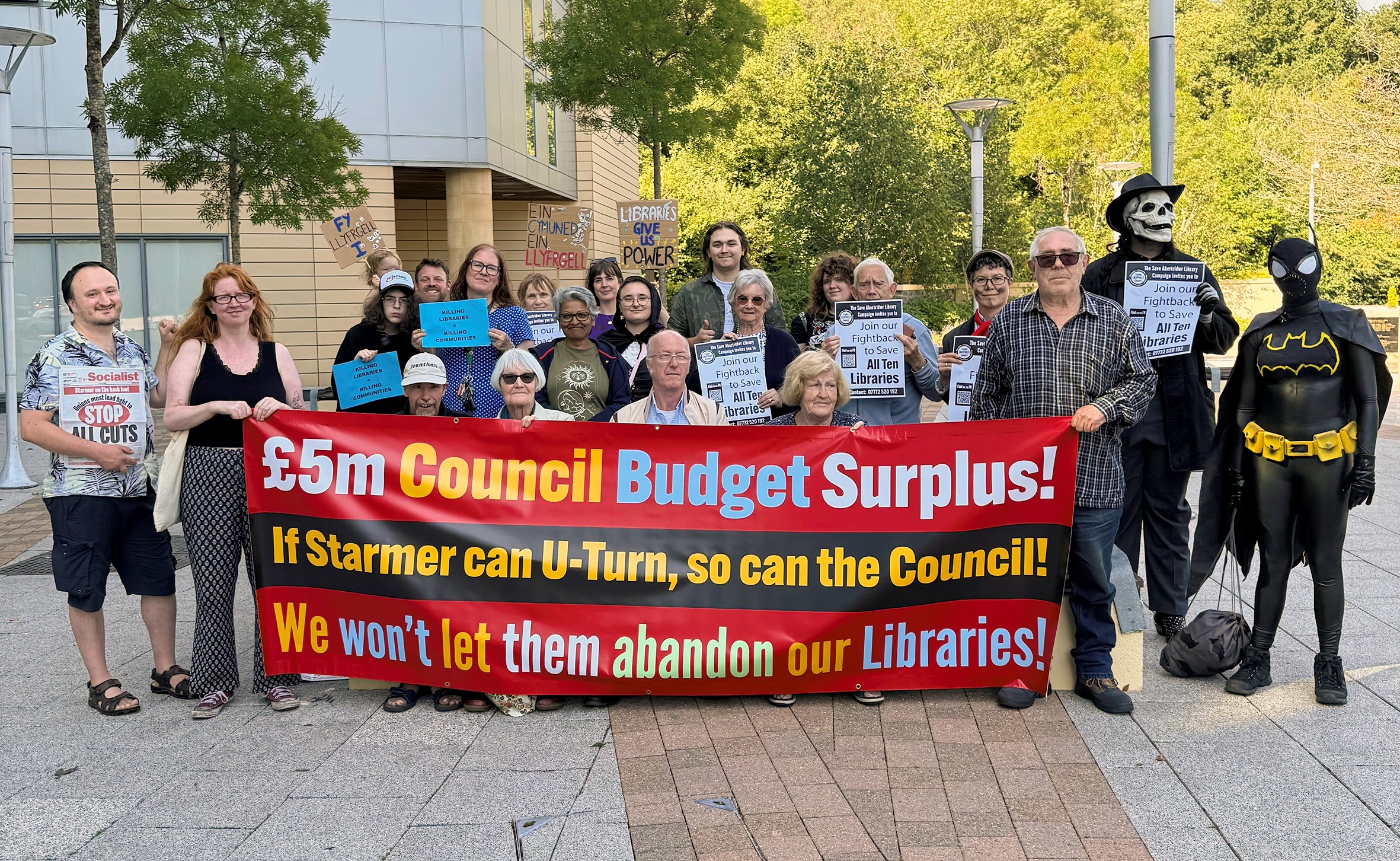
The 800,000 who signed up to Jeremy Corbyn and Zarah Sultana’s initial Your Party announcement this summer showed the huge appetite for an alternative to the austerity establishment parties. The May 2026 local elections present a huge opportunity for Your Party councillors to be elected, or even to lead councils. How could those elected positions be used to help mobilise a movement to defy Starmer’s austerity?
The Trade Unionist and Socialist Coalition (TUSC) is the electoral coalition which the Socialist Party has been a part of since 2010. TUSC has given its full backing to moves towards a new party. The following has been taken from the TUSC discussion document ‘Ideas about the next local elections – Opportunities and challenges for a new working-class party in May 2026’, tusc.org.uk
How can councils resist cuts?
Nobody can seriously question that local councils could be an important alternative power to central government. Around a fifth of public spending is done by local authorities, providing 800 or so different services. Many are statutory functions that they have to fulfil, others are discretionary. There are 1.295 million workers employed in total by local government in England and Wales, and 240,000 in Scotland. Who controls your local council then is not a matter of indifference.
But equally, nobody could dispute that councils and the local services they provide have been at the frontline of the austerity offensive. The core spending power of local authorities, for example, is down by around 18% per person compared to 2010, the Institute of Fiscal Studies calculates. The GMB union estimates that councils across England and Wales – Tory and Labour alike – have cut nearly 600,000 jobs since 2012.
And the situation will not improve under the current spending plans of Starmer and the chancellor Rachel Reeves. Some additional grant funding was announced for local government in the June 2025 Spending Review but completely insufficient to meet its needs. Dr Jonathan Carr-West, the chief executive of the Local Government Information Unit, a membership organisation of over 200 different authorities, argued that “we have made some progress” because, whereas in 2024 half of councils were “telling us that if nothing changes in terms of how they’re funded they are going to go bust within five years”, now it was one third! (BBC News, 26 August)
‘Funding formula’ changes and re-organisation
In fact, the future position of local government is even worse than the already desperate headline figures suggest. Also announced in June was a new system for allocating central government funding between local authorities, to be in place for the 2026-27 council budgets after ‘consultation’. Redistributing around £2.1 billion in annual funding, including the income councils can keep from growing business rates revenue, the estimate is that 186 councils will lose out.
Some councils, obviously, will gain some additional funding; but one in four will see a real-terms fall in overall funding over the next three years with 30 facing cuts of 11-12%. And although the exact details of how the new funding formulas would apply are still unclear, the biggest losses are set to be inflicted on inner London boroughs and slow population growth areas, such as South Tyneside and Sunderland in the North East.
Ominously the changes to the funding arrangements are also being accompanied by a ‘review’ of what statutory duties councils should have, and whether and how much fees can be charged for certain local services.
One set of rights certainly in the government’s target line are those of school pupils and their families requiring special educational needs and disabilities (SEND) services. Up to now, councils have been able to incur deficits to meet their SEND spending needs – deficits which currently total over £5 billion combined – through a government ‘statutory override’ of the requirement for councils to produce a ‘balanced budget’ each year. This has recently been extended until 4 April 2028 but on the implicit basis that SEND services rights will be reviewed and cuts in provision made. What other statutory functions will be cut, or charges imposed for?
And all this is taking place against the backdrop of the biggest reorganisation of local government in England since the 1970s, as Labour aims to merge many district councils into larger, less accountable, single bodies – known as unitary authorities – and increase the number of directly elected mayors.
Larger, more remote, councils are favoured by the Starmer government because it fits with their aim to weaken local democratic accountability. Whereas people living in towns and cities like, for example, Exeter, Basildon, Worcester, Crawley or Norwich, can currently vote every year for who runs their local public services – in district council elections, for one-third of the seats each time, and a county election in the fourth year – under the new plans they will only have a vote once every four years, and then only for distant mega-councils with populations of half a million or more.
With this erosion of local democracy, topped off by US-style directly elected mayors, it will be easier to take unpopular decisions to cut or privatise services – or to favour special business interests – than to win support for pro-business austerity policies amongst a wider group of regularly elected councillors, who have to justify themselves to local people.
Will it make local services ‘more efficient’ or ‘save money’? The latest estimate from the County Council Network, which had previously supported reorganisation plans on the latter grounds, is that the government’s plans could actually increase costs by £850 million over five years. (BBC News, 29 August) But what does that matter to Starmer and co as they look to get the ‘best’ arrangements in place to push through their austerity agenda?
So is resistance futile?
No, it’s not! Since its inception, TUSC has pioneered an anti-cuts strategy of councils using their prudential borrowing powers and reserves to set needs-based budgets as part of building a mass campaign for proper government funding for local services, explaining exactly how that was possible. Not by ignoring the legal requirement for a council to set a balanced budget each year before it is able to spend money or issue council tax bills, but by formally ‘balancing’ it by the use of borrowing powers and reserves.
What powers councils have and how they could be used to this end has been detailed in previous TUSC documents, including the 55-page briefing Preparing a No Cuts People’s Budget, available from the TUSC website at https://www.tusc.org.uk/txt/450.pdf. There really has been no excuse for local austerity policies. But, until now, there has not been the prospect of electing councillors on a sufficiently large scale who are prepared to fight them.
The latest version of the TUSC briefing was published in 2021 and obviously things have moved on since then. One of the last pieces of legislation passed by the Tories to get royal assent, for example, was the so-called Levelling-Up and Regeneration Act which gave greater intervention powers to the Secretary of State for Housing, Communities and Local Government over council borrowing. The implications were analysed by TUSC, the conclusion drawn that, while the battleground was being reset, councils still retained the capacity to resist austerity diktats. And recent developments have only confirmed the broad point of the flexibility that still exists in council budget-setting and funding decisions.
Not just in the council chamber
The alternative budget amendments moved by TUSC-supporting councillors and explored in the TUSC material were not recommended by council finance officers when they were presented, although they were not ruled as ‘illegal’ either.
In particular there was debate over whether a council budget could include borrowing which could arguably be used for ‘current’ spending, to pay for day-to-day services, rather than ‘capital’ spending, and whether the possibility of increased government support could be built into budget projections. In one case a QC’s opinion was sought by the Labour-led council, which was inconclusive. Yet, confirming our arguments, this year, for example, 30 councils have been given ‘capitalisation directions’ by the government explicitly enabling them to take out loans to pay for current spending. The ‘statutory override’ on SEND deficits is another example of this elasticity in the system, on a massive scale.
Meanwhile, in August, the Ministry of Housing, Communities and Local Government agreed to provide funding towards repaying the £2 billion debts that had been incurred by Woking Borough Council in Surrey.
A ministry official was quoted as saying “it is not typical for a council’s debt to be addressed or written off centrally. However, the government accepts that there are exceptional circumstances in Woking”. (BBC News, 6 August) In this case, it was because the borough council’s debts were potentially derailing the government’s reorganisation plans – none of the other ten councils in Surrey, the county or the districts, wanted to be burdened with Woking’s debts when they were merged.
But couldn’t a councils’ revolt against austerity, spearheaded by new party-led councils and councillor groups, create ‘exceptional circumstances’ too? ‘Circumstances’ that could also force the government to ‘accept’ it has to pay up?
The ‘technical’ means to fight back can always be found, if the will is there.
Local austerity, it must be said again, will not be defeated by action in the council chambers alone but by combining such defiance with building a mass movement.
But that is the potential which is opening up in the new political situation in Britain and which must be seized.
Preparing for the May elections: local People’s Budgets
Discussing policy amongst supporters of Jeremy and Zarah’s new party call is vital preparation for the May elections, certainly to ensure that those who put themselves forward as candidates are committed to an absolute, no-cuts, anti-austerity stand.
But building a movement that could back councillors taking such a stand beyond those who have already declared their support for a new party is equally important, if not more so. And that must start now, well before the election period begins next spring.
One way of doing this in each council district would be to use the budget-making timetable that local authorities will begin in the autumn, before they set their 2026-2027 spending plans in January-February. Councils will publish initial spending plans – and any new cuts – including ‘consultations’ with the council trade unions, local groups whose services might be affected, and sometimes public meetings, before they reach their final budget proposals to be voted on in the new year. This can provide a framework to produce an alternative ‘People’s Budget’ for the area, involving the widest possible input from the local community.
Almost certainly, by doing this – inviting local community organisations, trade union branches, campaign groups, student groups and others to contribute their ideas on what services the council should provide – more policy proposals would emerge, even beyond those raised in the previous section. And that really would establish the foundations to pull together the broadest possible anti-austerity electoral challenge in May.
How to start?
Drawing up a local People’s Budget can sound daunting – but it doesn’t have to be. Getting across the idea that council budgets should start from what local communities need – not what central government austerity policies demand – can begin with just one local campaign. In fact, all the alternative budget proposals presented by TUSC-supporting councillors in previous campaigns, explained in more detail in the TUSC ‘Preparing A No Cuts People’s Budget’ briefing document, started in this way. A local People’s Budget can be as broad or as specific as local campaigners make it.
But an open meeting to make sure it genuinely reflects the local community’s needs will be vital – ideally a specific ‘People’s Budget conference’ to draw together the local set of demands and campaign issues to take to the council ahead of their 2026-27 budget-setting meeting.
To prepare for that, Your Party supporters could draw up a list of trade union branches, campaign groups, community organisations, residents associations, students unions, student societies and so on, to take part. Ask them about co-hosting the event. But certainly invite them to contribute with their ideas and proposals for what the local community needs. Local authority websites, by the way, should have information on all the organisations that receive council funding or grants. Track this down and go through to see what relevant organisations may be good to contact to see if they want to be involved.
A draft ‘suggested People’s Budget of demands’ for the local council area could be discussed at an initial meeting of Your Party supporters. This could act as a starting point that could then be debated, added to and amended from the local, broader, conference.
If it does achieve wider input from the local community, a resulting ‘People’s Budget’ could, in itself, be the local manifesto for Your Party candidates in May’s elections; underpinned, of course, as it needs to be, by a clear no-cuts commitment. And really, what better way could there be to create unity across working-class communities against the divide-and-rule propaganda of the establishment politicians, including Reform?
Think local, aim big
Other campaign opportunities could also come from the process of bringing together a People’s Budget ahead of the council’s official budget-setting meeting. All councils, for example, accept petitions from residents, although they have different rules about what happens then. Some petitions on a defined issue (opposing a specific council proposal) may require the council to respond in a report following consultation. Petitions reaching a certain threshold may mean the council has to debate the issue at a full, public, council meeting, often with the lead petitioner having speaking rights.
Check the petition rules for individual local authorities to see what is possible but the main point is to use every avenue to build momentum for a real anti-austerity alternative before the May elections. To build the base in the community for the constant campaigning that will be needed after May if a new party councillor is elected – or, thinking big, if the new party wins a majority in the council!
And who is to say that is not possible in at least some of the councils that are being contested in this particular four-yearly cycle of elections next May? If, that is, there is a properly organised national stand.
