


The following is extracts by Uri Bar Shalom Agmon, from the Socialist Struggle Movement (SSM) in Israel/Palestine, for the full article see socialistworld.net
A mass mobilisation of Palestinian citizens of Israel took place on Thursday 22 January as part of a Day of Rage in protest at an all‑time record in the number of Arabs murdered amid the crisis of gun violence within the community – a crisis nurtured by policies of institutionalised crime.
The Day of Rage must not be allowed to become a one‑off ‘release of steam’. The struggle must continue to be built against Netanyahu’s ultra-right government of blood and for the eradication of anti‑social crime, poverty, and discrimination.
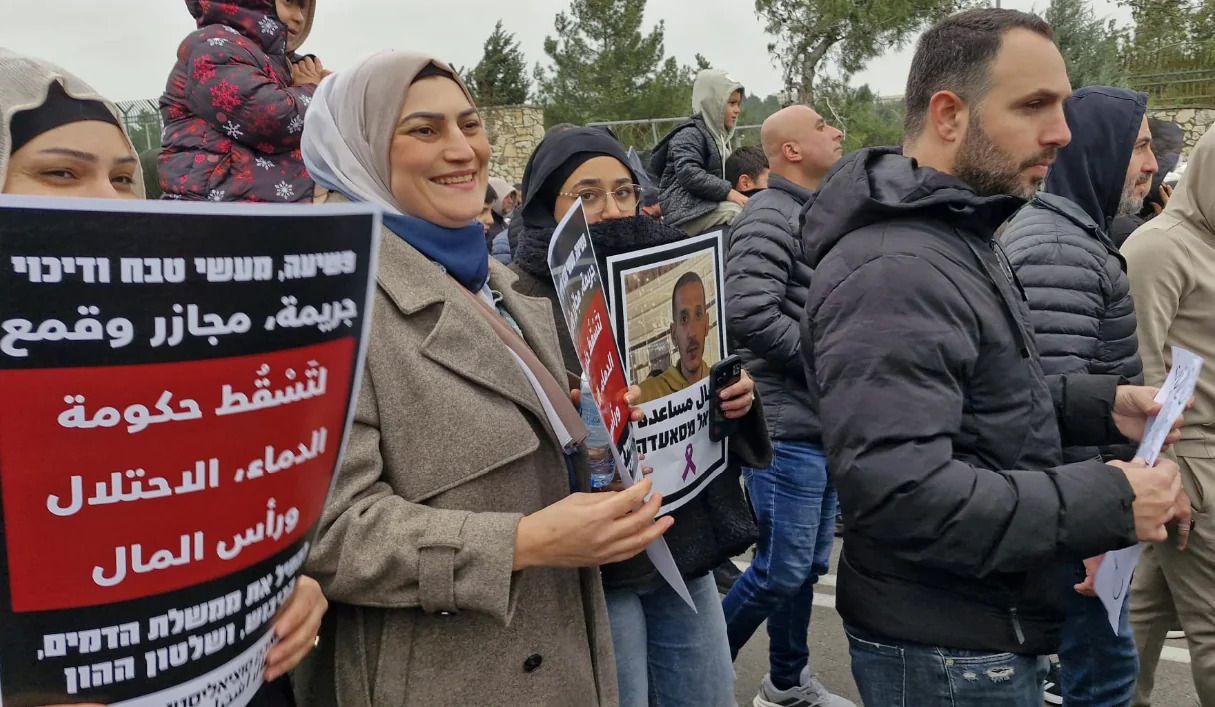
Around 50,000 people marched along Sakhnin’s main road all the way to the Yuvalim junction, near the Misgav police station. According to some estimates, this was the largest demonstration by the Arab‑Palestinian public within the Green Line since 2019. A demonstration was also held in Rahat, and several additional protest vigils were organised at other locations – including a cross-national vigil initiated by members of Socialist Struggle Movement (SSM) on the Tel Aviv University campus.
Thousands in Sakhnin shouted against crime, the racist police, and the government: “Netanyahu, you’re despicable, Arab blood is not cheap”, “My people are free, my people have decided, crime will not pass”, and also “The people want to topple crime” – echoing the popular slogan from the revolutionary wave in the Middle East and North Africa in 2011, “The people want to topple the regime”. Some protesters also chanted: “The police are the source of the problem” and “A criminals’ police”, along with more general slogans of the struggle against the national oppression of the Palestinian people.
A team from SSM took part in the demonstration and chanting, spoke with protesters, and distributed placards with the words: “General strike! Against crime, racist police and poverty”, “Crime, massacres and repression – bring down the government of blood, the occupation, and rule of capital”.
At the time of writing, 20 Arab‑Palestinian citizens in the 1948 territories [the land that became Israel in 1948] have been murdered since the beginning of 2026 – almost one murder per day on average. This marks a further worsening of the epidemic of killings, after 252 Palestinian citizens of Israel were murdered last year – an unprecedented number, set in the midst of the war of annihilation in Gaza and the massive displacement measures in the West Bank. The dehumanisation of Palestinians does not stop at the Green Line. Combined with the economic and social crisis, it further increases bloodletting, certainly in the eyes of the police tops appointed by Security Minister Ben‑Gvir.
Strikes
The mass demonstration in Sakhnin followed two days of strike action in the city, which began on 20 January, at the initiative of local business owners who launched a commercial strike, alongside a decision by the parents’ committee to shut down the education system. Sakhnin municipality initially opposed the parent committee’s decision, but quickly reversed course under public pressure and announced that it would join the strike.
The local initiative filled the vacuum left by the High Follow‑Up Committee for Arab Citizens of Israel, the leaderships of the established parties among the Arab‑Palestinian public, and the leaderships of the workers’ organisations – and it spread rapidly. Under pressure from below, the countrywide Arab schools parents’ committee declared a shutdown of the entire education system in Arab localities, and the chair of the Follow‑Up Committee, Jamal Zahalka (a former Balad party leader) announced that a countrywide strike would take place on Thursday.
Unlike many protest strikes declared by the Follow‑Up Committee, which often amounted to a symbolic commercial shutdown and the closure of some municipal institutions and parts of the education system, the strike included additional initiatives aimed at expanding its impact so that it would be felt beyond the Arab localities. Hundreds of doctors and pharmacists from Sakhnin – many of whom also work outside the city – organised in WhatsApp groups to strike, despite receiving no backing from the leaderships of their representative unions, and arrived at the demonstration as a bloc wearing their work uniforms.
Ibrahim Othman, a striking pharmacist from Sakhnin who took part in the demonstration, told us: “The pharmacists’ organising began yesterday. We organised in the evening, and within a few hours it was decided that we would strike. All the pharmacists working in Sakhnin and outside Sakhnin joined this protest. It started in WhatsApp groups. It came from below.”
At the same time, lawyers, engineers, and significantly some construction workers in the city also took part in the strike – although the scale is not yet clear. Protesters blocked the entrances to Sakhnin during the day, to strengthen the strike, and according to some reports many workers stayed home and did not go to work.
The chair of the Sakhnin parents’ committee, Fadi Tarad, told SSM activists that the Afifi Group bus company, which operates the city’s public transport, also halted its services under pressure from the parents’ committee.
What next?
After the demonstration, party representatives, the leadership of the Follow‑Up Committee, municipalities heads and political activists convened in the Sakhnin city council building to discuss the next steps. It was decided that the shutdown of the education system in Sakhnin would continue on the Saturday (a school day in the city). The chair of the Follow‑Up Committee, Zahalka, proposed holding a large demonstration in Tel Aviv soon, although initially the statement issued after the meeting did not include any concrete announcements regarding the continuation of the struggle.
During the meeting in Sakhnin, pressure was placed on the leaders of the four political parties based in the Arab‑Palestinian community within the Green Line – Hadash/al-Jabha, Ta’al, Balad and the United Arab List – by some activists and attendees in the room to commit to running together in the next election on a single list, based on the view that such unity is necessary to advance the struggle. The party leaders signed a commitment in principle to promote such a list, although it remains unclear whether they will ultimately reach agreement on running jointly.
However, the years of the Joint List’s existence in the past – and even more so the role of the United Arab List under Mansour Abbas, who joined the capitalist occupation government of Bennett-Lapid – have provided a clear warning sign against the idea of such an electoral bloc between forces from the left and the right, which in itself cannot deliver the desired results. The alignment of forces that is needed is one capable of strengthening a strategy for building a mass struggle around a left‑wing platform of radical reforms, as part of a fight to end discrimination and eradicate poverty through socialist change.
The current strike organising and the mass demonstration in Sakhnin have, on the one hand, exposed the lack of direction of the leaderships of those parties – which, generally speaking, do not advance a clear strategy for shifting the balance of forces in the struggle. On the other hand, they have given expression to some of the pent‑up anger among a large layer of the public that is ready to fight to end the crisis and achieve real change in living conditions.
The rapid organising of workers in the healthcare system for strike action, within a short time, points to the need to apply pressure on workers’ committees and on the leaderships of the trade unions to take concrete steps and join the struggle, particularly through strike action, in an effort to succeed in shutting down key sectors of the economy in a way that disrupts ‘business as usual’.
Efforts to effectively expand actions that disrupt the economy will also need to be combined with continued cross‑community public explanation work, organising to broaden strike‑enforcement pickets, and, decisively, mobilising sections of organised labour so that strike action is implemented in a generalised manner, also without any dependency on the consent of employers – most of whom, sooner or later, will not willingly accept damage to their profits.
It is positive that the trade union organisation Power to the Workers and the Social Workers’ Union issued basic solidarity statements supporting the strike. But active steps are needed to shut down workplaces with the demands to end enforced poverty, national oppression and crime. Massive pressure ‘from below’ can also push the right‑wing bureaucratic leadership of the General Histadrut trade union federation to take organisational steps – and left-wing political coalition Hadash/al-Jabha, which holds positions within the Histadrut, including the leadership of regional branches, must also apply pressure in this direction – and help harness the weight of organised labour as part of a broader struggle against the entire agenda of Netanyahu and Ben‑Gvir’s capitalist government of death, and for profound change in the daily reality of life.
