


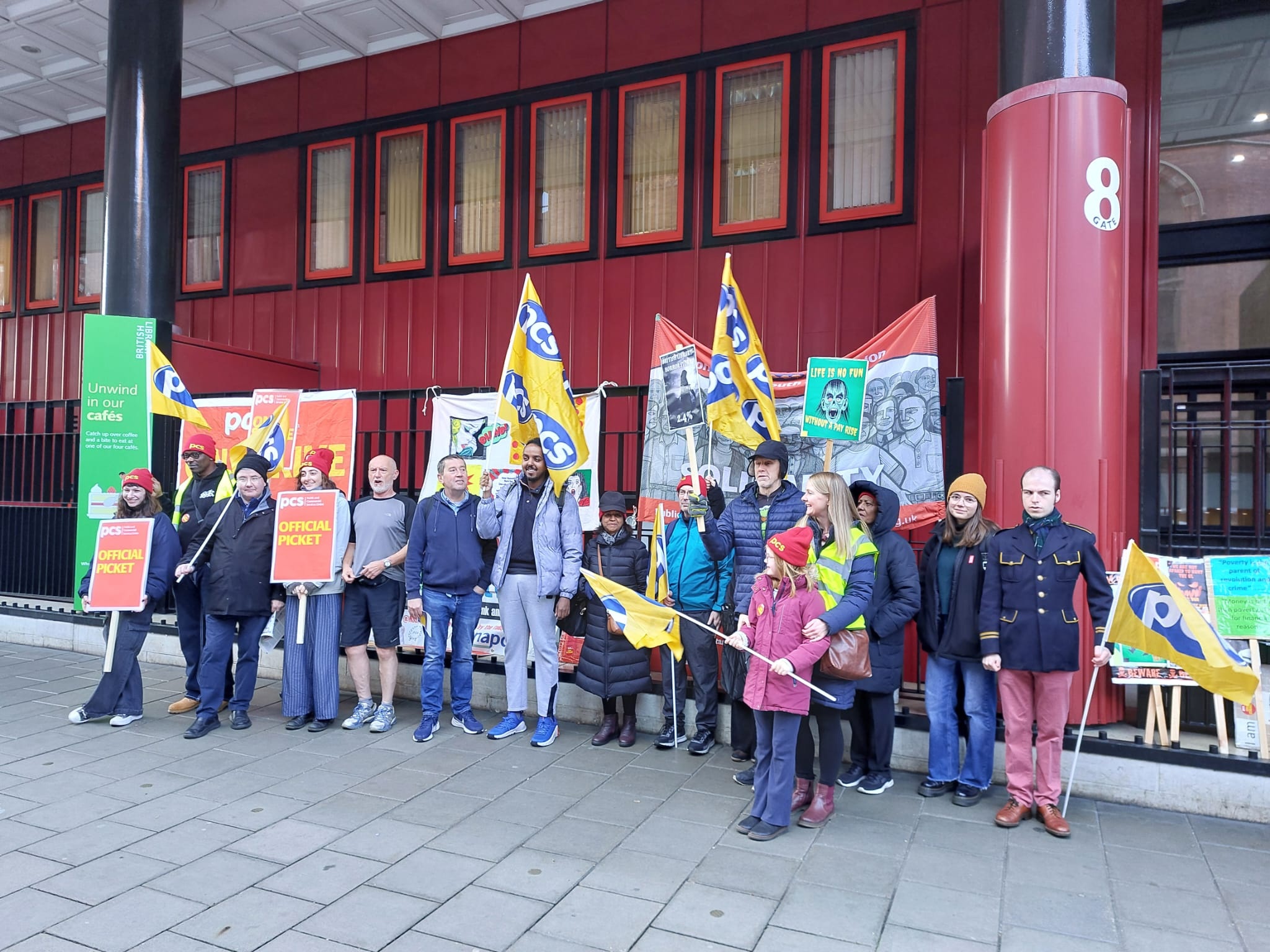
Socialist Party members in PCS
On 28 May, Unison, Unite and GMB unions wrote to the employer’s body that coordinates local government pay negotiations to reject their final offer of a 3.3% pay rise for local government workers. Unison has already announced that it intends to ballot, beginning in June. This follows the decision to ballot by the teachers’ union NEU on 9 May, in opposition to a 6.5% deal over three years.
Action is also in preparation at the Public and Commercial Services (PCS) union, which represents civil servants, public sector workers at national public bodies and private sector staff on national government contracts. The union’s newly elected Left Coalition-led National Executive Committee (NEC) met for the first time on 29 May, and agreed initial steps to prepare for a wide-ranging battle on civil service pay, jobs, office closures and more.
PCS annual conference, 18-21 May in Brighton, voted for a serious fight on pay, and the newly elected NEC majority, including six Socialist Party members as part of a broad left coalition for change, intends to deliver this.
On the final day of PCS conference, the Cabinet Office published the UK civil service’s pay remit for 2026-27. This remit is a cost control mechanism, set this year at 3.5%, which caps the overall increase to spending on pay by each civil service department, executive agency or other body. This headline figure is not fully funded either; up to a 2% increase is funded, the remainder will be made up via cuts to jobs and other “savings”.
The reaction from PCS members has been negative; 3.5% will not be enough to address longstanding issues of low pay, of repeated below-inflation pay awards dating back years. Even using the government’s Consumer Price Index (CPI) measure of inflation, which does not include housing and routinely underestimates real inflation, prices are set to rise by 3.5% by the end of 2026.
The NEU and Unison have shown the way – we need to demand more from the Cabinet Office and we need to prepare for a serious national campaign on pay and more besides.
Pay ‘flexibility’ in 2026-27: myth versus reality
This year’s pay remit also contains some additions – which are being touted as successes by the union’s General Secretary Fran Heathcote. In her eyes, this ‘flexibility’, and the 3.5% itself, are results of her off-the-record chats with the Cabinet Office. Socialist Party members are rightly wary of this approach. Concessions are not won by honeyed words; they are won by leverage and hard campaigning work. Where employers make concessions without a campaign, it is the surest bet in the world that they would have given up a lot more if a campaign had been deployed.
Neither do we describe either the 3.5% itself, or much of the ‘flexibilities’ being touted in this year’s pay remit, as major ‘concessions’. This year’s pay remit is accompanied by a ‘Pay Compression Framework’. This framework – which is voluntary – permits government departments to develop plans to ensure a 5% pay gap between each of the bottom three grades AA, AO and EO. Whilst this can be funded on top of the 3.5%, the latter is not fully funded and departments will need to find the money from existing budgets, likely leading to job cuts.
Under the government’s plans, the intention of HM Treasury is to hold the lowest AA grades down to the National Living Wage (NLW) forever. Future pay awards for AAs would be non-consolidated, i.e. not pensionable pay, but a one-off pro-rata payment. Departments are also expected to create an AA to AO ‘pathway’. This may be welcomed by some members at the AA grade. It is intended to lead to the abolition of the AA grade as HMRC have already done. But, if this goes ahead on this basis it will not mean ‘levelling up’, instead in time it will be the AO grade held down to the NLW.
Those areas seeking to introduce the 5% gap would also be forced to demonstrate ‘ambitious plans’ to move from contracts of 42 hours per week to 37 hours per week, but this includes removing paid lunchbreaks. This is a key issue in DWP and some other smaller departments. If adopted, future calculations of NLW increases would be based on 37 hours per week so the absolute floor for pay would be reduced.
For some AO grades, in areas with 42-hour contracts, who earn less than £29,147 per year (i.e. 5% above the NLW), there may be some benefit to this extra flexibility. This is true in DWP, for AO grades outside of London. For AO grades on 37-hour contracts on the other hand, the magic figure would be earning less £25,676. All AO grades in key areas like HMRC are already over this figure. In addition, some departments have already indicated in discussions with negotiators that they don’t want to make use of the new Pay Compression Framework, and they intend to live within the 3.5%.
The picture for EO grades is even more mixed across the civil service. In DWP, the largest government department, even if AO grades were given an uplift to create a 5% differential with AA (i.e. AO pay raised to £29,147), most EO grades (£32,137) would still be well over 5% away from the new AO grade pay point. It is far from clear, therefore, that this Pay Compression Framework will yield serious improvements to pay.
Restoration of national pay bargaining, which was abolished in the early 1990s, has been a feature of PCS campaigning since the union was formed in 1998. Far from being a means to provide harmonisation of pay, in a manner favourable to half a million civil servants, the pay compression framework seems designed to ensure the permanency of low pay by tying the lowest grade to the national living wage.
Nor does the pay remit contain anything for higher grades – they will have to fit under the 3.5% cap. These workers have loyally stuck with the union despite below-inflation pay rises and no PCS campaign to remedy that.
Despite the inadequate 3.5% civil service pay remit, which cannot provide a basis for meeting any of our key demands, the PCS General Secretary attended the union’s NEC to propose that we move immediately to delegated, i.e. employer by employer pay talks, essentially foregoing a campaign.
The union’s NEC voted no to this. Instead, a short pause to delegated talks has been ordered while we seek to reopen talks at the Cabinet Office level, a task which has been made harder by Heathcote’s acceptance of ‘informal’ chats rather than genuine negotiations with Cabinet Office officials overseeing the government’s strategy on civil service pay. The entire union must be put on notice that we are readying for a fight.
A new national negotiating team has been appointed, including the union’s newly elected President, Bev Laidlaw, and newly elected Deputy President, Dave Semple, along with the General Secretary and John Moloney, the Assistant General Secretary. Training and information for delegated negotiators and for activists more generally is in preparation, and the Cabinet Office has been put on notice.
These are the first steps towards accomplishing the demand of three successive PCS annual delegate conferences: build a serious national campaign.
