


What can unions do next to oppose racism and far right?
Pippa Evans, Tower Hamlets resident and PCS union NEC (personal capacity)
It’s the 90th anniversary of the Battle of Cable Street. Then, hundreds of thousands of workers and young people mobilised across the East End of London to stop Oswald Mosley and the British Union of Fascists (BUF).
Mosley deliberately chose the area to march through to target predominantly working-class Jewish and immigrant communities, and provoke division. Instead, he faced a mass mobilisation of local workers, Jewish workers and residents, Irish dockers, trade unionists, socialists, and young people.
Thousands of police couldn’t clear a route for the fascist march, and they were forced to retreat.
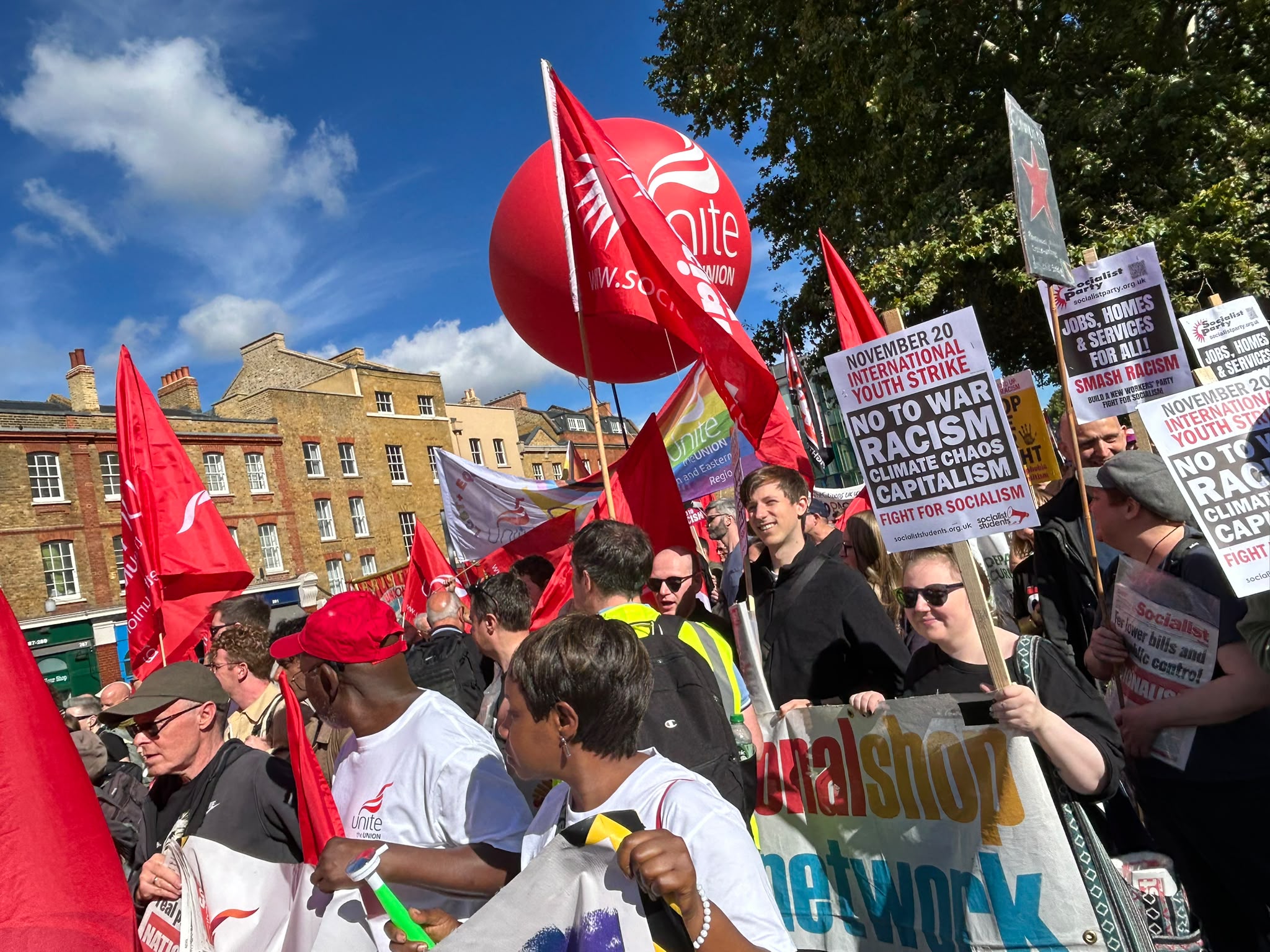
Thousands joined a demonstration on the 90th anniversary. There was a strong trade union presence, with workers travelling from across the country.
Unite the Union played a key role in organising and stewarding the event. There were lots of union banners, including Unite health workers from the local hospital and Tower Hamlets Unison.
The banner at the front of the march read: “No to: Antisemitism, Islamophobia, all racism. 1936 they did not pass. 2026 they will not pass.” Other banners linked the demonstration to wider struggles today. There were also chants against other forms of division and oppression, including the genocide on Gaza and anti-trans rhetoric.
How can we oppose racism and oppression today? Unite’s role helping organise the demonstration gives a glimpse of what the trade union movement can do, mobilising workers against the far right and racist division.
The far right is gaining support and confidence by exploiting growing anger, as working-class people see their lives getting worse. But trade unions bring millions of workers together, and have the collective strength to fight for improvements in our lives.
What we fight for today
The solution to a housing shortage is genuinely affordable council homes. The answer to low pay and insecurity is decent jobs and wages.
Ending sky-rocketing energy and water bills means democratic public ownership to replace vulture profit-seeking private companies. Trade unions need to take up these fights.
This was an important lesson from the Battle of Cable Street in 1936. Back then, rank-and-file Communist Party activists built support in the East End by organising around issues such as housing.
In the 1930s, the Stepney Tenants’ Defence League campaigned against high rents, poor conditions, and evictions. Fighting the far right was connected to the wider struggles facing working-class people.
In the Public and Commercial Services (PCS) union, the left coalition has a majority on the newly elected National Executive Committee. We’re pushing to implement the fighting programme agreed by members at this year’s union conference.
We’ve fought for a fighting national campaign over pay, jobs, pensions, and conditions. We are balloting for strike action from 20 October.
By taking up issues that directly affect workers’ lives, and organising around them, unions can cut across far-right attempts to exploit anger and division, pointing to what can actually improve working-class people’s lives.
The trade union movement already has a mandate to take this forward in a coordinated way. The Trades Union Congress (TUC) has policy going back to 2018 calling for action against the far right, and a campaign for jobs, homes, and services, not racism.
National demo
This year’s TUC Congress again passed a motion calling for a national Saturday demonstration against austerity. We can’t allow the TUC leadership to again ignore the motion. The TUC should set a date and mobilise.
A demonstration like this could bring together the struggles workers are already facing – housing, low pay, insecure work, cuts to public services. And provide a clear alternative to the far right’s attempt to blame migrants and other working-class communities.
A political vacuum exists. The Labour Party has abandoned the working class and is implementing austerity.
Many feel there is no alternative. The unions should take the lead in building a new mass workers’ party.
