


Gauche Révolutionnaire, CWI France
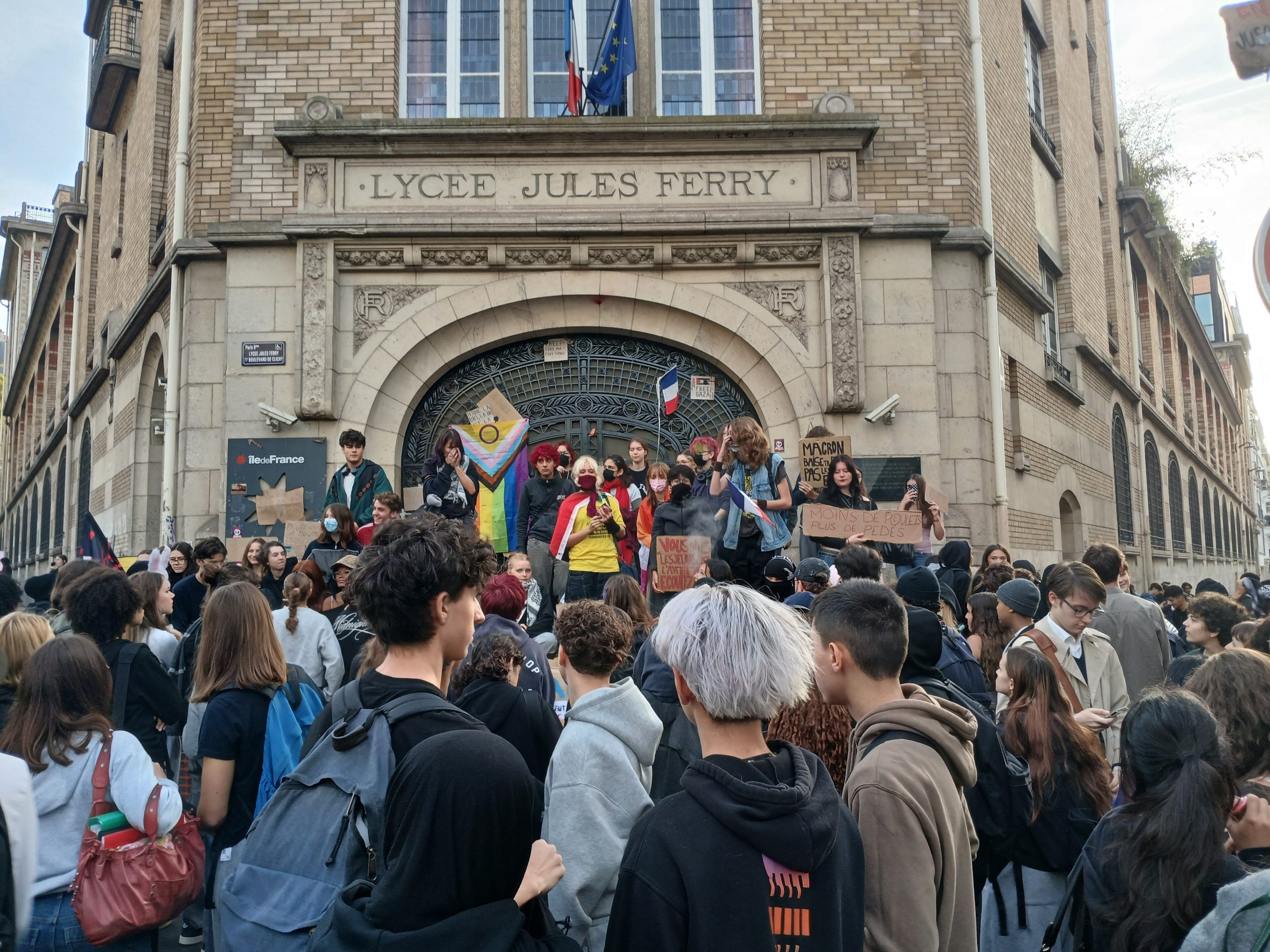
The school students’ mobilisation, which began more than 15 days ago, reached a new stage after the public sector strike on 29 September – 338 high schools were blockaded. More than 1,000 were affected by mobilisations on 1 October.
Thousands of young people have taken to the streets to reject the deterioration of their study conditions and their sacrificed future.
For years, school students have endured the shortage of teachers, overcrowded classes, absurd timetables, and the endless days that keep piling up. In many schools, buildings are dilapidated, toilets are insufficient, water leaks are multiplying, and heating or ventilation conditions are unfit for study.
When the time comes to think about the future after high school, it is either the search for jobs, hardship or unemployment. For those considering continuing their studies, Parcoursup (higher education application system) turns access to education into an obstacle course through fierce selection.
Faced with the anger being expressed, President Macron barely even pretends to hear the demands, and prime minister Lecornu proposes nothing. The government is even planning further cuts to teaching and staff posts.
At the same time, the repression is very violent, especially in working-class neighbourhoods and workers’ towns. Students’ blockades have been violently dispersed, police forces have been deployed outside schools from the outset, and school students have been attacked. So far, 170 school students have been injured. One young person lost an eye in Tours, shot by a rubber bullet. Another in St-Ouen, aged 14, had his jaw completely shattered. In Lens, a 15-year-old school student had his left hand torn off. 5,000 people have been taken into police custody since the start of the movement.
The government is now seeking to prevent young people from gathering by closing schools in a kind of ‘lockout’.
Youth defiance
All this reveals the government’s fear of seeing the mobilisation spread and connect with workers’ anger. This strategy is already failing, because all the teaching staff unions have been calling for mobilisations alongside students since 2 October.
Young people understand more and more clearly that the deterioration of the education system is not simply a ‘management error’. It is the result of a policy that prefers to finance the capitalists rather than meet the needs of the population.
The movement of 1 October showed the anger, rage and determination that have developed among young people. A revolt is developing.
The aggressiveness of the police is frightening but no longer stops the mobilisations. A small section of young people confront the police, sometimes in a logic of revenge against the government and the violence they suffer in working-class neighbourhoods. And there are small organised fringe groups seeking to smash things up. Infiltrated police officers who provoke and smash things are also regularly identified.
The chaos is Macron and the capitalists who feed it every day through their policies, and who want it. Damage to school buildings, fires and attacks on education staff are not a sign of radicalism. What is truly radical is being thousands-strong in demonstrations putting forward demands, building a mass struggle of young people for their futures.
Accusations of manipulation against La France Insoumise have the same objective: to divide young people and workers. But it is not working! Activists from La France Insoumise and from other left-wing organisations are present alongside school students to support the mass struggle, not to control it… which is impossible anyway.
Our side is taking shape again against Macron, the far-right National Rally, and all the capitalist parties: it is that of young people and workers uniting in a massive and determined struggle.
To win, it is necessary to discuss, decide together and give the struggle a clear direction. School students must be able to meet in general assemblies, draw up their demands and regularly elect representatives in each school. Coordination between mobilised high schools would make it possible not to remain isolated, to share experiences and to prepare common actions, locally and then nationally.
It is to prevent students organising that the government is closing the majority of secondary school premises on the eve of the 6 October strike. The workers’ movement has a duty to support those who are fighting. We must reopen the secondary school buildings and ensure these are spaces where pupils can come together and decide for themselves what their demands are and how they wish to organise themselves.
Since Friday 2 October, education, health and other sector unions have begun calling strikes and organising solidarity, aware of the essential role that organised workers can play. Unions in education, health and social care, railway workers and others will stand alongside young people on Tuesday 6 October. In workplaces, assemblies must be called to discuss the situation and decide on concrete actions.
6 October must not be a simple day of demonstrations, but the beginning of a lasting struggle. The public-sector strike on 29 September showed that potential exists. It is now necessary to prepare a massive strike, public and private, which could take the form of a three-day consecutive strike in all sectors.
Such a struggle against Macron will strengthen all workers against the capitalists and their system. The activists of Gauche Révolutionnaire are fighting for this in their workplaces or places of study, and in their trade unions. We are fighting for a society free from exploitation, poverty and the destruction of the environment: a socialist society managed democratically and collectively by the workers themselves.
This article was published in full at socialistworld.net on 6 October
