


Panos Tsiolakidis
Last year in Greece, due to the lack of funding in public education infrastructure, a ceiling collapsed inside the classroom of an Athenian primary school. Instead of pointing to the root cause of the issue, two decades of brutal austerity measures, the local education authority instead responded by imposing disciplinary action on 22 teachers.
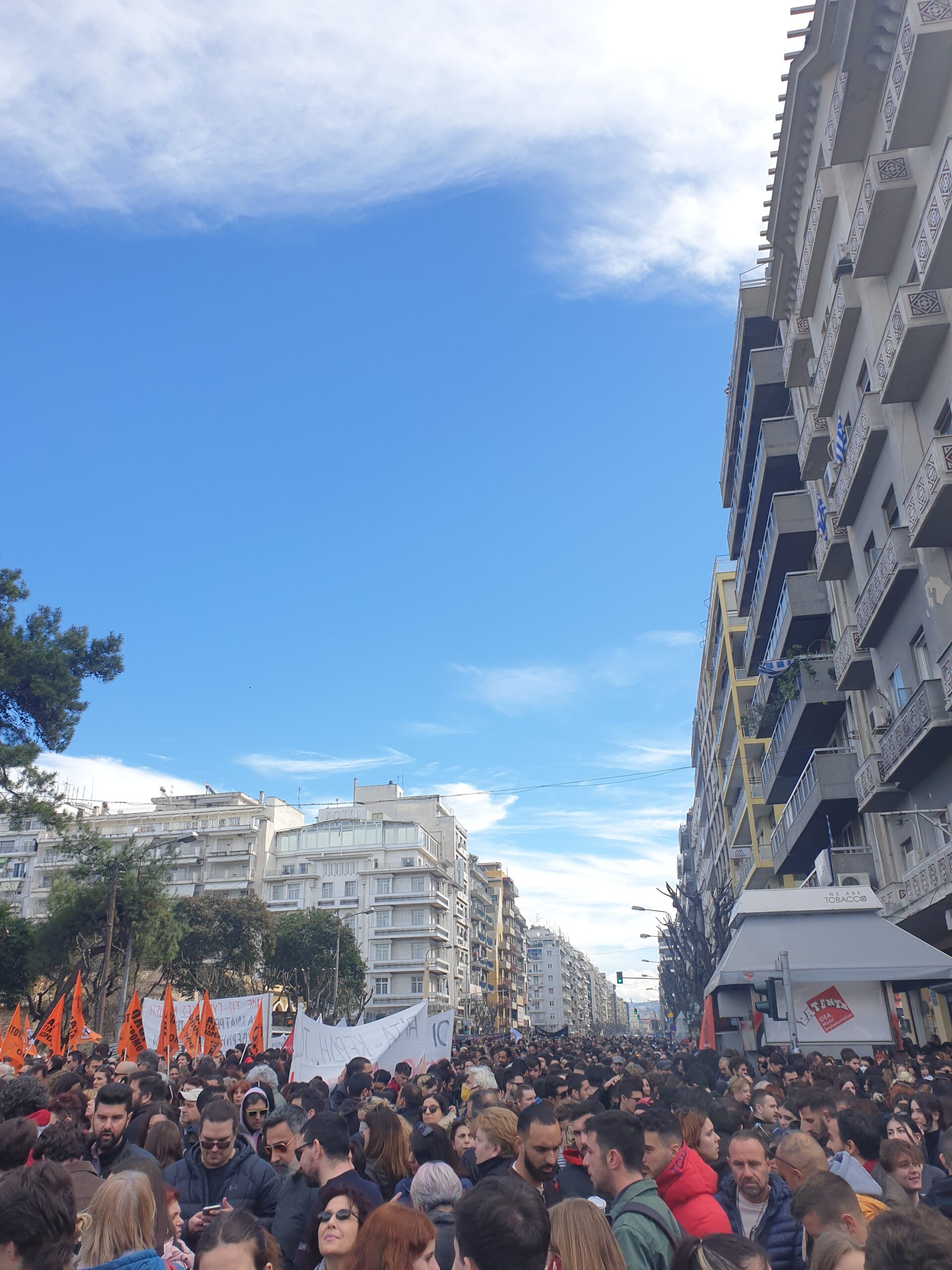
On 21 October, Greek students, educators, nurses and workers of all professions united in national mobilisation against austerity under the slogan: ‘From France to Greece, we fight for free public education’. The two-day protest took place in more than 50 towns and cities across the country. Being a movement spearheaded by students, protesters’ demands initially centred around increased funding towards education and student housing. Before long, educator, healthcare and civil servant unions joined the fight calling for strike action amongst their members, expanding their demands to include increased pay, hiring of permanent staff, and measures against the cost-of-living crisis.
More than 10,000 people took part in the Athenian protests. Students gathered in Syntagma Square, opposite the Greek parliament, and set up their tents in preparation for the overnight protes, despite the rain. A sign glued on one of the tents reads: “Future student accommodation”. Placards and banners were written in Greek, English and French, as the demonstrators, inspired by their counterparts on the rest of the continent, stand united in international struggle.
Soaring rents, energy and grocery bills have turned higher education into a matter of survival, states Nina Nifakou, the President of the Student Union at the University of West Attica. Existing halls of residence, she said, are not even equipped to handle 4% of the students’ needs. Many universities, including her own, lack halls altogether, forcing students to privately rent €600 studios. These conditions leave some students unable to attend higher education. In her closing statement to the reporting news agency, Nifakou notes that students are aware of the true cause of this crisis: “We know that when they tell us there’s no money to meet our needs, there is money for military armaments, money for frigates to be sent out to slaughter peoples.”
Bleak prospects, fighting back
The material conditions of all young European working-class people are one and the same. Our schools are crumbling, the threat of dying in a pointless forever-war looms over our heads, and our jobs – if we are lucky enough to have one – barely cover our eye-watering energy bills and rents. At the same time our governments are committed to spend billions in rearmament, all funded by cuts to our public services.
It is apparent that young people are not buying the lies of the ruling class and their lobbied politicians any more. With bleak-looking prospects ahead, students have nothing to lose but everything to gain in joining the fight to ensure a future worth living for. A future that cannot be secured under capitalism. As our states are not equipped to deal with the inevitable, multi-faceted crises arising from this very system, waves of protest will keep sweeping Europe and beyond until our needs are met.
French protests continue – make 5 November a 24-hour general strike!
On Saturday 31 October protests saw more than 320,000 people take to the streets around France in the build-up to Thursday 5 November, when trade unions, students plus France’s “yellow jacket” (gilets jaunes) movement – that staged demonstrations for over a year in 2018, during Macron’s first term as president – have announced strikes and huge protests.
Read the latest on where next for the movement in France from Gauche Révolutionnaire (CWI France), published 21 October: ‘France: Make 5 November a 24-hour general strike!’ at socialistworld.net
Spanish State: Deadly train crash leads to further anger ahead of general strike
As the general strike in Spanish State on 11 November draws closer, anger has again erupted in Spain, this time provoked by a horrific train crash which killed at least 69 people on 28 October. It follows the huge recent protests over the housing crisis and only months after another deadly train crash which killed 46. The government were quick to try and blame the workers citing “human error”. But the workers have accused authorities of chronic underinvestment in infrastructure. All of this and more, such as the cost-of-living crisis gripping Europe, feeds into the general strike on 11 November, ahead of a general election.
