

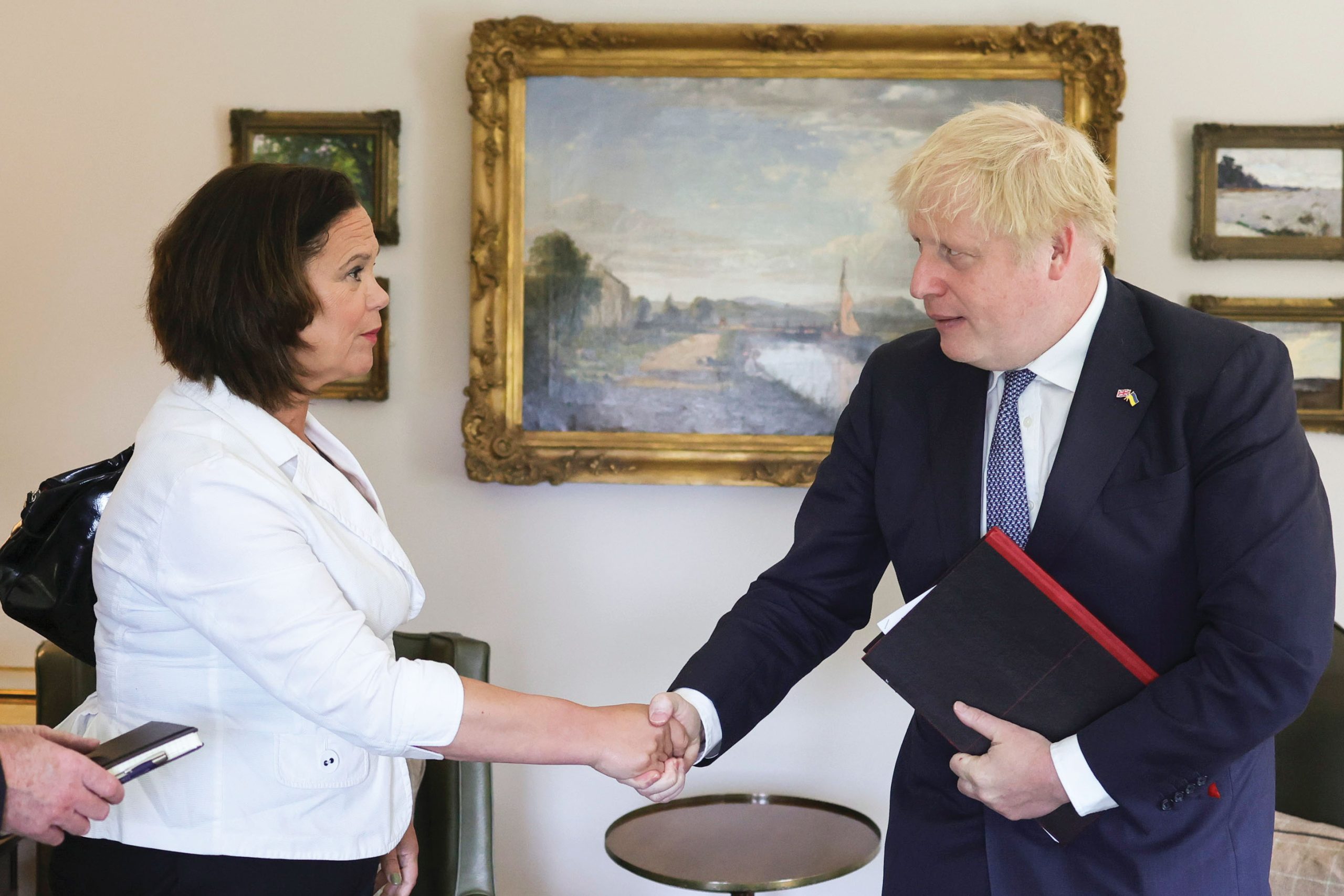
The Tories have announced that they are preparing legislation which would allow them to unilaterally change the ‘Northern Ireland Protocol’, a key component of their Brexit agreement with the EU.
This is against the background of a nationalist party, Sinn Féin, emerging from recent Northern Ireland Assembly elections with the most number of seats, and the biggest unionist party, the Democratic Unionist Party (DUP), boycotting the Assembly, demanding the Protocol be scrapped (see Northern Ireland Assembly Election: A Political Turning Point).
Going down this road risks provoking a trade war with the EU, aggravating the already serious economic crisis in Britain, and further destabilising the situation in Northern Ireland. Below we print an amended version of an article by Clive Heemskerk, which first appeared in the Socialist Party’s magazine Socialism Today in May 2021, explaining the background to this Protocol crisis – one of the many facing this unstable and dysfunctional Tory government.
Before the December 2019 general election, the Socialist Party warned that Boris Johnson’s withdrawal agreement with the European Union, which would “effectively leave Northern Ireland within the EU’s economic jurisdiction” following the UK’s exit, “will dangerously escalate sectarian tensions; spilling over into Britain too as in the past”. (see socialismtoday.org)
The Socialist Party opposes the EU, which at bottom is a bosses’ club attempting to co-ordinate the policies of different capitalist nation states on a continental scale in the interests of big business.
We backed a leave vote in the binary choice referendum on the UK’s EU membership in 2016 from the standpoint of working-class socialist internationalism.
But that did not signify a commitment to offer even one ounce of support to the subsequent outcome of negotiations between the UK government and the 27 other EU member states on what the new relationships would be, including the so-called ‘Northern Ireland Protocol’.
Johnson and the right-populist clique at the heart of the Tory government have acted recklessly throughout the Brexit process, even from the standpoint of the interests of British capitalism.
The overwhelming majority of the ruling capitalist class had wanted to remain within the EU or at least, when faced with the result of the 2016 referendum, retain a closer alignment to the EU single market than the ‘hard Brexit’ that Johnson sought.
One factor was the border between Northern Ireland and the Irish Republic.
UK and Irish membership of the common EU economic area had seen the removal of customs controls in 1993 which, after the end of security checks under the 1998 Good Friday ‘peace agreement’, reduced the border’s physical manifestation to changing road signage.
A capitalist hard Brexit, however, with a different UK customs and regulatory regime aimed to undercut the EU single market, inevitably posed its reinstatement as a hard border.
Former Tory prime minister Theresa May’s proposed withdrawal agreement envisaged the UK as a whole remaining in a customs union with the EU unless and until alternative arrangements to avoid a border were made in a new trade deal.
But Johnson was looking to the Tory party membership, a narrow social base of 150,000 or so, 73% of whom when polled in a 2018 Future of England Study saw Brexit as more important than preserving the Northern Ireland peace process.
Johnson dismissed May’s deal as a ‘Brexit in name only’ and, as part of his campaign for her removal, pledged to the Northern Ireland Democratic Unionist Party (DUP) conference in November 2018 that he would never accept a regulatory and customs border in the Irish Sea.
Once installed in Downing Street, however, Johnson casually dropped his promise to the DUP, as his EU counterparts insisted on preserving ‘the integrity of the single market’.
The potentially ominous consequences for the working class were so much small change for the negotiators on both sides. “There was, in reality”, we warned, “no prospect of capitalist politicians reaching an agreement that could recognise the national, religious and cultural differences – and the economic needs of the working class across Ireland – while not threatening workers’ unity”.
Only a programme for a socialist Ireland with full rights for the Protestant minority, and a genuinely equal voluntary socialist federation of Ireland, Scotland, Wales and England, could do that.
In the new period opening up of revived sectarian tensions, building support for such a programme – in the workers’ movement in Britain as in Ireland – becomes an ever more vital task.
EU leaders also culpable
Since Britain’s exit from the EU and the end of the transition period, the Johnson government has shown little sign of heeding warnings of escalating sectarianism from more serious strategists of capitalism, or the US administration of president Joe Biden.
But EU representatives too have shown imperial disdain. For the EU Commission, defending the common economic area for the interests of the big European corporations ultimately trumps empty declarations about the ‘equal interests’ of EU members.
This was starkly revealed at the end of January 2021 when the EU Commission president Ursula von der Leyen, without consulting the Irish government, threatened to invoke Article 16 in the withdrawal agreement to block the export of Covid-19 vaccines into Northern Ireland, in order to ensure that the Commission’s mooted controls on EU-manufactured vaccine exports to the UK could not be bypassed.
DUP response
The dominant political force amongst Northern Ireland Protestants since 2003, the DUP had been undermined by the duplicity of ‘Johnson the Lundy’ (traitor) in accepting an Irish Sea border.
The Ulster Unionist Party, who the DUP had displaced, had already criticised Johnson’s withdrawal agreement when it was announced for leaving Northern Ireland as a “hybrid part of the UK”.
The Traditional Unionist Voice, a 2007 hardline split off from the DUP, recently picking up polling support, had also denounced the deal as putting Northern Ireland in a “waiting room for a united Ireland”.
So the then DUP leader Arlene Foster gratefully seized on von der Leyen’s invocation of Article 16 to call for ‘Unionist unity’ to secure the scrapping of the Northern Ireland Protocol. The Sinn Féin then Deputy First Minister Michelle O’Neill retorted that “the Protocol is absolutely necessary”, while lamenting that the EU Commission had given out “a rod to beat it with”.
Days later graffiti appeared threatening customs checkpoint staff, who were withdrawn from the ports at Belfast and Larne.
In early March 2021 the Loyalist Community Council, including representatives of Protestant paramilitaries, announced that they were ‘temporarily’ withdrawing support for the Good Friday Agreement in opposition to the Northern Ireland Protocol.
And then from late March came ten days of nightly rioting in towns and cities including Belfast, Carrickfergus, Ballymena and Newtownabbey, initially in Protestant areas but then developing into sectarian clashes at a so-called ‘peace wall’ dividing Protestant and Catholic communities in West Belfast.
The immediate trigger for the riots was the decision announced by the Northern Ireland Public Prosecution Service not to prosecute senior Sinn Féin politicians for potentially breaching Covid restrictions when attending the funeral of the leading IRA member Bobby Storey in June 2020, feeding into a narrative that Protestants are now the unfavoured community.
But the EU Withdrawal Agreement and its changes to the constitutional position of Northern Ireland provided the glowing underfire.
Workers’ unity the only answer
Seeking to de-escalate the immediate crisis around the sea border issue, UK-EU talks have taken place on possible modifications to checks on goods entering Northern Ireland from Britain. But what is involved are not technical issues with the operation of the Northern Ireland Protocol but how to overcome the deep legacy of divide and rule bequeathed by capitalism to Ireland and for which it has no answers.
The interests of British capitalism today are different to what they were when they partitioned Ireland in 1921. The British ruling class imposed partition then primarily to cut across the revolutionary movement of the working class that developed at the end of world war one, which the leadership of the workers’ organisations, fatally weakened by the execution of James Connolly in 1916, failed to lead to its inherent socialist conclusion.
But they also wanted to maintain access to the naval bases in the north and retain direct control of the most industrialised region of Ireland, factors which no longer apply.
Preserving the tools of divide and rule – whether racial, religious, national, gender or other differences amongst the working class – is a ‘permanent interest’ of the capitalists, who can only secure their rule as a truly privileged minority through such means.
But they can also spiral out of control. Declassified files released in Dublin in 2018 showed the despair of Margaret Thatcher, the alleged ‘Iron Lady’, when she confided to the then Irish premier Charles Haughey in June 1988 that “I do not know what to do about the border”.
Any move towards a united Ireland would spark “the worst civil war in history”, she said, which “would spread to the mainland”.
That would shatter Britain’s global position, not least in relations with the US with its more than 30 million strong Irish-American population.
The British ruling class today would have no fundamental objections to a united Ireland. But the results of their poisonous legacy cannot be wished away.
The 1998 Good Friday agreement, establishing a power-sharing Assembly in the north, contained but also institutionalised sectarian divisions which are still reflected in daily life.
There are more permanent ‘peace walls’ than before 1998 and the proportion of children in integrated primary schools is only up from 3% in 2000 to 5.8% (in 2018).
But Catholics now hold nearly half the jobs in both the public and private sectors, with the majority of workplaces now mixed. And it will be the impulse for working-class unity against the interests of the bosses that holds the key to the future.
How else, for example, could the fears of Protestant workers of what a change in constitutional arrangements could mean for their livelihoods be answered except through a militant assertion of working-class interests against the capitalists?
History has shown what is possible and a further glimpse was seen during the 2021 riots when bus drivers, united across sectarian lines, walked out when they and their colleagues were threatened.
The fact that in the recent elections to the Assembly one-third of voters did not vote and one in six of those who did voted for anti-sectarian parties also shows the potential for building workers’ unity through a non-sectarian and cross-community working-class party.
