


Editorial of the Socialist issue 1365
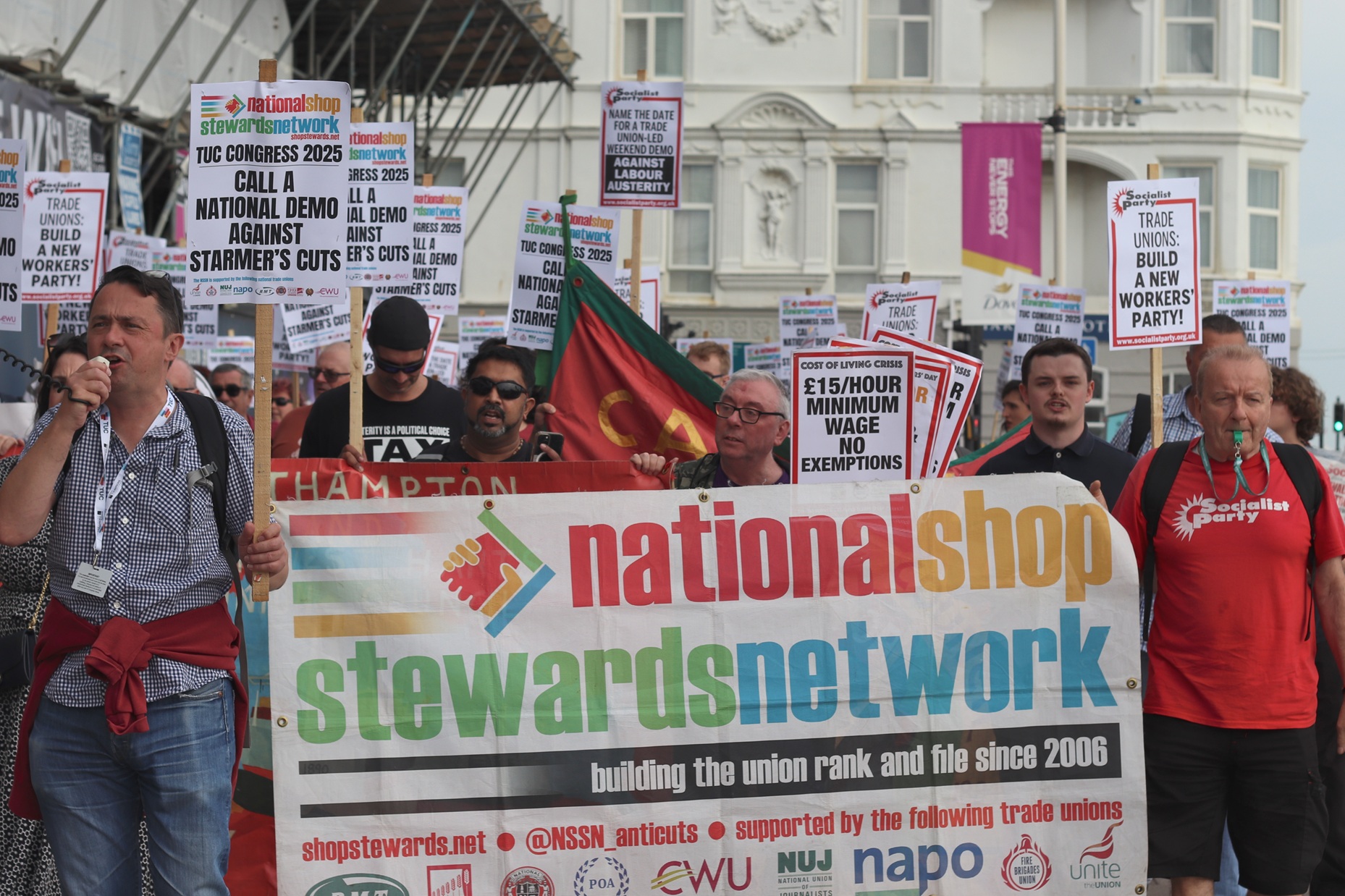
This summer the National Shop Stewards Network (NSSN) will organise its twentieth conference. In October 2006, the RMT transport workers’ union, then under the leadership of Bob Crow, brought together representatives from across the trade union movement to agree that a shop stewards’ network was needed.
The following summer, the first conference of the NSSN took place on the eve of the 2007-08 world economic crash. The NSSN was founded to bring together rank-and-file trade unionists, reps and activists from across the trade union movement to rebuild the strength of the workers’ movement from the bottom up. To help coordinate action and, above all else, as a means to put pressure on the leaders of the trade unions to organise the action necessary to fight capitalism’s attacks on the working class.
Over its 20-year history, the NSSN has sought to bring militant trade unionists together to draw out the key next step and how to organise it, depending on the challenges facing the workers’ movement at a given moment. It was key to applying pressure to the leadership of the TUC, through lobbies and NSSN-organised regional demonstrations, to organise coordinated action to defeat the new ‘Con-Dem’ government’s opening salvo of austerity attacks.
On 30 November 2011, two million workers participated in what was effectively a public sector general strike. In the run-up, the NSSN helped coalesce the fighting forces in the trade unions around the demand for the TUC to name the date for coordinated action.
In the years that followed, on whatever issue the organised workers’ movement faced, the NSSN and the reps and activists which make it up have been at the forefront of trying to coordinate the fightback. From the 2016 ‘Kill the Bill’ campaign against the introduction of the Tory anti-union laws, to in 2020 bringing together nationally the main opponents in the trade unions against social partnership with the Tories, fighting for workers’ safety and interests during the Covid pandemic.
And two years ago, ahead of the general election, the NSSN pre-empted the battles which were to come under a Labour government, with the pre-general election forum at its 2024 conference ‘How can we fight for a workers’ manifesto?’ to discuss how workers’ policies could be fought for under a pro-big business Labour government. Following the general election, the NSSN lobbied the TUC on 7 September 2025 in support of the call for the TUC to organise a national demo against Labour austerity.
What role for the NSSN today?
The discussions at NSSN’s 2024 conference were a foretelling of the many struggles working-class people are today facing under Starmer’s government. Despite the promise of change from 14 years of Tory rule, life for us is extremely similar to under the Tories – the only difference being things have got worse!
Public services and infrastructure continue to crumble; the Tory anti-trade union laws remain in place; and with the new round of war in the Middle East, prices are beginning to rise faster and faster while our wages stagnate.
The war on Iran poses all sorts of problems for trade unionists, including the question of what role workers can play in halting the capitalist classes’ drive to war while simultaneously defending the jobs, pay and conditions of all workers. But the front and central issue for the majority will be the new inflationary and cost-of-living crisis.
The last time the energy bosses price-gouged to protect their profit margins, workers responded in their millions with the biggest wave of industrial action in three decades, forging a new generation of trade union reps and activists in the process.
That 2022-23 strike wave forced money to be paid into workers’ pockets which the Tories initially insisted ‘just wasn’t there’. Who does that sound similar to? Not only that, it provided the underpinnings of the Tories being kicked out of office in July 2024.
But that action didn’t fall from clear blue sky – it had to be fought for, and pressure applied on the trade union leaders. As the then RCN nursing union leader Pat Cullen summed up on behalf of other trade union leaders at that stage: “I may personally have underestimated the members and their sheer determination”.
Labour facing its own strike wave?
Levels of industrial action have receded since that 2023 peak, but still remain higher than in the pre-Covid period. Resident doctors organised in the BMA are currently leading the charge in the public sector against Labour’s policy of managed pay erosion. This was following the nationally coordinated action taken by UCU members in Further Education earlier in the year.
But national action is brewing elsewhere. An indicative ballot of National Education Union members showed a determined mood to reject and fight the Labour government’s unfunded and inadequate pay offer.
The inherent power of the working class is increasingly on display in this unstable period. The RMT just last week shut down London over the attempt by Transport for London and London Mayor Sadiq Khan to attack tube drivers’ working conditions. The Cwm Taf Morgannwg health visitors in Unite are leading the fight against the Welsh Labour government over pay. And ongoing is the heroic action of the bin workers in Birmingham against the Labour council’s fire-and-rehire attacks. All this before the next cost-of-living tsunami hits.
The NSSN then and now
The role the NSSN played in the run-up to and in the aftermath of the 2011 public sector strike came immediately after a period of relative economic stability and under the long shadow cast by the collapse of the Stalinist states in Eastern Europe, a historic turning point in history which threw back working-class consciousness and organisation for decades.
A decade and a half since 2011, the situation has developed in favour of the workers’ movement. Austerity and stagnant or falling living standards have discredited illusions that the capitalist system can offer a future to workers and youth. The working class in Britain and internationally is in the early stages of beginning to rebuild the strength of its organisations and to re-enter the scene of history.
The 2022-23 strike wave not only saw fresh layers joining the trade unions and a certain renewal of rank-and-file trade union leaders, it also burned into the consciousness of millions of workers that, as the most powerful collective tool at the disposal of the working class, ‘striking works’. As the Socialist Party predicted in the document agreed at our 2024 Congress: “The strike weapon will therefore be picked up much more easily in the next period than was the case in recent decades.”
That resulting confidence from the strike wave has haunted Starmer’s Labour government from day one. To the chagrin of the capitalists, Rachel Reeves in summer 2024 awarded above-inflation pay rises to some public sector workers, saying: “There is a cost to not settling, a cost of further industrial action”. The government is paying that price now! Starmer and Reeves are in vain trying to put the genie back into the bottle to make it up to the bosses.
Although 30 November 2011 brought two million workers out, the right-wing trade union leaders at that stage were able to end the action. As a result, Cameron and Clegg’s coalition was able to ride out the movement and commence the biggest round of attacks on the working class in modern history.
But that couldn’t be further from the position facing the Labour government today. After 14 years of austerity, so rotten is the edifice of British capitalism, Starmer faced humiliating defeat in Parliament without the leaders of the trade unions as much as lifting a finger over proposed cuts to disability benefits, attacks which the government is returning to this summer.
NSSN 2026 conference
Even the greatest optimists amongst the capitalist class would struggle not to worry about the reliability of Labour to hold down wages and get more public spending cuts through Parliament. But with the majority of trade union leaders still making excuses for Labour and attempting to steady Labour’s ship, the militant industrial action workers need will again have to be fought for.
How workers can fight for this coordinated action against Labour austerity and to take on the new cost-of-living crisis will be a key theme of the NSSN conference 2026.
It will also be taking place near the eve of the potential repealing of the 50% industrial ballot thresholds in August, kept in place by Labour now for two years at the behest of big business. With the thresholds having only just saved Labour from potential national action by Unison in local government over pay, the question of how the trade union movement responds whether or not they are repealed – either using their lifting to go on the offensive, or demanding their immediate repealing along with all the other anti-union laws – will be central in the coming period.
And it will be coming after the seismic political earthquake which is set for the 7 May local elections. With Labour set to sustain a historic defeat, with a ‘patchwork’ of Reform, Green, and various independent councillors filling the resulting gap, questions for trade unionists will be posed about how the rising tide of industrial militancy being fought for every day by rank-and-file trade unionists in our workplaces can be expressed at the ballot box.
- Register for NSSN Conference on Saturday 27th June here – https://www.eventbrite.co.uk/e/nssn-conference-2026-saturday-27th-june-11am-430pm-conway-hall-london-tickets-1988618741187
