


Duncan Moore, UCU NEC member, personal capacity
Starmer’s government is in crisis. Now is the time to pile on the pressure – we can win for post-16 education if we mount serious national action, and fight for our own independent political voice.
Universities announced more than 12,000 job cuts last year. 24 institutions are now at risk of insolvency. A recent Education Select Committee report stated: “Currently, there is no clearly understood protocol for how the government might respond to a situation of a provider at risk of imminent insolvency, which is a very serious problem.” Indeed!
Yet the Labour government remains adamant: there will be no bailouts. Rather than abolishing the fees funding model, the only inadequate measure the government took was to re-index fees to inflation.
Further Education (FE) colleges also face a massive funding shortfall, after the government announced just a 0.5% increase to the national per-pupil funding rate for 16-19 year olds. 32,000 new students are unfunded. This would mean further falls in real pay, staff retention and increasing workloads. Adult and Community Education is even less well funded and hit by cuts to local authority spending.
This crisis looms over the congress of the University and College Union (UCU) this year.
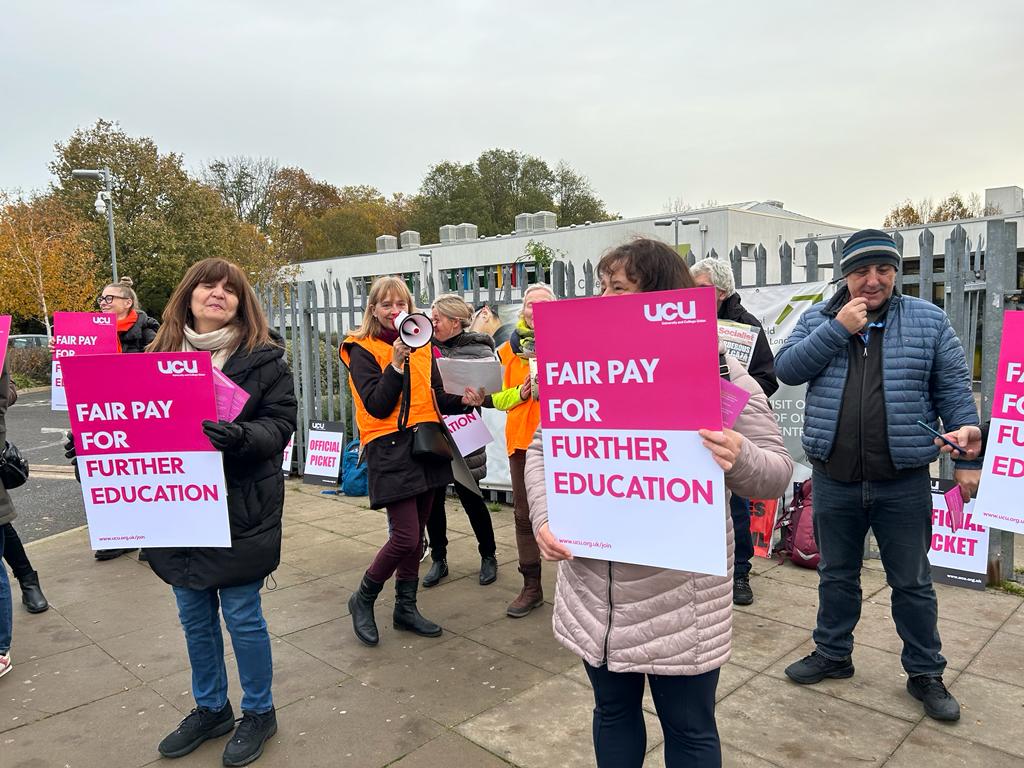
At the FE sector conference, which takes place mid-UCU congress, several branches have submitted motions calling for an aggregate ballot.
In November’s FE ballot, 62 colleges returned a 90% ‘Yes’ vote for action on a 50.6% turnout nationally. But the UCU leadership opted for a disaggregated ballot and not every area got over the 50% turnout threshold, scandalously still in place nearly two years into a Labour government.
The leadership delayed action till January, before which many branches accepted local pay offers. 29 colleges took action, and then it was left to individual branches to decide a way forward. Congress 2026 gives us an opportunity to reset: we need aggregated strike action in the autumn term.
In universities, many branches have taken audacious strike action to protect jobs and defend pensions. Those branches could already be coordinating action, especially if a lead was given by UCU general secretary Jo Grady and the Higher Education (HE) Committee.
Coordinate the strikes
The voice from many picket lines is: coordinate the strikes; the fight for our universities is national, not local; don’t leave us on our own! But this mood is not reflected in the motions on the HE Sector Conference agenda. Last year, conference voted to return to national action; this year, the only motion on industrial action strategy calls for disaggregated ballots by default, at least while the 50% threshold applies.
A national aggregated ballot took place last autumn, but while members voted overwhelmingly for action, turnout fell short of 50%. Even Jo Grady’s reports acknowledge the lack of effective leadership – she says members wanted to fight, but they wanted to know what the strategy was!
The motion for disaggregation is perhaps an attempt to ensure some coordinated action can take place. While best tactics at any stage should be discussed, we should not agree to disaggregate as a default position. The existing policy should remain – but it needs to be implemented.
The scale of the crisis poses the need for UCU to have a serious strategy that links the fight against job cuts and attacks on conditions with the fight against marketisation and the fee-based model.
Lots of motions at congress are about combating Reform and the far right. Our union must do this by mounting a serious fight on funding, jobs and pay, and Grady must go to the TUC General Council to demand it calls a national demonstration against Labour austerity and racist division, as agreed at TUC Congress last year.
This also underlines the need for an independent political voice. Speaking on BBC Question Time last May, Grady said: “Not a single political party in the UK is offering solutions to the issues that we face.”
At conference last year, delegates passed the motion from West London College, moved by Socialist Party member Marco Tesei, for the UCU to take steps towards trade union-based political representation. It agreed to invite MPs who say they are on our side to discuss how our union’s demands could be fought for in parliament, and encourage our own members to stand.
This has yet to be implemented. A parliamentary group of MPs for UCU has been created, though according to Grady, this was on the initiative of the MPs! A motion this year from West London College calls for membership oversight, regular meetings between the NEC and the MPs, and for UCU to take the lead in a cross-union conference to discuss political representation.
